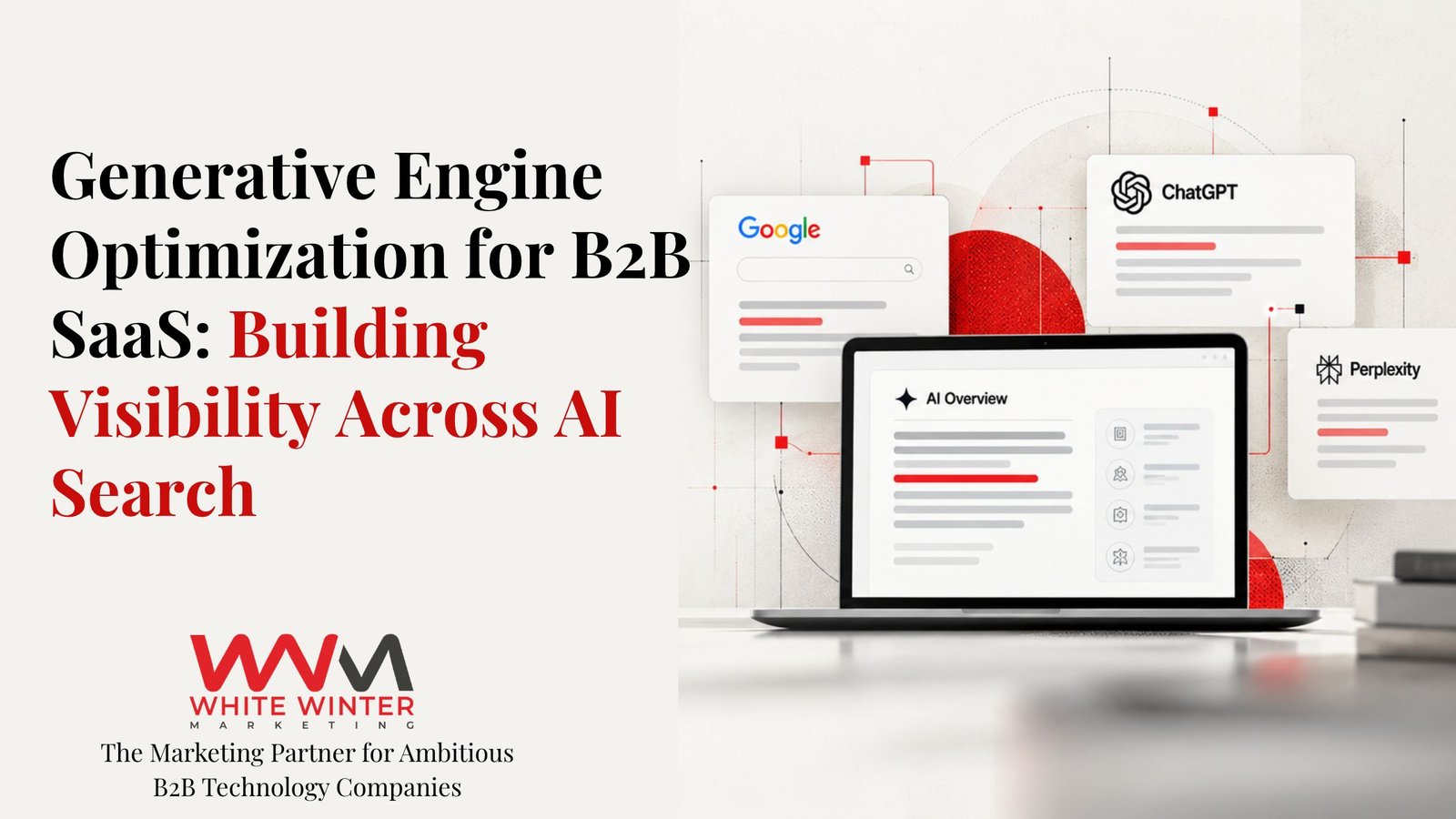
The AI market is becoming crowded faster than many companies can define their position within it.
New AI platforms, agents, copilots, automation products, infrastructure providers and industry-specific solutions are entering the market continuously. The competition is no longer limited to established technology companies. Startups, specialist vendors, enterprise software providers and AI-native businesses are all competing for buyer attention.
The scale of investment reflects the intensity of this market.
According to Stanford’s AI Index 2025, global private investment in artificial intelligence reached $252.3 billion in 2024. Generative AI attracted $33.9 billion during the same period. Recent reporting has also highlighted the scale of infrastructure spending by major technology companies, with projected AI-related capital expenditure reaching hundreds of billions of dollars.
This investment is accelerating product development, market entry and category expansion. It is also increasing the pressure on AI companies to explain why their solutions deserve attention.
Building an AI product is no longer the only challenge. Making that product visible, understandable and credible is becoming equally important.
The AI Market Is Becoming a Visibility Competition
AI companies compete on product capability, pricing, integrations, implementation expertise and customer outcomes.
They also compete for visibility across:
- Google search
- AI assistants
- Generative search platforms
- Industry publications
- Product review websites
- Partner ecosystems
- Webinars and events
- Sales conversations
- Customer referrals
A buyer may encounter several vendors offering similar capabilities before speaking to any of them.
Many companies use comparable language to describe their products:
- AI-powered automation
- Intelligent workflows
- Enterprise-grade AI
- Autonomous agents
- Generative AI solutions
- AI-driven insights
- Next-generation intelligence
These phrases may be technically accurate. They rarely create a distinctive market position on their own.
The issue is not necessarily a lack of innovation. The issue is that the market is becoming crowded with similar explanations of innovation.
Recent reporting has also brought greater attention to the gap between AI investment and enterprise value creation. A Financial Times analysis noted that companies are still working through how to turn significant AI investment into sustainable business outcomes, while questions around implementation, infrastructure and operating models remain unresolved.
For AI solution companies, this creates a more demanding buying environment.
Customers are not evaluating the technology in isolation. They are asking whether the solution addresses a real problem, integrates with existing systems, protects sensitive data and produces measurable value.
Visibility must therefore be connected to trust.
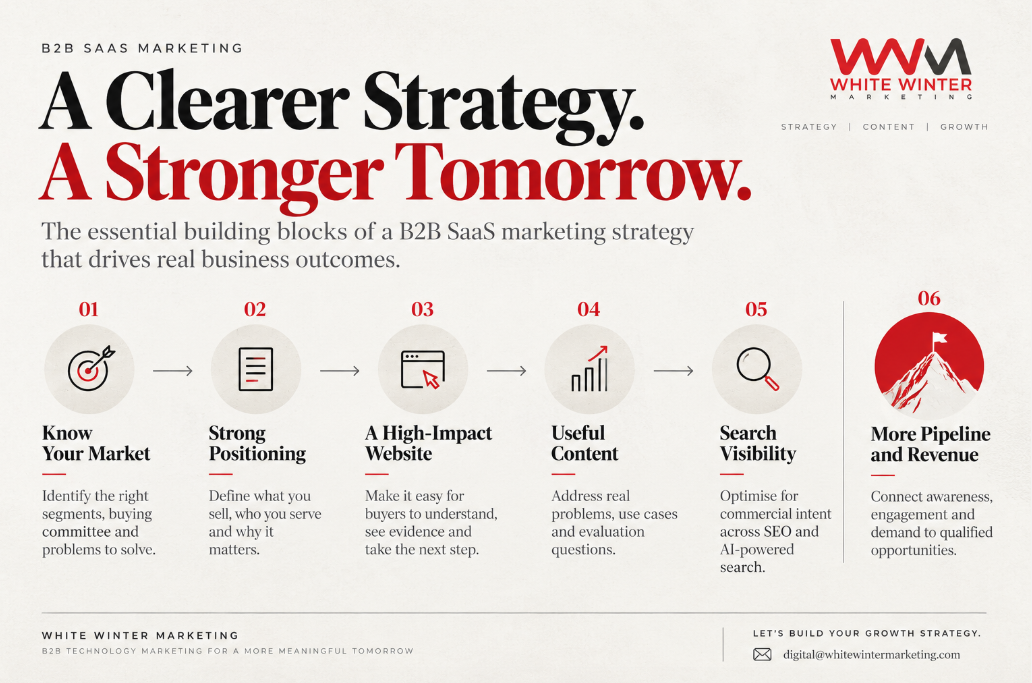
The Visibility Problem Is Bigger Than Google Rankings
Search visibility was once discussed primarily in terms of rankings, traffic and keywords.
Those metrics remain important. However, the B2B buying journey now extends across several information environments.
A buyer may discover an AI solution through Google, investigate the category through ChatGPT or another AI assistant, read a founder’s LinkedIn post, watch a product video, review a customer story and return to the website several weeks later.
Another stakeholder from the same buying group may encounter the company through an industry publication, technology partner or sales presentation.
These interactions rarely happen in a straight line.
An AI company may rank for a relevant keyword but still fail to create trust. It may publish regularly on LinkedIn but lack a clear website. It may have a strong product demo but weak positioning. It may appear in generative search results but provide little evidence for buyers to evaluate.
This is why AI solution visibility must be considered across the entire buying journey.
The question is not simply:
Can buyers find our AI solution?
The more important question is:
When buyers find us, do they understand why our solution is relevant, credible and different?
SEO, AEO and GEO Are Connected
SEO, AEO and GEO address different visibility moments, but they depend on the same strategic foundation.
SEO, or Search Engine Optimisation, helps buyers discover a company through relevant searches. For AI companies, this means connecting the solution with specific business problems, industries, use cases and buying requirements rather than relying only on broad terms such as “AI solutions” or “artificial intelligence.”
AEO, or Answer Engine Optimisation, focuses on the questions buyers ask. These questions may concern implementation, security, integrations, cost, accuracy, deployment models or the difference between competing technologies.
GEO, or Generative Engine Optimisation, concerns how clearly a company and its content can be interpreted and referenced within generative search environments. The field is still developing, and different AI platforms use different systems. No company can guarantee inclusion in an AI-generated answer. However, clear positioning, consistent terminology, credible information and strong external references make a company easier to understand.
These disciplines should not operate as isolated campaigns.
If the website describes a company as an AI automation platform, LinkedIn presents it as a data intelligence business and sales material calls it an enterprise AI agent provider, the market receives conflicting signals.
Consistency does not mean repeating the same sentence across every channel. It means maintaining a clear connection between the company’s category, audience, problem, capability and value.
Why “AI-Powered” Is Not a Positioning Strategy
The phrase “AI-powered” has become a weak differentiator when used without context.
It describes the presence of a technology. It does not explain the commercial value of that technology.
Consider the difference between:
We provide AI-powered business solutions.
And:
We help logistics companies reduce manual document processing by connecting AI-based data extraction with existing operational workflows.
The second statement is more useful because it gives the market a clearer category, audience, problem and application.
It also creates stronger opportunities for SEO, AEO and GEO.
Search engines can associate the company with more specific queries. Answer engines have a clearer explanation to work with. Generative search systems can better interpret the company’s relevance.
Positioning is not a copywriting exercise that happens after the product is built.
It determines how the product is understood across the website, search results, social channels, sales material and customer conversations.
Generic AI Content Creates Noise, Not Authority
The AI industry is producing a large volume of similar content.
Common topics include:
- The future of AI
- Benefits of generative AI
- AI trends
- Why businesses need automation
- AI transformation
- The rise of AI agents
- How AI is changing industries
These subjects may be relevant, but relevance alone does not create authority.
When every company publishes similar articles, uses similar design templates and repeats similar claims, content becomes difficult to associate with a specific brand.
Generic AI content weakens positioning in three ways.
- It makes companies interchangeable: If every vendor claims to improve productivity, efficiency and decision-making, buyers have little reason to remember one company over another.
- It avoids commercial questions: A broad article about AI may explain the technology without addressing security, integration, implementation, cost or operational impact.
- It creates visual sameness: Many AI companies rely on glowing interfaces, humanoid robots, circuit patterns and abstract digital imagery.
These visuals may communicate “technology,” but they rarely communicate a distinctive business position.
The strongest AI content is not necessarily the content that says the most about artificial intelligence.
It is the content that demonstrates a clear understanding of a specific business problem.
An article about “AI in manufacturing” is broad.
An article examining why manufacturing AI projects fail when data remains disconnected from production workflows is more distinctive.
The second topic creates room for expertise, opinion and commercial relevance.
Branding Is a Trust Infrastructure
For many AI companies, branding is still treated as a visual layer involving logos, colours, websites and social media templates.
That is too narrow.
AI solutions may involve sensitive data, operational dependency, integration effort and organisational change. Enterprise buyers may need approval from technology, finance, security, operations and senior leadership teams.
They are not evaluating the product alone.
They are evaluating the company behind it.
Does the company appear capable of implementation? Does it understand the industry? Can it explain the product without exaggeration? Does its website reflect the maturity expected of an enterprise technology provider? Is its leadership visible? Can its claims be supported?
Branding influences these judgements before the sales conversation begins.
A strong brand does not replace product capability. It gives that capability a credible context.
It also helps the company occupy a recognisable position in a crowded category.
For AI companies, this matters because product features and technical terminology change quickly. A clear brand can create continuity while the product, market and technology evolve.
Visibility Must Continue Through the B2B Buying Cycle
Complex B2B AI solutions are rarely closed after one interaction.
Depending on deal size, implementation requirements, security reviews, proof-of-concept projects and procurement structures, the sales cycle may extend across several months. For enterprise-oriented AI solutions, a planning range of three to nine months may be more realistic than expecting immediate conversion, although larger or regulated deals can take longer.
This is not a universal industry benchmark. The timeline varies considerably by product, buyer and implementation complexity.
The important point is that buyers continue validating the company during this period.
They may:
- Search for the brand again
- Review the founder’s LinkedIn profile
- Read technical articles
- Watch product demonstrations
- Look for customer evidence
- Compare alternative vendors
- Ask an AI assistant to explain the category
- Check security and integration information
- Revisit the website before an internal discussion
A company that appears only when a salesperson sends an email may struggle to remain part of the buyer’s consideration set.
A company that maintains a consistent presence across Google, LinkedIn, generative search, industry content, product videos, case studies and partner channels is more likely to remain familiar throughout a longer decision process.
Active presence does not mean publishing everywhere without discipline.
It means ensuring that every meaningful touchpoint reinforces the same positioning.
The New Visibility Advantage
The AI market will continue to attract investment, new entrants and competing solutions.
As technical capabilities become easier to access and product categories become more crowded, the difference between companies will increasingly be expressed through clarity, credibility and market recognition.
AI companies need to be visible where buyers search. They also need to be understandable when buyers ask questions, credible when buyers compare alternatives and recognisable when buyers encounter the brand across multiple channels.
That requires a connected approach to:
- SEO
- AEO
- GEO
- Content marketing
- Brand positioning
- Founder visibility
- Customer proof
- Demand generation
The objective is not to dominate every conversation about artificial intelligence.
It is to become the company that the right buyer can find, understand and trust when a specific business problem emerges.
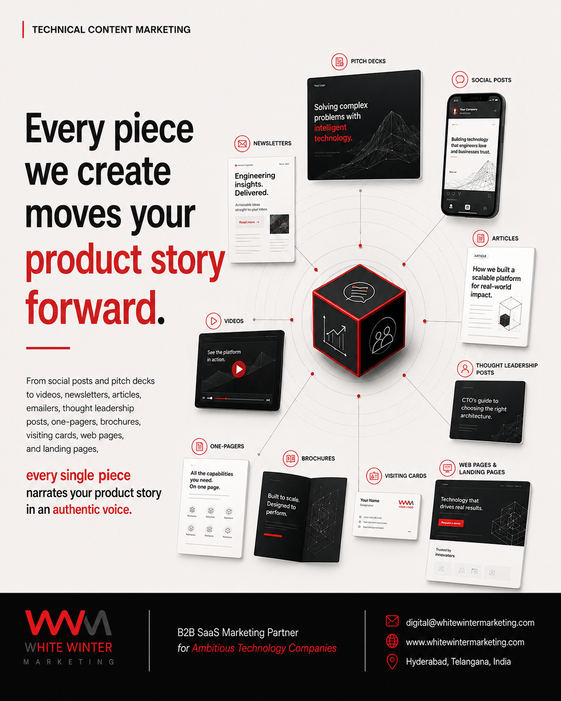
AI companies do not need more generic content about the future of AI. They need a clearer position in the present market.
At White Winter Marketing, we help B2B technology and AI companies connect positioning, branding, SEO, AEO, GEO and content into a visibility system designed for longer buying journeys and more informed buyers.
The starting point is not more content. It is a clearer answer to one commercial question: Why should this buyer trust this company to solve this specific problem? Contact us to learn more.