B2B companies selling complex products and services rarely operate on short buying journeys.
A prospect may discover a company through search, return several weeks later through LinkedIn, review its website with colleagues, compare alternatives and engage only after an internal business case has been developed.
This is particularly common in SaaS, cybersecurity, industrial technology, manufacturing, IoT, enterprise software and professional services.
In such markets, lead generation cannot depend entirely on immediate form submissions or short-term campaigns. The marketing function must remain useful throughout the period between initial discovery and commercial conversation.
That requires a lead generation system rather than a collection of disconnected activities.
Why long sales cycles create a marketing challenge
A long sales cycle introduces several forms of uncertainty.
The buyer may not yet have a clearly defined requirement. Multiple stakeholders may influence the decision. The budget may be under discussion. The company may be comparing internal development with external solutions. Procurement, security or technical teams may introduce additional evaluation stages.
During this period, the buyer is gathering evidence.
If a company is visible only when the buyer is ready to contact sales, it may have already missed several important moments in the decision-making process.
A B2B lead generation system should therefore support discovery, education, evaluation and engagement over time.
1. Establish a clear market and buyer focus
Long sales cycles become harder to manage when the company’s target audience is too broad.
A business that claims to serve every industry and every company size may struggle to create content that feels relevant to any particular buyer. Its website may contain many capabilities, but the commercial message remains indistinct.
A focused market position helps the company communicate with greater precision.
This does not mean refusing every opportunity outside the core market. It means identifying the industries, use cases, company profiles and buying roles where the company can communicate the strongest relevance.
How WWM helps:
WWM supports B2B companies in refining their positioning, ideal customer profile and messaging so that marketing activity is directed towards commercially relevant audiences.
2. Build content for different stages of evaluation
A buyer at the beginning of the journey has different needs from a buyer preparing a vendor shortlist.
Early-stage content may explain a business problem, emerging industry change or category of solution. Mid-stage content may address use cases, capabilities, implementation considerations and comparisons. Later-stage content may focus on proof, risk, support, integration and commercial confidence.
A long sales cycle requires content that remains useful across these stages.
The objective is not to publish more content without direction. It is to create a body of relevant material that helps buyers answer the questions they are likely to encounter as evaluation progresses.
How WWM helps:
WWM develops content strategies that connect educational articles, solution pages, case studies, industry content, executive thought leadership and conversion assets.
3. Make the company discoverable before the buyer is ready
Search visibility is particularly important during long buying journeys because buyers often begin researching before they have selected vendors.
SEO helps the company appear in traditional search results. AEO helps structure content around direct questions. GEO addresses visibility in generative search environments where buyers may ask AI systems to explain categories, compare solutions or identify providers.
This wider discovery environment matters because a buyer may not search for the company’s brand name initially. They may search for a problem, an industry requirement or a possible approach.
Companies that appear only for branded searches may become visible too late.
How WWM helps:
WWM combines SEO, AEO and GEO with relevant website and content development to improve discoverability across problem-led, solution-led and industry-led searches leading to effective lead generation system.
4. Use credibility to reduce perceived risk
The longer and more complex the buying process, the more opportunities there are for uncertainty to slow progress.
Buyers may question whether the provider understands their sector, whether the solution can integrate with existing systems, whether implementation will be disruptive or whether the vendor will remain available after the contract is signed.
Marketing cannot remove every concern, but it can make credible evidence easier to find.
Customer stories, case studies, technical explanations, leadership perspectives and industry-specific insights help demonstrate that the company understands the buyer’s environment.
Credibility is especially important when the product is unfamiliar or the company is competing against established providers.
How WWM helps:
WWM helps make expertise visible through customer-focused storytelling, thought leadership, executive branding, website content and industry communication.
5. Keep prospects engaged without forcing premature conversion
A long sales cycle does not mean that every visitor should be pushed towards a sales call immediately.
Some prospects need more time. Others may be interested in a specific use case but not yet have internal approval. A useful marketing system provides relevant ways to continue the relationship.
This may include subscribing to a newsletter, reading related content, accessing a practical resource, following an executive on LinkedIn or returning to a solution page when the requirement becomes more urgent.
The important principle is continuity. The company should remain useful without becoming intrusive.
How WWM helps:
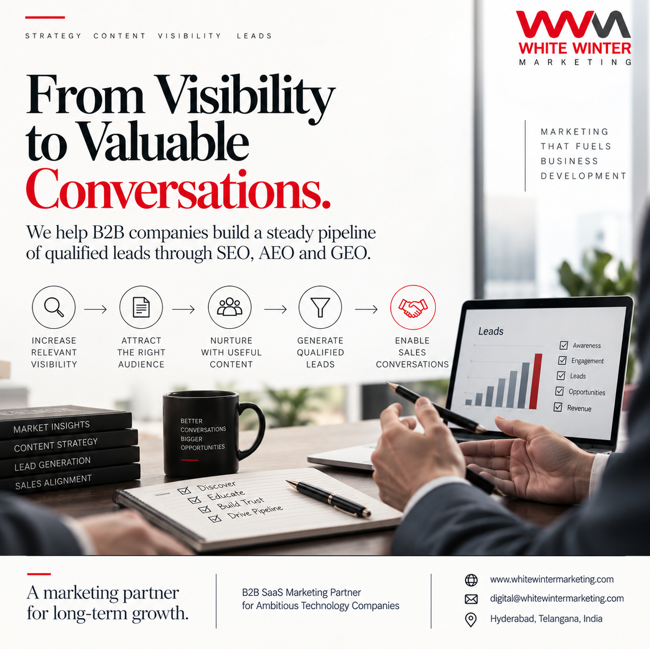
WWM connects content, LinkedIn activity, lead magnets and website conversion paths to support continued engagement throughout the buying journey.
6. Align marketing activity with sales conversations
Marketing and sales often measure different outcomes.
Marketing may focus on traffic, impressions, downloads and engagement. Sales may focus on company fit, urgency, budget, authority and purchase timing.
These measures are not identical, but they should inform one another.
Marketing content should reflect the questions sales teams hear from prospects. Sales feedback should help identify gaps in website messaging, case studies, FAQs and industry content.
This alignment is especially important when the number of potential accounts is limited and each opportunity carries substantial commercial value.
How WWM helps:
WWM helps connect marketing communication with sales priorities by developing content and digital assets around buyer concerns, commercial intent and the questions that influence evaluation.
7. Measure progress beyond immediate lead volume
In a long sales cycle, the first meaningful outcome may not be a completed enquiry form.
Other signals can include engagement from target accounts, repeat visits, downloads of high-value content, interactions with executive posts, requests for technical information or movement from general content to solution-specific pages.
These signals should not be treated as guaranteed sales opportunities. They are indicators that help companies understand how prospects are progressing and are a part of b2b lead generation system.
A mature lead generation system therefore evaluates both immediate conversions and the quality of engagement developing over time.
Conclusion
Long B2B sales cycles require marketing that remains relevant before, during and after the first interaction.
A functioning B2B lead generation system brings together:
- Clear market positioning
- A focused buyer profile
- Content for different evaluation stages
- SEO, AEO and GEO visibility
- Credibility and customer proof
- Consistent LinkedIn and executive communication
- Conversion paths that respect buyer readiness
- Feedback between marketing and sales
The goal is not to force every visitor into an immediate sales conversation. It is to build enough relevance, visibility and confidence that the right buyers can progress when the timing is appropriate.
White Winter Marketing helps B2B companies develop this foundation through SEO, AEO, GEO, content marketing, LinkedIn branding, executive thought leadership and conversion-focused digital strategy. Consult us.