Standing out in the highly competitive IoT consulting market isn’t easy, especially when you’re competing against established technology giants.
An India-based IoT consulting firm approached us with a familiar challenge. They had exceptional engineering talent, strong expertise across manufacturing, logistics, and industrial automation, but almost no digital visibility.
They were being outranked by major consulting firms for high-value search terms, their website generated very little organic traffic, and their founder had almost no presence on LinkedIn.
Six months later, the results looked very different.
- 80–100% increase in organic traffic
- Top 10 rankings for high-intent keywords
- Visibility in AI-generated search experiences
- Qualified B2B inquiries arriving directly through the founder’s LinkedIn profile
Here’s how we combined SEO, Answer Engine Optimization (AEO), Generative Engine Optimization (GEO), and Executive Branding to build a predictable inbound growth engine.
Client Background
The client is an India-based IoT consulting company specializing in:
- Industrial IoT
- Manufacturing automation
- Smart logistics
- AI-powered IoT platforms
- Infrastructure monitoring
Despite strong technical expertise, their digital presence failed to reflect their capabilities.
Their objective wasn’t simply to improve rankings.
They wanted to become the preferred IoT consulting partner for enterprise buyers.
The Challenges
When we audited their digital presence, four critical issues became immediately apparent.
1. Low Visibility for Commercial Keywords
The company struggled to rank for commercially valuable searches such as:
- IoT Consulting India
- Industrial IoT Consulting
- Custom IoT Platform Development
Large consulting firms dominated the search results, leaving almost no visibility for smaller specialists.
2. Missing Educational Content
The website lacked content addressing the questions enterprise buyers were actively searching for.
Topics such as:
- How AI and IoT improve warehouse operations
- Predictive maintenance using IoT sensors
- Reducing manufacturing downtime through connected devices
were completely absent.
Without this educational content, search engines and AI platforms had little reason to reference the company.
3. Technical SEO Issues
The website contained several technical problems that limited search performance.
These included:
- Crawlability issues
- Missing structured data
- Google Search Console errors
- Weak internal linking
- Slow page speed
Even strong content would have struggled to perform under these conditions.
4. Limited Executive Visibility
The founder’s LinkedIn presence generated very little engagement.
Without a visible leadership voice, the company missed opportunities to build trust before sales conversations even began.
Our Growth Framework
Rather than relying on isolated marketing tactics, we implemented an integrated growth strategy built on four core pillars.
1. Commercial Keyword Research
Instead of targeting high-volume vanity keywords, we focused on search intent.
Our research prioritized two categories.
High-Intent Commercial Keywords
Examples included:
- IoT consulting for manufacturing
- Industrial IoT consulting services
- Custom IoT platform development
These keywords indicated active buying intent.
Long-Tail Educational Queries
We also targeted informational searches such as:
- How IoT sensors reduce factory downtime
- AI-powered IoT cost savings
- Benefits of predictive maintenance
These topics positioned the company earlier in the buyer journey while increasing visibility in AI-generated answers.
As a part of our SaaS content marketing audit, we performed a detailed competitor analysis that revealed several content opportunities overlooked by larger consulting firms.
2. Building Topical Authority
Instead of publishing disconnected blog posts, we developed structured content clusters around three core themes.
IoT Consulting
- Comprehensive pillar page
- Supporting implementation guides
- Industry-specific use cases
AI-Powered IoT
Content addressing technical questions from engineers and solution architects.
Industrial Automation
Educational resources designed for manufacturing leaders and plant managers evaluating modernization initiatives.
Every article included:
- Answer-first introductions
- FAQ sections
- Structured headings
- Comparison tables
- Schema markup
This improved both traditional search visibility and AI search eligibility.
3. Technical SEO Optimization
A complete technical audit identified several opportunities to strengthen website performance.
Key improvements included:
- Resolving crawl errors
- Optimizing Core Web Vitals
- Improving mobile performance
- Adding Service, FAQ, and Article schema
- Rebuilding internal linking
- Resubmitting XML sitemaps
Page speed improved significantly, making the website faster and easier to crawl for both search engines and AI systems.
4. Executive Branding
Search visibility creates awareness.
Executive branding builds trust.
We repositioned the founder as an industry expert through a structured LinkedIn strategy.
The approach included:
- Publishing three to five posts each week
- Sharing implementation lessons and customer insights
- Explaining real-world IoT challenges
- Optimizing the LinkedIn profile
- Encouraging employee advocacy
Rather than promoting services directly, the content focused on practical expertise and operational problem-solving.
This transformed the founder’s profile into a consistent source of qualified inbound conversations.
Strengthening Trust Signals
Enterprise buyers evaluate more than rankings.
They evaluate credibility.
To strengthen trust, we added:
- Customer success stories
- Named client testimonials
- Industry recognition
- Technical expertise throughout the website
These elements supported Google’s E-E-A-T principles while improving buyer confidence.
SEO AEO GEO Implementation Timeline
Weeks 1-2
- Keyword research
- Competitor analysis
- Content gap assessment
Weeks 3-4
- Service page optimization
- Metadata improvements
- Internal linking
- FAQ implementation
- Conversion-focused CTAs
Weeks 5-8
- Publication of AI-optimized content
- Topic cluster development
- Internal link expansion
Technical Improvements
Completed alongside content production:
- Structured data implementation
- Google Search Console cleanup
- Sitemap optimization
- Performance improvements
Executive Branding
Launched during the early stages of the engagement.
Activities included:
- LinkedIn profile optimization
- Weekly content calendar
- Employee advocacy
- Performance tracking
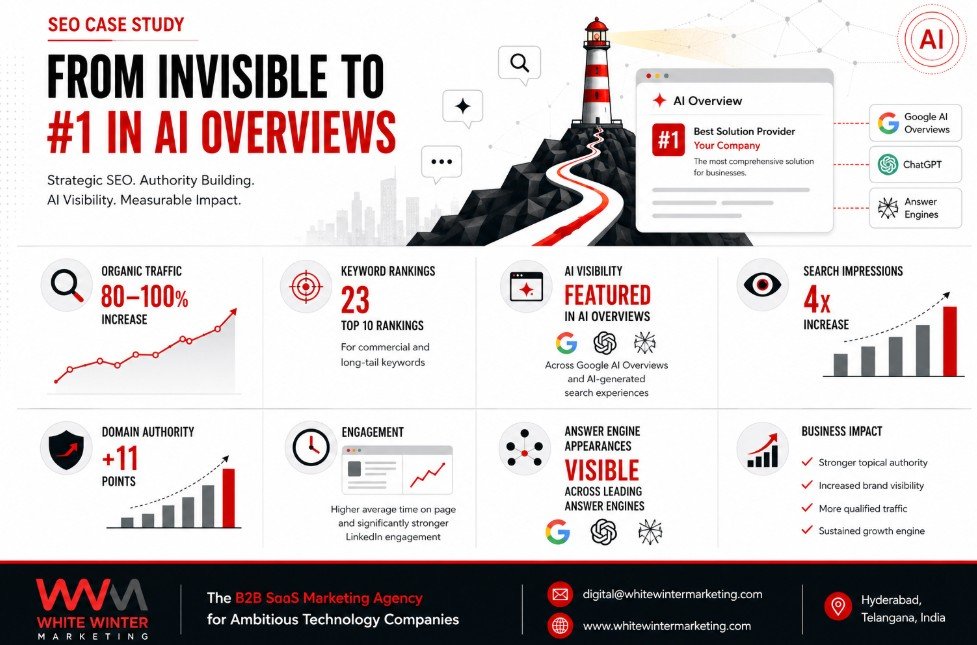
Results After Six Months
| Metric | Outcome |
| Organic Traffic | 80–100% increase |
| Keyword Rankings | Top 10 rankings for 23 commercial and long-tail keywords |
| AI Visibility | Featured in Google AI Overviews and AI-generated search experiences |
| Search Impressions | 4× increase |
| Qualified B2B Leads | 3× increase through website inquiries |
| LinkedIn Inbound Messages | Consistent demo inquiries from decision-makers |
| Domain Authority | Increased by 11 points |
| Engagement | Higher average time on page and significantly stronger LinkedIn engagement |
Beyond traffic improvements, the quality of inbound conversations also improved.
Prospects frequently arrived already familiar with the founder’s expertise after reading LinkedIn content, shortening sales conversations and increasing trust.
Key Takeaways
This engagement demonstrated that sustainable B2B growth requires more than traditional SEO.
The strongest results came from combining multiple disciplines into a single strategy.
The growth framework included:
- Commercial keyword research
- Topic clusters
- Technical SEO
- AI-ready content
- Executive branding
- Strong trust signals
Together, these initiatives increased visibility across search engines, AI platforms, and LinkedIn while improving the quality of inbound pipeline.
Final Thoughts
Competing against larger consulting firms doesn’t always require a larger marketing budget.
It requires greater relevance.
Organizations that build authority around specific industries, answer buyer questions comprehensively, and consistently showcase executive expertise can outperform much larger competitors in targeted markets.
The combination of SEO, AEO, GEO, and leadership branding has become one of the most effective ways for B2B technology companies to build sustainable inbound growth.
Ready to Grow Your B2B Technology Brand?
If you’re a technology company looking to increase visibility and generate qualified enterprise opportunities, we’d be happy to help. We’ll identify the biggest opportunities across your SEO, AEO, GEO, and executive branding strategy and show you where your next pipeline opportunities are coming from.
About White Winter Marketing
White Winter Marketing is a B2B growth agency helping SaaS and industrial technology companies build predictable pipeline through SEO, AEO, GEO, LinkedIn executive branding, and high-converting websites. We don’t focus on vanity metrics. We focus on building marketing systems that generate qualified pipeline and long-term business growth. Contact us today.