How a strategic content refresh helped a B2B technology company unlock the hidden potential of its existing content library.
Every SaaS and technology company invests significant time and resources into publishing blogs, product guides, and educational content. But what happens when those articles stop delivering results?
For many businesses, the instinct is to publish more content. However, one of the most effective growth strategies is often overlooked: optimizing the content you already have.
At White Winter Marketing, we partnered with a B2B technology company that had built a strong library of technical articles. The content was informative, well-researched, and aligned with the brand’s expertise. Yet, several high-value articles were underperforming in organic search due to changing search intent, evolving Google’s ranking systems, and increased competition.
Instead of expanding the content library, we focused on improving the performance of existing assets through a structured SaaS content strategy that combined technical SEO, content optimization, semantic SEO, Answer Engine Optimization (AEO), and Generative Engine Optimization (GEO).
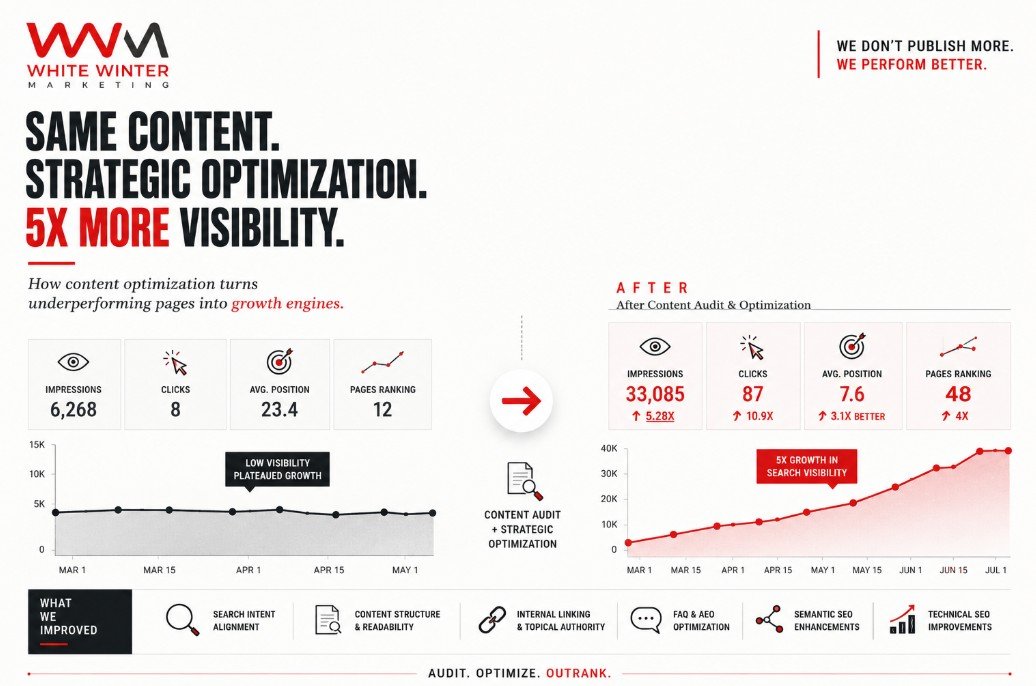
The outcome was significant. Within a few months, multiple articles doubled, tripled, and even achieved more than 5X growth in Google Search impressions, accompanied by noticeable improvements in organic clicks.
This case study explains our methodology, the optimization framework we followed, and the measurable business impact.
About the Client
Our client is a B2B technology company serving enterprise customers with innovative digital solutions. Due to confidentiality agreements, we cannot disclose the company’s identity. However, the challenges and outcomes presented in this case study are based on an actual client engagement.
The company had invested consistently in thought leadership and educational content to build trust with B2B buyers, establish industry authority, and improve inbound lead generation. While the foundation was strong, much of the content had not been revisited since publication, creating an opportunity to improve its search performance.
The Challenge
The company had published a series of technical articles covering industry-specific topics, product education, and emerging technologies.
Although the articles ranked for several keywords, many had reached a performance plateau.
Our initial content audit identified several common issues.
Content had become outdated: Technology evolves quickly. Some statistics, examples, and references no longer reflected current industry trends.
Search intent had shifted: Google increasingly rewards content that provides comprehensive answers to user queries. Several articles no longer aligned with how buyers searched for information.
Limited topical depth: While the content addressed the primary topic, it lacked supporting entities, related concepts, and contextual information that strengthen topical authority.
Weak internal linking: Many articles existed in isolation instead of supporting one another through strategic internal links.
Limited optimization for AI-powered search: With conversational search and AI-generated answers becoming increasingly important, the articles were not structured to perform well in Answer Engine Optimization (AEO) or Generative Engine Optimization (GEO).
These challenges are common among SaaS companies and highlight why a proactive SEO content strategy is essential for long-term organic growth.
Our Content Optimization Strategy
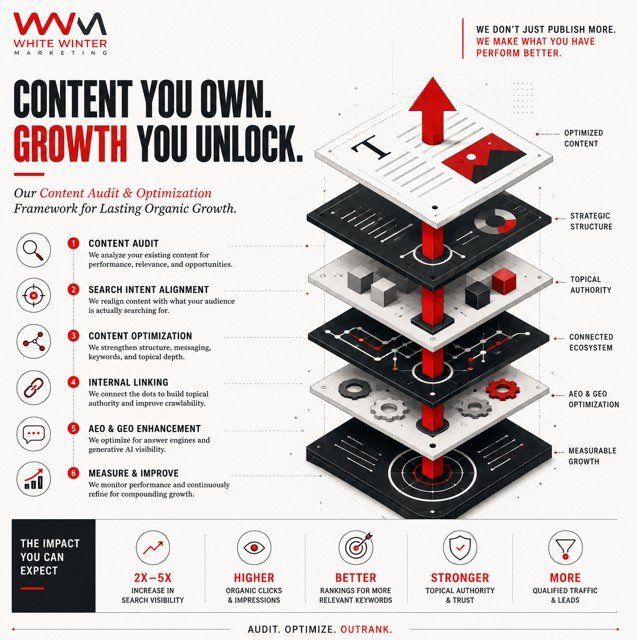
Rather than rewriting articles from scratch, we developed a structured optimization framework focused on increasing search visibility while preserving the authority the content had already earned.
Step 1. Comprehensive Content Audit
Every article underwent a detailed review against our technical SEO checklist and content quality framework.
The audit covered:
- Search intent alignment
- Keyword relevance
- Semantic keyword opportunities
- Heading hierarchy
- Metadata optimization
- Content freshness
- Internal linking
- External references
- Readability
- User engagement signals
- Content structure
- Duplicate information
- Technical SEO considerations
This helped us prioritize improvements based on business impact.
Step 2. Search Intent Optimization
Ranking today requires much more than inserting keywords.
Every article was rewritten to better answer the questions users were actually asking.
We expanded explanations, improved introductions, strengthened conclusions, and reorganized sections to create a more logical flow for both readers and search engines.
The objective was simple:
Deliver the most helpful answer available for each target topic.
Step 3. Semantic SEO
Modern search engines understand topics rather than isolated keywords.
Instead of repeating target phrases, we naturally introduced related concepts, supporting entities, and contextual information that strengthened topical relevance.
This approach improved Google’s understanding of the subject while creating a better reading experience.
Step 4. Strengthening Internal Linking
Content performs better when it exists as part of a connected knowledge ecosystem.
We strategically linked related articles, service pages, and supporting resources to:
- Improve crawlability
- Increase session duration
- Distribute page authority
- Strengthen topical clusters
This transformed individual articles into an interconnected resource hub.
Step 5. Answer Engine Optimization (AEO)
Search behaviour continues to evolve.
More users now expect direct answers through featured snippets, AI Overviews, and conversational search experiences.
To improve discoverability, we:
- Added structured FAQs
- Simplified technical explanations
- Improved heading hierarchy
- Created concise answer-focused sections
- Optimized for question-based queries
These improvements enhanced visibility across both traditional search and answer engines.
Step 6. Generative Engine Optimization (GEO)
As AI assistants increasingly recommend content, websites must be optimized not only for search engines but also for generative AI platforms.
Our GEO strategy focused on:
- Improving entity recognition
- Creating well-structured explanations
- Enhancing topical relationships
- Increasing factual clarity
- Reducing ambiguity
- Strengthening authoritativeness
This ensures content remains discoverable as AI-powered search continues to reshape how information is consumed.
Results
Following optimization, we monitored performance through Google Search Console.














The improvements were evident across multiple articles.
Highlights
- 15 existing technical articles optimized
- Organic clicks increased across nearly every article.
- Multiple articles recorded 2X to 5X growth in Google Search impressions.
- Previously underperforming pages began ranking for additional search queries.
- Visibility improved without publishing additional long-form content.
Sample Performance Improvements
| Article | Before | After |
| Technical Guide A | 7 clicks | 23 clicks |
| Industry Guide B | 1 click | 26 clicks |
| Technology Comparison C | 3 clicks | 18 clicks |
| Product Guide D | 6 clicks | 12 clicks |
| Technical Resource E | 6,268 impressions | 33,085 impressions |
These results demonstrate the value of investing in existing content before allocating resources to creating new assets.
Why This Content Optimization Strategy Worked
Many organizations measure content success by the number of articles they publish.
However, search performance depends on relevance, depth, authority, and user experience.
By improving content quality rather than simply increasing content quantity, we aligned every article with Google’s Helpful Content principles while strengthening topical authority across the website.
The combination of technical improvements, semantic optimization, AEO, and GEO created a stronger foundation for long-term organic growth.
Key Takeaways for SaaS and Technology Companies
If your business has been publishing blogs consistently for more than a year, there is a strong possibility that your existing content contains untapped SEO potential.
A structured content optimization strategy can help you:
- Build trust with B2B buyers through authoritative educational content.
- Improve organic rankings without significantly increasing content production costs.
- Strengthen topical authority within your niche.
- Increase qualified organic traffic.
- Support AI-powered discovery through AEO and GEO best practices.
- Improve the performance of your existing content marketing investment.
For many organizations, refreshing existing content produces a faster return on investment than creating entirely new articles.
Why White Winter Marketing
At White Winter Marketing, we help startups, SaaS companies, and enterprise technology brands turn content into a predictable growth channel.
Our integrated approach combines:
- SaaS content strategy
- Technical SEO
- Content optimization
- Semantic SEO
- Answer Engine Optimization (AEO)
- Generative Engine Optimization (GEO)
- Content audits
- B2B storytelling
- Founder-led content marketing
- Search-driven content marketing
Whether your objective is improving organic visibility, generating qualified leads, or building trust with B2B buyers, our strategies are designed to create sustainable, long-term growth.
Conclusion
Publishing more content is not always the fastest path to better rankings.
Sometimes, the greatest opportunity lies within the content you already own.
This project demonstrates how a strategic content optimization initiative helped a B2B technology company significantly increase its organic search visibility, strengthen topical authority, and improve overall search performance without expanding its content library.
For SaaS companies competing in increasingly crowded markets, regular content audits and optimization are no longer optional. They are essential components of a modern SEO strategy that serves both search engines and AI-powered discovery platforms.
Expected SEO Timeline After Optimization (Tentative Time)
| Timeframe | Results |
| 1–2 weeks | Google re-crawls updated pages |
| 2–4 weeks | Impression increase in Google Search Console |
| 4–8 weeks | Ranking improvements start |
| 2–3 months | Traffic increase becomes noticeable |
| 3–6 months | Stable rankings and higher organic traffic |
Frequently Asked Questions
What is content optimization in SEO?
Content optimization is the process of improving existing web pages to enhance their relevance, quality, search visibility, and user experience. It includes updating information, aligning with search intent, strengthening internal links, improving metadata, and enhancing semantic relevance.
How often should SaaS companies update their blog content?
A comprehensive content audit every six to twelve months helps ensure articles remain accurate, competitive, and aligned with evolving search behavior. High-performing pages should be reviewed more frequently to maintain their rankings.
Can updating old blog posts improve Google rankings?
Yes. Refreshing existing content with updated information, improved structure, and stronger keyword intent often leads to higher rankings, increased impressions, and more organic clicks.
What is the difference between SEO, AEO, and GEO?
Traditional SEO focuses on improving visibility in search engine results. Answer Engine Optimization (AEO) helps content appear in featured snippets and AI-generated answers, while Generative Engine Optimization (GEO) improves how AI platforms understand, reference, and recommend your content.
Why should technology companies invest in content optimization instead of publishing more blogs?
Optimizing existing content leverages the authority and indexing history already built by your website. It often delivers faster results, improves ROI, and strengthens topical authority without the higher costs of creating new content from scratch.