A company can rank well on Google and still be difficult to find when a buyer asks an AI engine about its category.
That is not necessarily an SEO problem. It is a problem of how clearly the market understands the company, and how much evidence exists for an AI system to draw on when constructing an answer.
The distinction is becoming commercially important. Gartner reported in May 2026 that 45% of surveyed B2B buyers had used GenAI during a recent purchase, primarily to research vendors and products. At the same time, 69% said they preferred to validate AI-generated information with a sales representative.
The implication is easy to miss. AI is not replacing the B2B buying process. It is becoming part of the research layer that precedes it.
A prospect may never begin with your homepage. They may begin by asking:
Which SaaS platforms are best for a mid-sized manufacturing company?
What should I look for in an enterprise CRM?
How does one warehouse management platform compare with another?
Which companies in India specialise in this problem?
The question for a B2B SaaS brand is therefore no longer only whether it ranks for those searches.
Does the brand become part of the answer?
That is where AEO and GEO deserve serious attention.
AEO and GEO are not another set of SEO tricks
AEO, or Answer Engine Optimization, is generally concerned with making information useful and retrievable when a system needs to answer a specific question.
GEO, or Generative Engine Optimization, takes a wider view. It concerns the signals that help generative systems understand a company, its expertise, products, reputation and relevance across the web.
The distinction is useful, but it should not be exaggerated.
Google’s own guidance on its generative search features is remarkably clear on this point. There is no separate technical recipe for appearing in AI Overviews or AI Mode. Google continues to recommend the fundamentals of good SEO and specifically cautions against pursuing supposed AEO or GEO “hacks.”
That makes sense.
An AI system still needs reliable information before it can produce a useful answer. Changing the label from SEO to GEO does not change that underlying requirement.
What has changed is the way information is assembled and consumed.
Traditional search presents a set of pages and asks the user to investigate them.
AI search can investigate first and present a synthesis.
That makes the quality, clarity and corroboration of the underlying information much more important.
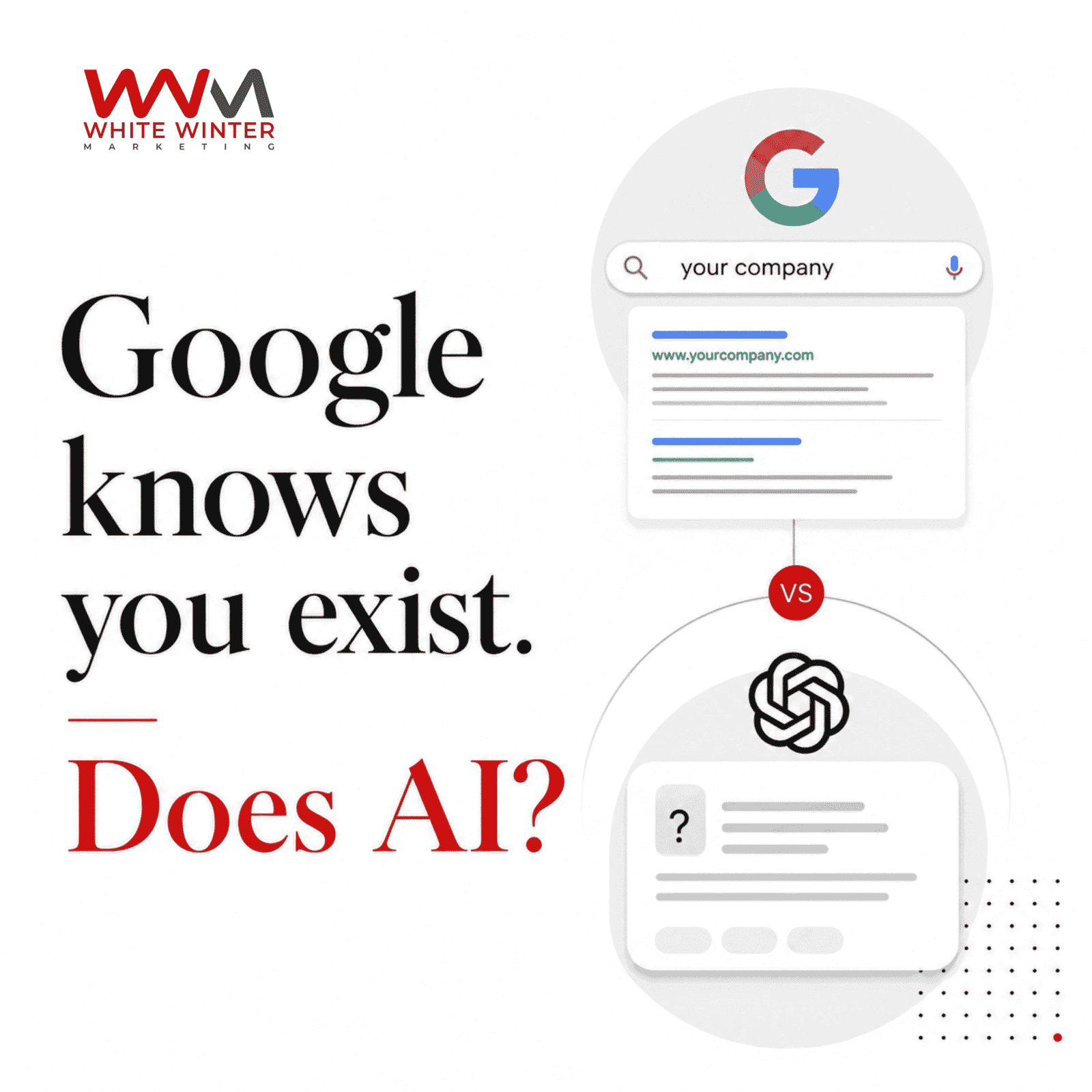
Why a good Google ranking is no longer the whole story
Consider two SaaS companies competing in the same category.
Company A has a technically strong website, hundreds of blog posts and good rankings for several commercial keywords.
Company B has fewer pages but explains its product clearly, publishes original research, has detailed customer stories, appears in relevant industry publications, and has executives who regularly discuss the problems their customers face.
Which one will an AI engine mention?
There is no universal answer, and anyone promising one is oversimplifying a probabilistic system. But the question itself reveals the limitation of thinking about AI visibility as another ranking position.
A recent B2B SaaS citation study by VisibleIQ, covering 2,020 citations across ChatGPT, Perplexity, Gemini and Claude, found substantial differences in where the systems sourced information. For product queries, 79% of citations on Perplexity, Gemini and Claude pointed to third-party websites, while ChatGPT cited vendor websites much more frequently in its sample.
The important finding is not the percentage itself.
It is that there is no single source hierarchy across AI engines.
For a SaaS marketer, that means your website matters, but your website cannot be the entire strategy.
What makes a B2B SaaS brand discoverable in AI search?
The answer begins with something more fundamental than content volume: clarity.
We use five interconnected signals when thinking about AEO and GEO for SaaS brands:
Entity
Can the system clearly establish who you are?
Your company name, category, products, industries, geography, customers and areas of expertise should form a coherent picture.
This sounds basic, but B2B technology websites often describe the same business in several different ways. One page calls the company an AI platform. Another describes it as a digital transformation provider. The leadership team talks about automation while the product pages emphasise analytics.
The market may understand the connection.
A machine should not have to reconstruct it.
Expertise
Does your content demonstrate that you know the subject?
There is a significant difference between publishing an article about AI trends in manufacturing and publishing an analysis based on what you have actually seen in manufacturing environments.
The second contains experience.
That experience is what gives an article something worth citing.
This is also where AEO for SaaS intersects with thought leadership. The strongest answer to a question such as how are manufacturers adopting AI? is rarely a generic list of trends. It is an informed explanation grounded in evidence.
Evidence
What supports your claims?
Customer outcomes. Original research. Product documentation. Expert interviews. Reviews. Industry coverage. Case studies. Pricing information. Specific numbers.
These details matter because AI-generated answers still need grounding.
Gartner’s research is revealing here: buyers are using GenAI for research, but they are also looking for human validation when the information affects a purchase decision.
AI may accelerate discovery. Evidence still reduces perceived risk.
Context
A product is easier to understand when its place in the market is clear.
Who is it designed for?
Which problem does it solve?
What makes it different?
When should a buyer consider it?
What are the alternatives?
This is why a well-developed SaaS website needs more than product pages and a blog. Comparison pages, use cases, industry pages, implementation guides and customer stories provide the context buyers and AI systems need to interpret the product correctly.
Consistency
Finally, does the same understanding of the company appear across the web?
Your website says one thing. Your CEO says another. A review platform uses different terminology. An industry publication describes you differently again.
That creates a fragmented entity.
GEO is therefore not simply a website optimisation exercise. It is a brand authority exercise across the web.
The content problem is actually a positioning problem
This is where many AEO and GEO strategies go off course.
A company notices that competitors are appearing in AI answers, so it commissions another fifty articles.
The articles contain the right keywords. They answer obvious questions. They are technically well structured.
But they do not add anything new.
Google’s current guidance explicitly places emphasis on valuable, unique, non-commodity content and warns against scaled content created primarily to manipulate search rankings.
The same principle makes sense beyond Google.
Why would an AI system need another generic explanation of what is CRM when thousands already exist?
What it needs is information that helps resolve a particular question.
That could be an original benchmark, a comparison based on real data, a customer implementation lesson, an expert’s interpretation of a market shift or a detailed explanation of how a product actually works.
This changes the role of the content team.
The question is no longer:
How many articles should we publish this month?
It becomes:
What information do buyers need that we are uniquely qualified to provide?
That is a much more productive AEO strategy.
Third-party visibility matters more than most SaaS companies realise
A company naturally writes about itself.
Independent sources create a different kind of signal.
Industry publications, customer reviews, comparison sites, interviews, podcasts, LinkedIn discussions and expert commentary can establish associations that a company’s own website cannot establish alone.
The VisibleIQ research illustrates this particularly well: for three of the four AI platforms studied, third-party websites accounted for 79% of citations for product queries.
That makes digital PR, founder visibility and customer advocacy relevant to GEO for SaaS, not merely to conventional brand awareness.
It also explains why a strong AI visibility strategy often crosses disciplines.
SEO cannot do all of it.
Content cannot do all of it.
PR cannot do all of it.
Founder branding cannot do all of it.
The signals need to reinforce one another.
What should a SaaS company optimise for?
| Asset | What it should establish | Why it matters for AEO and GEO |
|---|---|---|
| Product pages | What you sell and who it is for | Gives AI systems clear first-party information |
| Comparison content | Differences, use cases and alternatives | Helps with evaluation-stage questions |
| Customer stories | Outcomes and implementation experience | Adds evidence and specificity |
| Expert content | Original analysis and expertise | Builds topical authority |
| Founder content | Perspective and market interpretation | Connects expertise to identifiable people |
| Industry pages | Category and customer context | Strengthens entity understanding |
| Third-party coverage | Independent validation | Provides external evidence and associations |
This is also why AEO and GEO should not sit in isolation from your wider SaaS marketing strategy.
The same customer story can support SEO, sales enablement, LinkedIn, PR and AI visibility.
The same founder interview can strengthen executive positioning and give the market more context about the company.
The same original research can attract backlinks, generate media coverage and provide information that an AI system can reference.
Good marketing increasingly has to work in several directions at once.
How do you know whether GEO is working?
This is one area where marketers should be careful.
AI visibility is not equivalent to a Google ranking, and a single prompt producing a mention is not a meaningful measurement system.
AI responses can change with the wording of the question, the engine, the model, the sources available at the time and the context supplied to the system.
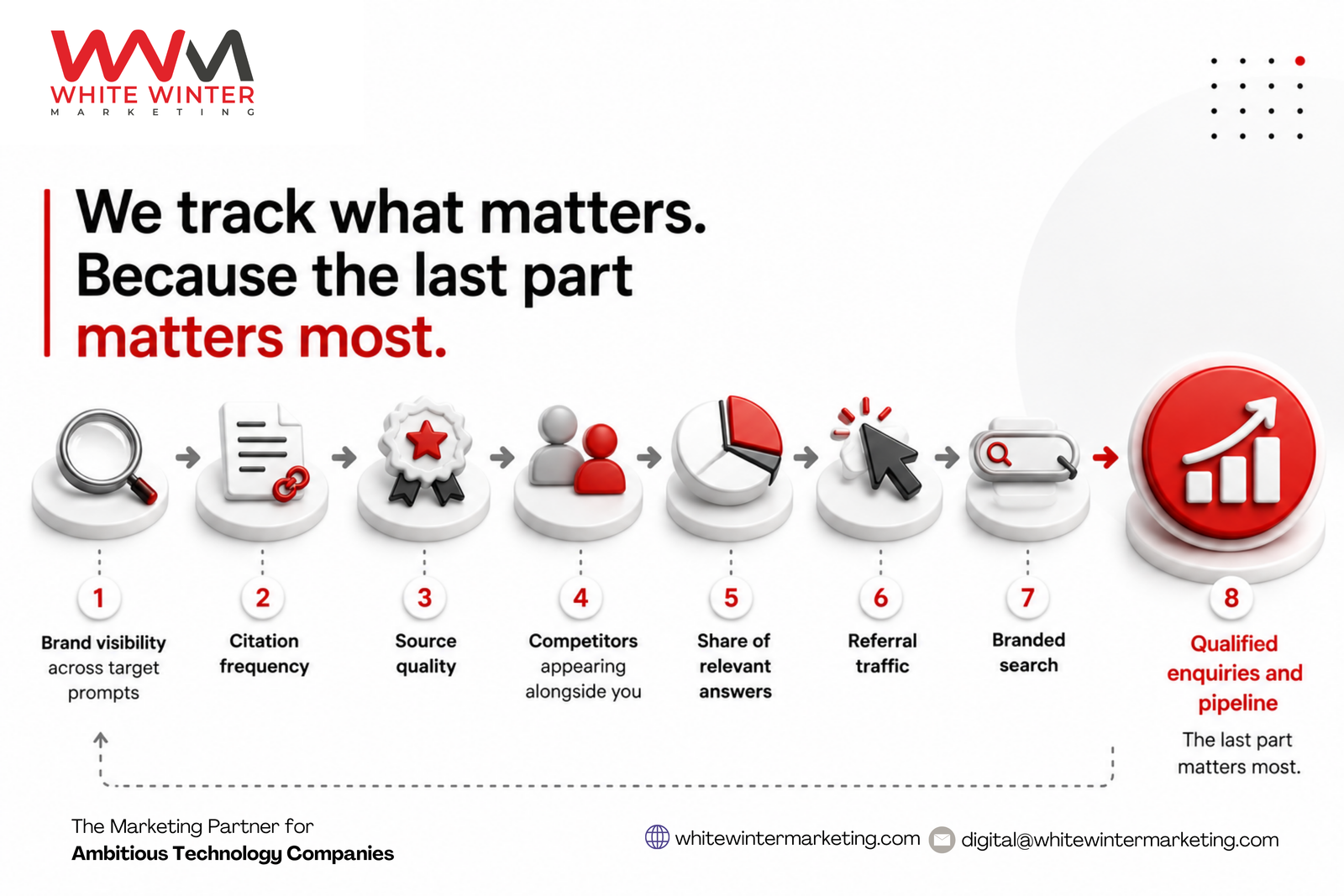
A sensible measurement programme therefore tracks a set of signals:
Brand visibility across target prompts → citation frequency → source quality → competitors appearing alongside you → share of relevant answers → referral traffic → branded search → qualified enquiries and pipeline.
The last part matters most.
The purpose of AEO and GEO is not to collect screenshots of ChatGPT mentioning your company.
It is to make your company easier to discover and easier to trust during the buying process.
OpenAI currently allows websites to appear in ChatGPT Search when they permit OAI-SearchBot to crawl their content, and referrals from ChatGPT can be tracked through analytics platforms.
That makes technical accessibility worth checking, but technical accessibility is only the beginning.
A crawlable website still needs something worth finding.
The real opportunity for B2B SaaS brands
AEO and GEO are sometimes presented as the next stage of SEO.
I think that description misses the larger opportunity.
They are forcing marketers to answer questions that good B2B marketing should have been answering all along.
What exactly do we want to be known for?
Can we prove that we understand the problem?
Are our claims supported by evidence?
Does the market describe us consistently?
Are other credible people and organisations talking about us?
Can a buyer understand our relevance without speaking to sales?
If those answers are weak, adding another hundred optimised articles will not solve the underlying problem.
If they are strong, AEO and GEO become extensions of a much more durable marketing asset: market authority.
AEO helps your content answer the question. GEO helps your brand become part of the answer.
For B2B SaaS companies, that distinction is becoming increasingly important as buyers use AI not simply to find information, but to narrow their choices.
The brands that benefit will not necessarily be the ones publishing the most.
They will be the ones that have given buyers, search engines and AI systems the clearest evidence of what they know, who they serve and why they deserve consideration.
And that is a much better definition of AI search optimisation than another checklist of tricks.
If your SaaS brand is not showing up when buyers ask AI about your category, the problem may not be your content volume. It may be how your expertise, positioning and evidence are being understood across search. Talk to White Winter Marketing for an AEO and GEO consultation and we will look at where your brand is visible, where it is being missed, and what needs to change to build stronger AI search visibility. Email: digital@whitewintermarketing.com