A B2B SaaS company can have a capable product, an experienced sales team and a clearly defined target market, yet struggle to generate a consistent flow of qualified opportunities.
Marketing may be publishing regularly. Sales may be sending hundreds of emails. LinkedIn outreach may be generating responses. The CRM may contain thousands of contacts.
But how many of those contacts represent businesses with a genuine requirement, the authority to make a purchase and a realistic intention to evaluate a solution?
This distinction separates lead generation activity from effective demand development.
For B2B SaaS companies, lead generation is not simply about collecting contact details. It involves identifying the right accounts, establishing relevance, communicating business value and creating opportunities for meaningful sales conversations.
Content marketing plays a central role in this process. It helps potential customers understand a problem, evaluate possible solutions and develop confidence in a company before they engage with its sales team.
When combined with targeted outbound campaigns, it can become an important component of a more connected B2B lead generation system.
The Lead Quality Paradox: Why More Leads Do Not Necessarily Mean More Business
Many marketing teams continue to evaluate lead generation through volume.
More contacts, more form submissions, more email responses and more meetings are treated as indicators of progress.
However, volume alone says little about commercial quality.
Consider two hypothetical SaaS lead generation campaigns.
The first produces 100 contacts from a broad prospecting database. Most belong to companies outside the intended customer profile. Some have no relevant business requirement, while others have no involvement in purchasing decisions.
The second produces 25 contacts from carefully selected target accounts. These businesses match the company’s ideal customer profile and have identifiable operational requirements relevant to the product.
The second campaign may produce fewer contacts, but its commercial potential could be considerably higher.
This is the Lead Quality Paradox: increasing the volume of marketing activity does not necessarily increase the number of viable sales opportunities.
For SaaS companies, lead generation should therefore be evaluated through relevance, qualification and progression rather than contact volume alone.
How the B2B Buying Journey Is Changing
One reason traditional lead generation approaches need reconsideration is that B2B buyers increasingly conduct independent research before engaging with vendors.
The 2025 6sense Buyer Experience Report, based on responses from more than 4,000 B2B buyers, found that 94% of buying groups ranked their preferred vendors before contacting sales teams. The vendor ranked first before engagement ultimately won 77% of purchases.
The report suggests that companies are entering the buying journey with established preferences rather than making all their decisions during sales conversations.
Source: 6sense, 2025 Buyer Experience Report.
More recent research from 6sense’s 2026 Global B2B Buyer Experience Report reinforces the importance of early visibility. Its findings indicate that 91.4% of buyers rank their vendor shortlist before contacting sellers, while the pre-contact favourite ultimately wins approximately 81.5% of purchases.
Source: 6sense, 2026 Buyer Experience Report.
Gartner’s June 2025 survey of 632 B2B buyers found that 61% preferred an overall rep-free buying experience. The research also found that 73% actively avoided suppliers that sent irrelevant outreach.
Source: Gartner, B2B Buyers Prefer a Rep-Free Buying Experience.
These findings have an important implication for SaaS marketing.
A company cannot depend exclusively on sales outreach to establish its credibility. Prospective customers may already have formed opinions about the category, shortlisted vendors and evaluated available information before responding to an email or accepting a meeting.
Marketing must therefore establish relevance before the first sales conversation.
Why Content Marketing and Outbound Lead Generation Should Work Together
Content marketing and outbound lead generation are frequently managed as separate activities.
Content teams focus on blogs, website traffic, SEO and LinkedIn. Sales development teams focus on prospect lists, email sequences, LinkedIn messages and meeting generation.
Both functions have legitimate objectives, but operating independently can create gaps.
A sales representative may approach a prospect with a product pitch before the prospect understands the business problem. A content team may attract relevant website visitors without providing the sales team with useful resources to continue the conversation.
Connecting these activities creates a stronger approach.
| Content marketing | Outbound lead generation |
| Builds category awareness | Identifies relevant target accounts |
| Explains business problems | Reaches decision-makers |
| Establishes expertise | Initiates direct conversations |
| Supports independent research | Creates opportunities for engagement |
| Develops long-term organic visibility | Supports targeted prospecting |
| Helps evaluate solutions | Facilitates follow-up and qualification |
The objective is not to replace outbound with content or content with outbound.
It is to make sure that both activities reinforce the same positioning, communicate consistent value and address the requirements of the same buying group.
The Content-to-Pipeline System: Connecting Marketing Activity With Commercial Opportunities
A practical way to understand this relationship is through the Content-to-Pipeline System.
It connects five activities that should operate as part of a coordinated marketing and sales process.
1. Market Positioning and ICP Definition
Every lead generation programme should begin with a clearly defined ideal customer profile.
For a B2B SaaS company, this means understanding more than the industry and company size.
The ICP should consider:
- Target industries and sub-industries.
- Company size and operational complexity.
- Geography and market maturity.
- Existing technology infrastructure.
- Business problems the product addresses.
- Buying triggers and implementation requirements.
- Decision-makers and technical influencers.
For example, a company selling enterprise contract lifecycle management software may target organisations with high contract volumes, complex approval processes and multiple legal or procurement stakeholders.
A generic database of business executives will not provide the same value as a carefully researched list of organisations with those characteristics.
The positioning should also explain why the product is relevant to that audience.
2. Content-Led Visibility and Buyer Education
Once the audience and positioning are clear, content should establish the company’s relevance.
This is where B2B content marketing becomes a commercial asset.
Useful content includes:
- Educational articles addressing industry problems.
- Technical guides explaining product capabilities.
- SEO content targeting relevant search intent.
- AEO-optimised answers to buyer questions.
- GEO initiatives supporting AI discovery.
- Founder-led LinkedIn thought leadership.
- Case studies demonstrating implementation experience.
- Comparison guides supporting product evaluation.
For example, a warehouse automation software company could publish an article about common inventory visibility challenges.
That article can introduce the operational problem, explain its business implications and help readers understand the capabilities required from a modern solution.
A relevant prospect may encounter this information through Google, LinkedIn, an industry newsletter or an AI-assisted search experience.
The immediate outcome may not be a demo request. The more important contribution is that the company becomes a recognisable source of relevant expertise.
3. Targeted Outbound Lead Generation
Content-led visibility should be complemented by deliberate account selection and prospecting.
A B2B outbound lead generation programme should involve:
- Building an account list based on the ICP.
- Identifying relevant decision-makers.
- Researching company-specific business context.
- Developing personalised outreach.
- Creating email and LinkedIn sequences.
- Coordinating follow-ups.
- Tracking responses and engagement.
Personalisation should extend beyond inserting a recipient’s name or company into a message.
A useful outbound message should demonstrate an understanding of the recipient’s business context and introduce a relevant reason to start a conversation.
For example, a message to a manufacturing technology leader could refer to a specific operational challenge associated with traceability or asset visibility, provided that the observation is accurate and relevant to that organisation.
The objective is to establish business relevance rather than simply request a meeting.
4. Buyer Engagement and Content-Assisted Conversations
A prospect who responds to outreach may still require considerable information before considering a demonstration.
The sales team should have access to content that supports different stages of evaluation.
| Prospect requirement | Relevant content asset |
| Understanding an industry problem | Educational article |
| Investigating possible solutions | Solution guide |
| Comparing vendors | Comparison article |
| Evaluating technical suitability | Technical documentation |
| Assessing implementation capability | Case study |
| Building an internal business case | ROI guide or business brief |
| Not ready to purchase | Newsletter and thought leadership |
This is where content becomes particularly useful to sales teams.
Instead of repeatedly explaining the same concepts, representatives can share relevant resources that help prospects understand the product and evaluate its suitability.
5. Qualification and Pipeline Measurement
The final stage is understanding which interactions are progressing towards commercially relevant opportunities.
A qualified lead should be assessed against agreed criteria.
These may include:
- Fit with the ideal customer profile.
- Relevance of the identified business problem.
- Engagement with the solution.
- Decision-making authority or influence.
- Purchase timing and readiness.
- Budget or procurement considerations.
Not every positive email response represents a qualified lead. Similarly, a prospect who downloads a white paper should not automatically be classified as sales-ready.
Marketing and sales teams should agree on qualification definitions before campaigns begin.
Useful metrics include qualified lead volume, positive response rates, meeting attendance, sales-qualified leads, opportunity creation and pipeline progression.
The objective is to understand which activities contribute to genuine commercial opportunities rather than report activity in isolation.
What Should a B2B SaaS Lead Generation Agency Actually Deliver?
A B2B lead generation agency should provide a coordinated programme rather than simply supply contact lists or execute generic email campaigns.
The scope should address five areas.
Account Research and Prospect Identification
The agency should define the target market, identify relevant companies and map the buying group.
This includes company research, role identification, segmentation and prospect data validation.
Outbound Campaign Strategy
Campaign execution may involve email outreach, LinkedIn prospecting, personalised messaging, follow-up sequences and account-based engagement.
The strategy should reflect the market, product category and seniority of the intended recipients.
Content and Marketing Support
Outbound campaigns are more effective when supported by credible information.
A specialist B2B lead generation agency should understand how content marketing, website messaging and LinkedIn branding contribute to prospect engagement.
Multi-Channel Campaign Execution
Depending on the engagement, activities may include:
- B2B outbound lead generation.
- LinkedIn outreach.
- Email prospecting.
- Account-based campaigns.
- Content distribution.
- Lead nurturing.
The channels should be coordinated rather than operated as disconnected campaigns.
Reporting and Qualification
Reporting should clearly distinguish between contacts identified, messages delivered, responses received, meetings booked, qualified meetings and opportunities created.
These are different stages of the lead generation process and should not be combined into one headline number.
Understanding B2B Lead Generation Pricing and Costs
One of the most common questions companies ask before hiring a lead generation agency is how much the engagement will cost.
There is no universal price for B2B lead generation services.
Pricing depends on the target market, prospecting complexity, outreach volume, channels involved, qualification requirements and level of strategic support.
Understanding these variables is more useful than comparing agency quotations based on headline prices alone.
Six Factors That Influence Lead Generation Costs
- Target Market and Geography
Prospecting for enterprise decision-makers in the United States involves different research, data and outreach requirements from targeting small and medium-sized businesses in India.
Industry-specific targeting can also increase the research effort required.
- ICP Complexity
A company targeting a narrow group of organisations with specific technology requirements may need more extensive account research than a business targeting a broad professional audience.
- Prospecting Volume
The number of target accounts, contacts, campaigns and follow-up activities influences operational requirements.
However, higher volume should not automatically be treated as better performance.
- Channel Mix
Email, LinkedIn outreach, content distribution and account-based marketing require different resources and execution processes.
A multi-channel programme may involve greater operational complexity than a single-channel campaign.
- Content Requirements
Personalised outreach often requires supporting content such as case studies, solution briefs, industry articles and landing pages.
If these assets need to be created from scratch, they should be included in the overall engagement scope.
- Qualification Standards
There is a considerable difference between providing a database of contacts and delivering validated, sales-qualified conversations.
Companies should understand exactly what the agency considers a qualified lead and how that definition is applied.
Common B2B Lead Generation Pricing Models
Agencies generally use a few common commercial models.
| Pricing model | How it works | What businesses should examine |
| Monthly retainer | Fixed monthly fee for an agreed scope | Deliverables, resources and reporting |
| Pay per lead | Payment for each qualifying lead | Qualification criteria and data accuracy |
| Pay per appointment | Payment for booked meetings | Attendance and meeting quality |
| Project-based | Fixed fee for a defined campaign | Scope, duration and completion criteria |
| Hybrid | Retainer combined with performance-based fees | Attribution and performance conditions |
Each model has advantages and limitations.
A monthly retainer can support consistent campaign development and optimisation. A pay-per-lead arrangement may appear easier to evaluate, but only if the definition of a qualified lead is sufficiently precise.
Pay-per-appointment programmes also require clear agreement on meeting quality, attendance and relevance.
The right model depends on the company’s commercial objectives and internal sales capabilities.
How to Calculate the Actual Cost of Lead Generation
Comparing agencies through cost per lead alone can produce misleading conclusions.
A company should also understand how many leads become customers and how much it spends acquiring those customers.
Three basic calculations provide a useful starting point.
Cost per Qualified Lead (CPQL)
CPQL = Total Lead Generation Cost ÷ Number of Qualified Leads
Customer Acquisition Cost (CAC)
CAC = Total Acquisition Cost ÷ Number of New Customers
Lead-to-Customer Conversion Rate
Lead-to-Customer Rate = (New Customers ÷ Qualified Leads) × 100
Consider an illustrative campaign:
| Metric | Example |
| Monthly campaign investment | ₹2,00,000 |
| Qualified leads | 20 |
| Cost per qualified lead | ₹10,000 |
| New customers | 2 |
| Campaign cost per acquired customer | ₹1,00,000 |
In this example, the campaign generates 20 qualified leads and converts two into customers.
The resulting campaign cost per acquired customer is ₹1,00,000.
This is not necessarily the company’s complete CAC. A full CAC calculation may also include internal sales salaries, marketing personnel, software, advertising and other acquisition expenses.
For SaaS companies, these figures should be evaluated against contract value, gross margin, customer lifetime value and payback period.
A higher cost per qualified lead may still produce better commercial returns if the resulting customers have stronger contract values and retention potential.
When Should a SaaS Company Hire an External Lead Generation Partner?
Building an internal marketing and sales development function requires people, technology, management and ongoing investment.
An external partner may be useful when a company needs additional execution capacity or specialist capabilities.
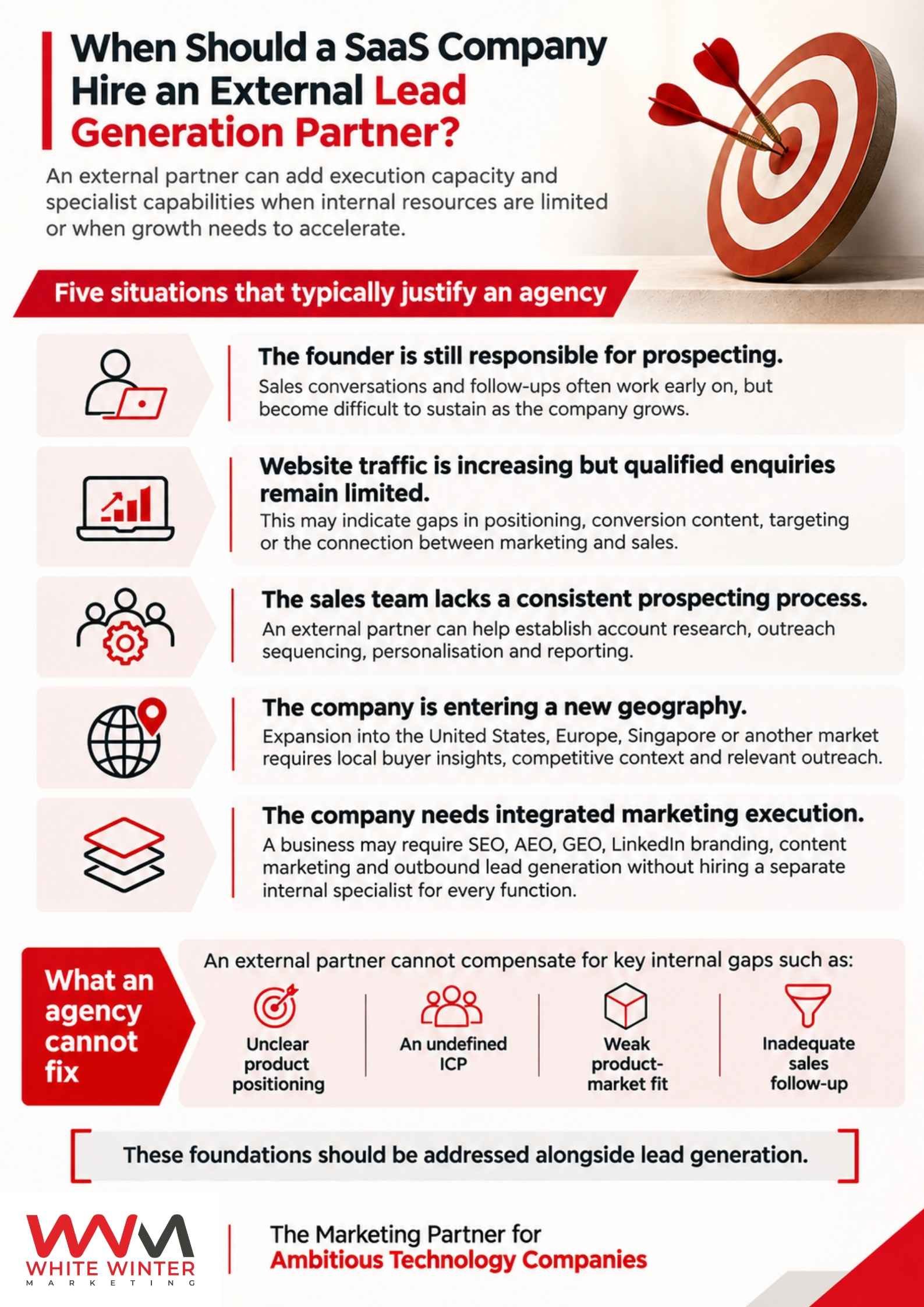
Five situations commonly justify considering an agency.
The founder is still responsible for prospecting.
In early-stage companies, founders frequently handle sales conversations, follow-ups and business development. This can become difficult to sustain as the company grows.
Website traffic is increasing but qualified enquiries remain limited.
This may indicate gaps in positioning, conversion content, targeting or the connection between marketing and sales.
The sales team lacks a consistent prospecting process.
An external partner can help establish account research, outreach sequencing, personalisation and reporting.
The company is entering a new geography.
Expanding into the United States, Europe, Singapore or another market requires an understanding of the local buyer profile, competitive environment and relevant outreach practices.
The company needs integrated marketing execution.
A business may require SEO, AEO, GEO, LinkedIn branding, content marketing and outbound lead generation without immediately hiring a separate internal specialist for every function.
However, an agency cannot compensate for every internal weakness.
Unclear product positioning, an undefined ICP, weak product-market fit and inadequate sales follow-up can undermine even well-executed campaigns.
These foundations should be addressed alongside lead generation.
Seven Questions to Ask Before Hiring a B2B Lead Generation Agency
Before signing an agreement, evaluate the agency’s operating methodology.
- How do you define and validate our ideal customer profile?
- How do you research target accounts and identify decision-makers?
- What exactly qualifies as a sales-ready lead?
- Do you integrate content marketing with outbound campaigns?
- Can you support SEO, AEO, GEO and LinkedIn branding?
- How do you report qualified conversations and sales opportunities?
- How will your team coordinate with our internal sales function?
The answers should provide clarity about targeting, execution, accountability and reporting.
A credible agency should also be transparent about what it can control and what depends on the client’s product, pricing, sales process and market conditions.
Frequently Asked Questions
What is B2B SaaS lead generation?
B2B SaaS lead generation involves identifying and engaging businesses that may have a requirement for a software product or service. It includes activities such as content marketing, organic search, account research, email outreach, LinkedIn prospecting and lead qualification.
What is the difference between inbound and outbound lead generation?
Inbound lead generation attracts potential customers through activities such as SEO, content marketing, social media and downloadable resources. Outbound lead generation involves proactively identifying and approaching relevant prospects through channels such as email and LinkedIn. Both approaches can work together.
How much do B2B lead generation services cost?
B2B lead generation costs depend on the target market, campaign volume, prospecting complexity, channels, qualification requirements and agency scope. Companies should compare proposals based on deliverables and lead quality rather than price alone.
Is a B2B lead generation agency better than an in-house team?
Neither model is universally better. An in-house team offers direct organisational control, while an external agency can provide specialist expertise and execution capacity. The right choice depends on budget, internal resources, market complexity and business priorities.
How does content marketing help generate qualified leads?
Content marketing helps potential customers understand their business problems, evaluate possible solutions and assess a company’s expertise. It also gives sales teams useful resources to support prospect conversations and follow-ups.
How long does B2B lead generation take to produce results?
Timelines vary according to the sales cycle, market, offer, targeting accuracy and outreach process. Outbound campaigns can generate early responses, while organic content and SEO generally require sustained investment. Neither should be assessed solely through short-term contact volume.

Building a Lead Generation System That Supports SaaS Growth
Qualified lead generation is the result of several connected activities.
The company needs clear positioning, an identifiable target market, relevant content, consistent digital visibility, carefully researched outbound campaigns and a sales process capable of converting interest into opportunities.
Treating these as separate marketing functions creates unnecessary gaps. Connecting them allows content to support prospecting, outbound campaigns to introduce relevant expertise and sales teams to engage better-informed buyers.
At White Winter Marketing, we work with B2B technology and SaaS companies across content marketing, SEO, AEO, GEO, LinkedIn branding and outbound lead generation.
Our approach brings visibility, communication and targeted engagement into a coordinated marketing programme.
Looking to strengthen your B2B lead generation strategy? Connect with White Winter Marketing to discuss how content marketing and targeted outbound campaigns can support your growth objectives.