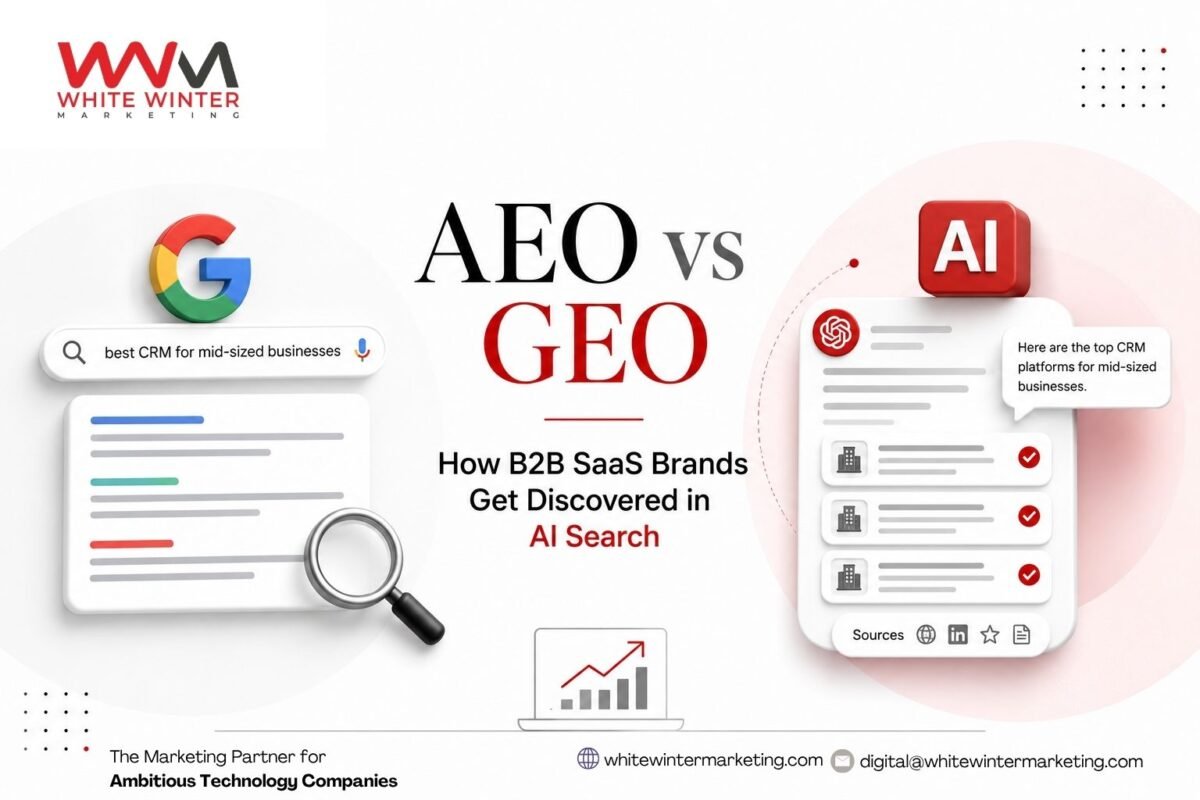
B2B software buyers are expanding the ways they research vendors. Alongside Google searches, they can use AI tools to compare solutions, investigate technical requirements and identify potential providers.
For B2B SaaS companies, this creates a strategic question: when a prospective buyer asks an AI search tool to recommend a solution or compare competing vendors, does your brand enter the conversation?
Traditional search engine optimization (SEO) remains important, but rankings alone do not capture every way a company can be discovered. Generative Engine Optimization (GEO) addresses the broader challenge of making a brand’s expertise accessible, understandable and potentially citable in AI-generated answers.
For marketing leaders, the objective is not to chase every new AI feature. It is to build a visibility strategy that connects search performance, original expertise, independent credibility and commercial relevance.
What Is Generative Engine Optimization?
Generative Engine Optimization is the practice of improving a company’s visibility and representation in AI-generated responses.
These experiences include ChatGPT, Perplexity and Google’s AI search features. Their retrieval methods differ, and no single optimization technique guarantees that a brand will be mentioned or cited.
GEO builds on established SEO principles while addressing an additional consideration: how AI systems discover information, interpret a brand’s expertise and select sources for relevant answers.
Consider a company selling contract lifecycle management software.
Its SEO strategy might target contract lifecycle management software and enterprise contract management platform. A GEO strategy would also address questions such as:
- Which contract management platforms integrate with Salesforce?
- What should an enterprise evaluate before purchasing CLM software?
- How do contract automation platforms differ in implementation complexity?
- Should a growing business choose standalone contract management software or an integrated revenue management solution?
Answering these questions requires more than keyword placement. It requires clear product information, useful comparisons, accurate technical documentation and evidence supporting the company’s claims.
SEO supports organic search discoverability. GEO extends the visibility strategy to how brands and their expertise appear in AI-generated responses. The disciplines overlap and should operate together.
Why AI Search Matters for B2B SaaS
The shift towards AI-assisted search has measurable implications for how people interact with search results, although its effects vary by platform and query type.
A July 2025 Pew Research Center analysis examined 68,879 Google searches conducted during March 2025 by 900 US adults whose browsing activity was tracked. Users clicked a traditional search result in 8% of visits where an AI summary appeared, compared with 15% of visits without one. A click on a link cited within an AI summary occurred in just 1% of visits where such a summary appeared.
These findings concern observed US Google browsing behaviour. They should not be treated as a direct measurement of B2B SaaS purchasing activity or as evidence of identical behaviour across all AI search platforms.
Google offered a different perspective in August 2025, reporting that its overall organic click volume to websites remained relatively stable year over year and that average click quality had increased. This was Google’s own assessment, without detailed supporting figures in that announcement.
The evidence supports a measured conclusion: AI is changing the search experience, but the effects on traffic and visibility are not uniform.
For B2B SaaS companies, an AI-generated answer may introduce a vendor, explain a product category or include a company in a comparison. A buyer may then visit the vendor’s website, consult an independent review or discuss the option with colleagues.
Not every mention generates a lead, and not every AI-assisted interaction can be attributed accurately. However, measuring only organic rankings and website sessions may provide an incomplete picture of how buyers discover a business.
Marketing teams should evaluate traditional search performance alongside AI visibility, connecting both to qualified enquiries and pipeline wherever possible.
The Four Foundations of a GEO Strategy
1. Technical accessibility
Important product pages, industry pages and technical resources should be discoverable through crawlable links, clear navigation and sound indexation practices.
Review robots directives, rendering issues, authentication barriers and internal linking. Maintain accurate sitemaps and implement relevant structured data where appropriate.
Schema markup can clarify information about a company, product or article. It does not guarantee AI citations or recommendations.
2. Clear product positioning
A company must explain what it does in language that buyers understand.
Descriptions such as “next-generation intelligent transformation platform” communicate little about functionality or relevance. A stronger description identifies the product category, target customer, core capabilities and business problem addressed.
An industrial IoT platform provider, for example, should explain which devices it connects, how it handles data, which systems it integrates with and what operational challenges it addresses.
Specific, consistent descriptions help buyers evaluate relevance and provide clearer context for information retrieval systems.
3. Evidence-backed content
Claims about product performance, implementation speed, customer outcomes and market leadership should be supported by evidence.
Detailed case studies, original research, technical documentation and transparent product comparisons offer more useful information than unsupported promotional statements.
Where possible, include the measurement period, methodology and conditions behind a reported result. Distinguish verified outcomes from projections and illustrative examples.
4. Independent credibility
A company’s website is only one part of its public information footprint.
Customer reviews, specialist publications, industry associations, software directories and implementation partners can provide additional context about its expertise and reputation.
A September 2025 research preprint, Generative Engine Optimization: How to Dominate AI Search, reported differences between AI search systems and traditional Google search in the sources they cited. The authors highlighted the importance of third-party coverage, source quality and differences between individual AI systems. As this is a preprint, its findings should be treated as emerging research rather than a settled industry standard.
The practical implication is to invest in genuine, relevant validation rather than mass-produced mentions or low-quality backlinks.
Build Content Around Buyer Questions
A practical GEO content strategy starts with the buying journey, not a list of AI-related keywords.
Different stakeholders evaluate software differently. A CTO may prioritise security and integration. A CFO may focus on total cost of ownership. An operational leader may examine implementation complexity and measurable efficiency gains.
Your content should address these distinct requirements.
A B2B SaaS company could organise its content around five areas:
- Category education: Explain the product category, its applications and the problems it solves.
- Technical evaluation: Cover integrations, architecture, security, implementation and scalability.
- Commercial evaluation: Address pricing models, total cost of ownership and build-versus-buy decisions.
- Vendor comparisons: Explain differences between products and approaches using transparent criteria.
- Customer evidence: Document implementation experiences, business outcomes and lessons learned.
Connect these resources through internal links. An article on revenue management software, for instance, could link to an integration guide, pricing resource, product comparison and relevant customer case studies.
The objective is to create a coherent body of expertise around the company’s product category, not a collection of disconnected articles.
Editorial quality remains essential. Every resource should answer a genuine question, provide defensible analysis and help buyers make a better-informed decision.
Connect GEO with Founder-Led Marketing
Founder-led LinkedIn content can complement a B2B SaaS GEO strategy by making executive expertise more visible to professional audiences.
A founder might explain a recurring customer problem, examine an industry assumption or discuss the commercial implications of a technology shift. A CTO might provide a technical perspective on architecture, security or implementation decisions.
These contributions should connect to the company’s broader expertise rather than operate as disconnected social media activity.
A practical workflow is to publish an in-depth article, develop a founder-led LinkedInFounder Branding post around its central insight, add a technical perspective where relevant and connect the content to supporting research or customer evidence.
However, LinkedIn engagement is not proof of AI search visibility. Publishing on a social platform does not guarantee citations or recommendations from AI systems.
Its role is to strengthen professional communication, audience reach and the company’s wider public presence.
How to Measure GEO Performance
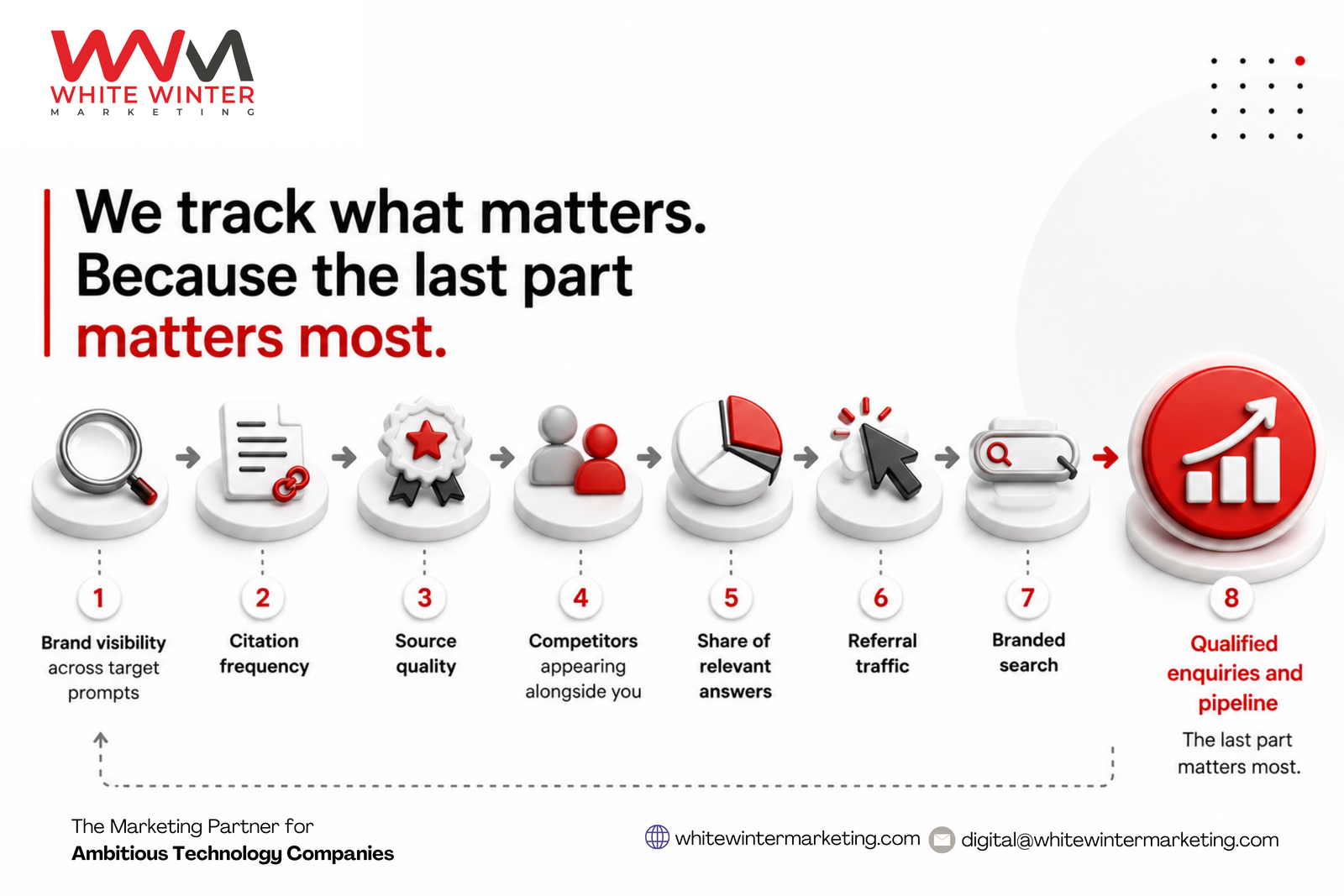
GEO measurement should connect visibility indicators to business outcomes rather than rely on a single AI visibility score.
| Metric | What it measures |
| Brand mentions | Frequency of brand appearances in relevant AI answers |
| Citations | How often AI answers cite the company’s website |
| Competitive visibility | Whether the brand appears alongside relevant competitors |
| Factual accuracy | Whether product capabilities are represented correctly |
| Referral traffic | Visits from identifiable AI platforms |
| Qualified enquiries | Relevant enquiries associated with the visibility programme |
| Pipeline influence | Opportunities where AI-assisted discovery may have contributed, where measurable |
Start with 20 to 50 buyer questions covering category research, technical evaluation, vendor comparisons and purchasing decisions. This is a practical starting point, not an industry-standard sample size.
Test them across relevant platforms and record the prompts, responses, citations and competitor mentions. Repeat the process periodically because AI responses can change.
Connect these observations with website analytics and CRM data where possible. Attribution will remain imperfect when buyers use multiple platforms and devices during a lengthy purchasing process.
The objective is to determine whether the company is becoming more discoverable among its target buyers and whether that visibility contributes to commercial opportunities.
A Practical 90-Day GEO Roadmap
A 90-Day SEO, AEO and GEO Implementation Roadmap
Days 1–30: Audit and prioritise
- Audit technical SEO, indexation, site structure and existing content.
- Map buyer questions to awareness, evaluation and purchase intent.
- Establish baseline search performance, AI citations where measurable, competitor visibility and qualified enquiries.
- Identify the highest-value content, positioning and credibility gaps.
Days 31–60: Implement priority improvements
- Improve core service, product, industry and comparison pages.
- Strengthen internal linking, factual accuracy and supporting evidence.
- Develop decision-focused content based on actual buyer questions.
- Improve relevant third-party validation and executive expertise.
- Verify technical changes and structured data against search engine guidelines.
Days 61–90: Measure and refine
- Compare search performance against the baseline.
- Review available AI citation data and repeat a consistent set of buyer-question tests.
- Evaluate referral traffic, enquiry quality and pipeline signals.
- Identify which pages need further improvement and establish the next quarter’s priorities.
The 90-day roadmap establishes an implementation and measurement cycle. Search visibility, AI citations and commercial outcomes depend on the starting position, competitive environment, quality of execution and changes in search platforms.
“AI search visibility is not won by publishing more content. It is built by making your expertise discoverable, your claims verifiable and your brand relevant to the decisions buyers need to make.”
White Winter Marketing | Generative Engine Optimization for B2B SaaS
Conclusion: Build Visibility Where Buyers Research
Generative Engine Optimization for B2B SaaS helps improve AI search visibility through strategic content, SEO, AEO and brand authority to reach buyers. It is an important consideration for B2B SaaS companies because buyer discovery extends beyond traditional search results.
The response should not be a separate collection of AI optimisation tactics. It should be a connected strategy built around technical accessibility, clear product positioning, evidence-backed content, independent credibility and consistent measurement.
For leadership teams, the central question is whether the company has made its expertise sufficiently clear and accessible for buyers to evaluate its relevance.
That requires more than publishing content. It requires a deliberate approach to explaining the product, demonstrating its value and establishing credibility throughout the buying journey.
The objective is not simply to appear in an AI-generated answer. It is to ensure that when buyers research a problem your company solves, they can discover credible information that makes your business relevant to the decision.
How White Winter Marketing Helps B2B SaaS Companies Build Search Visibility
White Winter Marketing is a B2B SaaS marketing partner helping technology companies turn expertise into discoverability, authority and demand.
We bring together SEO, Answer Engine Optimization (AEO), Generative Engine Optimization (GEO), strategic content marketing, founder-led LinkedIn branding and website optimisation to build a connected marketing system around the B2B buying journey.

Our approach goes beyond publishing blogs or pursuing keyword rankings. We align search strategy with buyer intent, strengthen the way companies communicate their expertise, develop content for complex buying decisions and improve visibility across the digital channels where prospects research solutions.
For B2B SaaS companies competing in crowded categories, the priority is to build a credible, differentiated presence that supports discovery and evaluation across traditional search and AI-assisted research.
Is your B2B SaaS brand visible where your buyers are searching?
Work with White Winter Marketing to assess your current search visibility, identify content and authority gaps, and develop a practical SEO, AEO and GEO strategy aligned with your growth objectives.