Artificial intelligence has entered business operations through a series of small, practical decisions. Employees use it to summarise reports, draft correspondence, analyse spreadsheets, generate code and prepare presentations. Departments experiment with specialised applications, while technology leaders evaluate larger deployments involving enterprise data, automation and AI agents.
These activities can produce immediate benefits. They can also create the impression that a company is further along in its AI transformation than it actually is.
There is a difference between giving employees access to a technology and redesigning a business around what that technology makes possible.
A team that uses AI to prepare reports faster may improve its productivity without changing the decisions those reports inform. A customer service department may automate responses while leaving the underlying causes of customer complaints untouched. A company may deploy an AI assistant without resolving the fragmented data that prevents it from answering questions reliably.
In each case, the technology is being used. The business itself may remain largely unchanged.
McKinsey’s 2026 State of AI research distinguishes reported individual productivity improvements from enterprise-level financial impact. The distinction is important because the benefits experienced by individual employees do not automatically translate into measurable improvements in organisational performance.
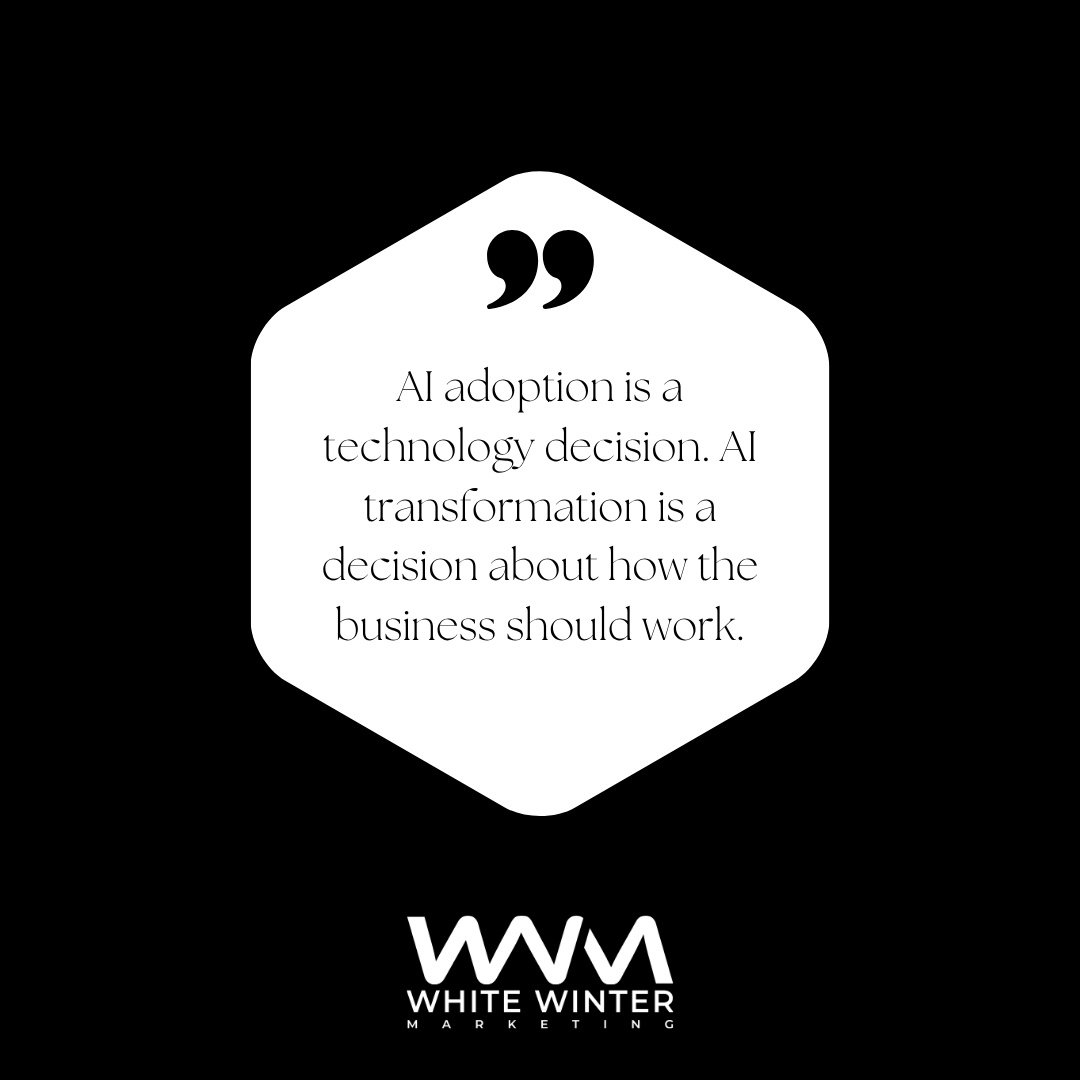
AI adoption is a technology decision. AI transformation is a decision about how the business should work.
For business leaders, the opportunity is not simply to deploy more artificial intelligence. It is to identify where the technology can improve a decision, remove an operational constraint or create a better way of delivering value.
What is artificial intelligence in business?
Artificial intelligence in business refers to the use of technologies that can interpret information, generate content, recognise patterns, make predictions or perform defined tasks to support organisational objectives.
Applications range from generative AI assistants and predictive analytics to machine learning systems, computer vision, natural language processing and agentic AI.
The appropriate technology depends on the problem.
A company that needs to summarise documents may benefit from a generative AI assistant. A business seeking to forecast demand may require predictive modelling. A manufacturer inspecting products on a production line may use computer vision. An organisation trying to coordinate several steps across a business process may consider workflow automation or an AI agent, subject to suitable controls.
These technologies are not interchangeable. Selecting a model before defining the operational problem can result in unnecessary complexity, avoidable expenditure and disappointing outcomes.
The first question should therefore be what the organisation needs to improve, not which AI tool it should purchase.
Five areas where artificial intelligence can create business value
1. Decision support and business intelligence
Businesses generate substantial volumes of information through financial systems, customer interactions, operational records, sales activity and market research. Yet information is useful only when people can interpret it in time to make decisions.
AI can help summarise reports, identify patterns, compare scenarios and make complex information easier to interrogate.
For example, a management team reviewing declining sales may use AI to organise customer feedback, compare performance across segments and identify questions requiring further investigation.
The output should not be mistaken for a verified explanation. A correlation in the data may not establish the cause of a business problem. Decision-makers must evaluate the evidence, test alternative explanations and account for information the system cannot access.
AI can reduce the effort required to investigate a problem. Responsibility for the decision remains with the organisation.
2. Customer service and experience
AI-powered systems can classify enquiries, retrieve information from approved knowledge bases, assist service representatives and handle selected routine interactions.
Their effectiveness depends heavily on the quality of the information available to them and the clarity of their operational boundaries.
A system that gives customers an incorrect answer with confidence can increase the workload it was intended to reduce. A chatbot that cannot recognise when a case requires human judgement may turn a simple interaction into a frustrating experience.
Businesses should therefore evaluate more than the number of automated conversations. Resolution accuracy, repeat contact rates, escalation quality, customer satisfaction and the handling of sensitive cases are equally important.
Automation is valuable when it improves the experience, not merely when it removes a human from the process.
3. Operations and workflow automation
Many operational inefficiencies arise from work passing between systems, teams and approval stages. Employees may repeatedly enter the same information, reconcile records, chase approvals or transfer requests between departments.
AI can assist with document processing, classification, information extraction and selected decisions within these workflows.
More advanced implementations can connect multiple steps, allowing an AI agent to retrieve information, initiate an approved action and report the result. However, actions involving money, customer commitments, compliance or operational safety require appropriate permissions, audit trails and escalation procedures.
The objective should be to improve the entire workflow rather than automate one step while preserving the delays around it.
4. Sales and marketing
Artificial intelligence can support customer research, demand forecasting, lead prioritisation, content production, account planning and sales enablement.
It can also help companies connect information from marketing, sales and customer service to identify recurring customer needs or changes in demand.
However, commercial performance depends on more than analytical capability. A sales team can identify more prospects without improving qualification. A marketing team can generate more content without becoming more distinctive. A forecast can appear precise while relying on incomplete historical data.
Businesses need to evaluate AI-enabled sales and marketing initiatives against relevant commercial measures, including conversion rates, customer acquisition costs, opportunity quality and revenue contribution.
5. Manufacturing, logistics and physical operations
Artificial intelligence also creates opportunities outside office-based work.
- In manufacturing, computer vision can support quality inspection, while predictive models can help identify equipment conditions associated with failure.
- In logistics, AI can assist with demand forecasting, route planning and inventory analysis.
- In facilities management, it can help interpret sensor data and identify unusual operating conditions.
These applications often combine AI with existing systems, including enterprise resource planning platforms, warehouse management systems, industrial sensors, connected devices and maintenance software.
The quality of the integration is critical. A predictive model that cannot access reliable equipment data, or whose alerts do not reach the maintenance team in time, may have limited operational value.
The commercial benefit emerges when information leads to an appropriate action.
Three roles AI can play inside a business
Business leaders can distinguish between three practical roles for artificial intelligence: assistant, workflow participant and decision-support system.
AI as an assistant
- AI helps an employee complete a task, retrieve information or prepare an analysis.
- An example is summarising a lengthy supplier report or preparing an initial analysis of customer feedback. The employee remains responsible for evaluating the result and deciding what to do with it.
AI as a workflow participant
- AI performs a defined step within a larger process, under specified rules and permissions.
- For example, a system may extract invoice data, validate required fields and route exceptions to an employee for review. Its performance depends on the quality of the source information, the reliability of the integration and the handling of exceptions.
AI as a decision-support system
- AI helps decision-makers evaluate options, identify patterns or prioritise actions using relevant evidence.
- An operations manager, for example, may use AI-supported analysis to prioritise maintenance inspections based on equipment condition and operating history. The recommendation should be evaluated against operational requirements and the consequences of an incorrect decision.
These roles can overlap, and the framework is intended as a practical way to assess an application rather than a formal taxonomy of AI systems.
A more autonomous system may perform multiple steps, but greater autonomy does not automatically mean greater business value. The appropriate level of autonomy depends on the consequences of error, the quality of the available data and the organisation’s ability to monitor and intervene.
The right measure of AI maturity is not how independently a system operates, but how reliably it contributes to a defined business outcome.
Why artificial intelligence projects struggle to deliver value
Poor data quality
AI systems are only as useful as the information available to them for a given task. Inconsistent records, outdated documents, duplicated entries and conflicting definitions can undermine otherwise capable technology.
Organisations should assess data quality, access permissions, ownership and update frequency before deploying applications that depend on internal information.
Technology without process redesign
Adding AI to a weak process can make the process faster without making it better.
If a business has unnecessary approvals, unclear responsibilities or duplicated work, automating those activities may preserve the original inefficiencies. Effective implementation requires examining which steps are necessary, which decisions can be improved and which responsibilities should change.
Unclear accountability
Businesses need to establish who owns the outcome, who approves consequential actions and who is responsible when an AI system produces an incorrect result.
This is particularly important in finance, hiring, customer commitments, regulated activities and safety-critical operations. Human oversight should be proportionate to the risk rather than applied as a generic final check.
Hidden costs
AI projects may involve more than subscription fees. Relevant costs include integration, data preparation, usage charges, testing, monitoring, security controls, staff training and ongoing maintenance.
A tool that performs well in a small demonstration may become expensive or unreliable at production scale. Business cases should account for the complete cost of operating the solution.
Productivity without economic impact
Time saved is a legitimate benefit, but its economic value depends on what happens next.
If employees save several hours a week but the organisation does not redeploy that capacity, improve service, reduce expenditure or increase output where demand exists, the financial impact may be limited.
This does not make productivity gains unimportant. It means businesses should distinguish between capacity created and value realised.
Research into enterprise AI increasingly highlights the importance of workflow redesign, leadership commitment and operational discipline alongside technology adoption. These are useful considerations when assessing an AI implementation strategy, although no single approach guarantees a positive return.
How businesses should implement artificial intelligence
An effective AI implementation strategy begins with a business problem and proceeds through a sequence of controlled decisions.
- Define the outcome. Identify the operational or commercial problem, the current baseline and the measure that will indicate improvement.
- Assess feasibility. Review data availability, integration requirements, security, regulatory obligations and the consequences of an incorrect output.
- Choose the right application. Determine whether a conventional software feature, rules-based automation, predictive model, generative AI system or AI agent is appropriate.
- Run a bounded pilot. Test the application on a defined use case, with clear success criteria and an appropriate level of human review.
- Evaluate the complete economics. Include implementation, operating, oversight and maintenance costs alongside the expected benefits.
- Scale with controls. Expand only after the application demonstrates acceptable performance, reliability and business value. Establish ongoing monitoring and a process for handling failures.
For Indian businesses, this process should also account for the existing technology environment, workforce capabilities, data governance requirements and implementation resources. An AI strategy suited to a large enterprise may be unnecessarily complex for a small or medium-sized business.
The most appropriate starting point is usually a specific, measurable problem with sufficient data and a manageable risk profile.
Artificial intelligence for small businesses versus large enterprises
Small businesses and large enterprises can both benefit from AI, but their implementation priorities differ.
| Consideration | Small and medium-sized businesses | Large enterprises |
| Initial priority | Solve a clear operational constraint | Coordinate value across functions |
| Technology approach | Focused tools and manageable integrations | Integration with enterprise systems and governance |
| Main resource constraint | Budget, specialist skills and implementation capacity | Complexity, fragmented systems and organisational coordination |
| Risk management | Clear permissions, verification and vendor assessment | Formal governance, access controls, auditability and cross-functional accountability |
| Scaling criterion | Demonstrable value with manageable operating costs | Reliable performance across multiple teams and use cases |
Neither group should adopt AI simply to match competitors. The investment should address a business requirement, fit the organisation’s capabilities and produce an outcome that can be evaluated.
How to measure artificial intelligence ROI
Businesses should assess the return on investment of AI through the outcomes relevant to each application.
| Measurement area | Examples |
| Productivity | Time saved, throughput, reduced manual effort |
| Quality | Error rates, rework, consistency and accuracy |
| Customer outcomes | Resolution time, satisfaction, repeat enquiries |
| Operational performance | Downtime, inventory accuracy, processing time |
| Financial impact | Operating costs, margin contribution, revenue and total cost of ownership |
The financial assessment should include the full cost of implementing and operating the system, not just the initial licence or development expenditure.
A useful business case distinguishes between estimated savings, capacity released and savings actually realised. It should also account for the possibility that an AI application creates new costs, risks or dependencies.
The objective is to establish whether the application improves the business enough to justify the investment.
Frequently asked questions about artificial intelligence for business
What is artificial intelligence used for in business?
Artificial intelligence is used for data analysis, customer service, document processing, forecasting, workflow automation, marketing, sales support, quality inspection and decision support. The best application depends on the business problem, available information and acceptable level of risk.
What are the main benefits of artificial intelligence for businesses?
Potential benefits include improved employee productivity, faster information processing, reduced repetitive work, better access to business insights and more consistent execution of selected workflows. Actual results vary by application, implementation quality and operating context.
How can a company start implementing AI?
A company should identify a specific problem, establish a baseline, assess data and security requirements, select a suitable application, run a controlled pilot and evaluate the total cost against the intended outcome. Successful pilots can then be expanded with appropriate governance.
Is artificial intelligence suitable for small businesses?
Yes. Small businesses can use AI for research, customer communication, document processing, content development, reporting and selected administrative workflows. The priority should be a manageable use case that addresses a real constraint rather than an extensive technology programme.
What are the risks of using artificial intelligence in business?
Risks include inaccurate outputs, privacy and security issues, biased decisions, unreliable integrations, unclear accountability, vendor dependence and costs that exceed the value delivered. Appropriate controls depend on the sensitivity of the information and the consequences of an error.
How should businesses measure AI ROI?
Businesses should compare implementation and operating costs with measurable outcomes such as time saved, error reduction, service quality, throughput, conversion rates, operating expenditure or revenue contribution. They should also distinguish between estimated benefits and benefits demonstrated in practice.
Conclusion: Business value is created by the system around the technology
Artificial intelligence is becoming a general-purpose capability across business functions. Its potential extends from individual productivity to the redesign of workflows, customer experiences and operational decisions.
But access to AI does not remove the need for sound management. Organisations still need reliable information, well-defined processes, accountable decision-makers and a credible way to measure results.
The businesses that benefit most will not necessarily be those deploying the largest number of tools. They will be those that identify where intelligence can improve an important decision or process, integrate the technology into the way work is performed and establish whether the resulting change justifies the investment.
Artificial intelligence can expand what a business is capable of doing. Management must determine which capabilities are worth building, where they belong and how their value will be demonstrated.