A DevSecOps platform can scan code, identify vulnerabilities, secure cloud infrastructure, monitor dependencies, automate compliance checks and integrate with existing development workflows.
The product may be technically sophisticated. The engineering team may have solved difficult problems. The platform may perform exceptionally well in production.
Yet the website often communicates very little of that value.
Instead, it presents a familiar list of capabilities:
- Continuous security
- Shift-left security
- AI-powered analysis
- Cloud-native protection
- Automated remediation
- CI/CD integration
- Developer-first workflows
- Risk-based prioritisation
These phrases may be accurate. They are also used by a large number of cybersecurity vendors.
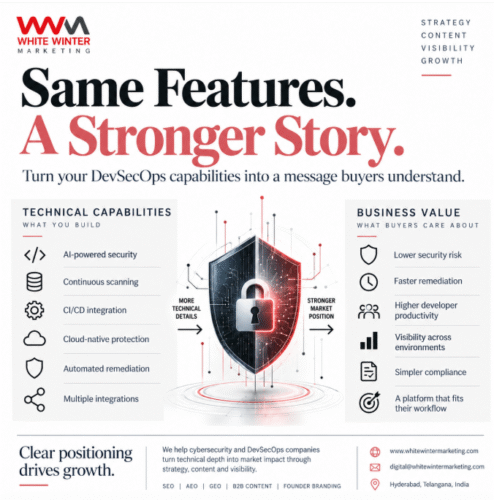
The problem is not that DevSecOps products are too technical to market. The problem is that their value is often buried beneath their capabilities.
The Feature-Density Problem in DevSecOps Marketing
Technical teams naturally describe products through architecture, functionality and performance. They understand the complexity behind every feature, so the product is often communicated in the same language in which it was built.
Buyers evaluate it differently.
A CISO may want to understand how the platform reduces exposure and supports risk prioritisation.
A security engineering leader may focus on detection quality, remediation workflows and operational visibility.
A developer may be concerned about false positives, workflow disruption and integration effort.
A CTO may evaluate scalability, implementation complexity and the platform’s effect on delivery velocity.
Procurement may ask about cost, vendor risk, support and commercial justification.
The product is the same. The buying questions are not.
When a website speaks only in technical language, it forces every audience to translate the product into business value independently.
Most buyers will not do that work.
What Is DevSecOps Platform Positioning?
DevSecOps platform positioning is the process of defining:
- Who the platform is built for.
- Which security or development problem it solves.
- Why that problem matters to the buyer.
- How the platform differs from competing approaches.
- What evidence supports its claims.
Positioning is not about removing technical depth or reducing a sophisticated product to vague marketing language.
It is about organising technical depth around the buyer’s priorities.
A product description may say:
An AI-powered DevSecOps platform that enables continuous application security across the software development lifecycle.
This establishes a category, but it does not create a compelling reason to continue reading.
A more buyer-oriented description might say:
A security platform that helps engineering and security teams prioritise actionable vulnerabilities and address them within the development workflows they already use.
The second statement connects capability with a recognisable operational problem.
It identifies a clearer audience, a more specific need and a practical outcome.
Technical documentation explains how a platform works. Positioning explains why it deserves consideration.
Product-Led Language Versus Buyer-Led Positioning
| Product-led communication | Buyer-led positioning |
| AI-powered DevSecOps platform | Helps teams prioritise actionable security risk |
| Continuous vulnerability scanning | Reduces time spent identifying which vulnerabilities need attention |
| CI/CD integration | Brings security into existing development workflows |
| Automated remediation | Helps teams move from detection to corrective action |
| Cloud-native security | Improves visibility across distributed cloud environments |
| Compliance automation | Reduces manual effort involved in preparing security evidence |
| Developer-first security | Supports adoption without unnecessary workflow friction |
| Multiple integrations | Connects with tools already used by security and engineering teams |
The first column describes capability. The second connects capability to a problem the buyer already understands.
That distinction should shape the entire cybersecurity product marketing strategy, from the homepage and solution pages to SEO content, founder branding and sales enablement material.
The Category Language Trap
Many cybersecurity companies use the language of the category instead of creating a distinctive position within it.
Their websites repeatedly use terms such as:
- Application security
- Cloud security
- Software supply chain security
- Vulnerability management
- Security orchestration
- Continuous compliance
- Developer security
- AI-powered protection
These terms are relevant to SEO for cybersecurity companies. Buyers use them when searching for solutions, and they should appear naturally across the website.
But category language alone does not create preference.
A vendor that describes itself only through broad industry terminology risks becoming interchangeable with its competitors.
The more important question is:
What specific problem does this company want to be known for solving?
A platform may be built primarily for organisations struggling with:
- Vulnerability overload
- Slow remediation cycles
- Disconnected security tools
- Poor visibility across cloud environments
- Security friction between development and security teams
- Compliance evidence collection
- Risk prioritisation across complex application estates
Each problem leads to a different positioning strategy.
A company focused on vulnerability prioritisation should not lead with the same message as a company focused on developer workflow automation.
A platform built for highly regulated enterprises should not communicate in the same way as a lightweight tool designed for fast-moving software teams.
Positioning begins when a company stops trying to represent the entire category and starts defining the part of the category it intends to own.
The Search-Intent Problem
A technically strong product can still struggle with search visibility when its content is organised around internal product terminology rather than buyer intent.
A website may contain pages for:
- Platform
- Features
- Integrations
- Architecture
- Resources
- Pricing
- Contact
That structure may reflect the company’s internal organisation. It does not always reflect how buyers research a solution.
A buyer may search for:
- How to reduce vulnerability remediation time
- Best tools for software supply chain security
- How to secure CI/CD pipelines
- DevSecOps platforms for regulated enterprises
- Alternatives to manual application security testing
- How to prioritise vulnerabilities across cloud environments
- How to integrate security into developer workflows
A stronger cybersecurity content strategy should therefore include:
- Problem-led pages: Pages focused on vulnerability prioritisation, application security automation, cloud visibility, security tool consolidation and remediation workflows.
- Use-case pages: Content explaining how the platform supports CI/CD security, software supply chain protection, secure cloud migration and compliance readiness.
- Audience-led content: Different explanations for CISOs, CTOs, security engineering leaders, DevOps teams, developers and procurement stakeholders.
- Evaluation content: Buyer’s guides, comparison pages, alternatives pages, implementation guides and security platform evaluation checklists.
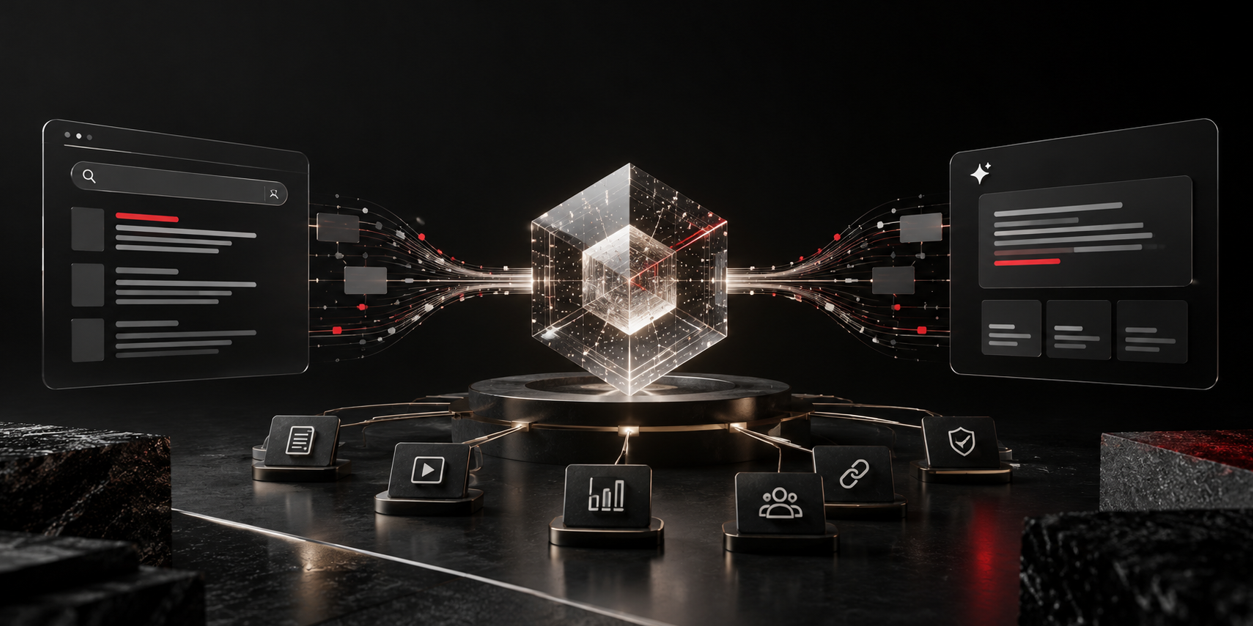
This is where SEO, AEO and GEO should work together.
- SEO, or Search Engine Optimization, improves discoverability for relevant search queries.
- AEO, or Answer Engine Optimization, helps the company answer specific buyer questions clearly and directly.
- GEO, or Generative Engine Optimization, supports visibility across AI-led search experiences by making the company’s expertise, terminology and evidence easier to interpret.
For cybersecurity companies, SEO, AEO and GEO should not operate as disconnected content activities.
They should be built around clear positioning, relevant buyer questions and credible evidence.
Search visibility can increase discovery. It cannot decide what your company should stand for.
The Proof Problem
Positioning creates a promise. Evidence determines whether the promise is credible.
A DevSecOps company may claim that its platform improves visibility, reduces risk or accelerates remediation. Those claims need support.
Useful proof includes:
- Customer case studies
- Documented implementation outcomes
- Before-and-after operational comparisons
- Product demonstrations
- Independent assessments
- Security architecture documentation
- Integration examples
- Customer interviews
- Detailed use-case narratives
A case study that says a customer “transformed its security posture” offers limited value.
A stronger customer story explains:
- What problem existed before implementation.
- Which teams were involved.
- What changed in the workflow.
- Which capabilities were used.
- What measurable improvement was observed.
- What implementation challenges had to be addressed.
The purpose of proof is not to manufacture impressive language.
It is to reduce uncertainty.
That matters particularly in cybersecurity, where buyers evaluate product functionality, implementation risk, operational consequences and vendor credibility together.
A Practical DevSecOps Positioning Audit
Before commissioning another series of blogs or launching another product campaign, review five areas.
- Category clarity
Can a visitor understand what category the product belongs to within a few seconds?
- Problem clarity
Does the website explain the specific problem the platform solves, or does it only list features?
- Audience clarity
Is the message relevant to the people involved in the buying decision?
- Differentiation
Could a competitor use the same homepage copy without making significant changes?
- Evidence
Are the product’s strongest claims supported by customer stories, implementation details or credible documentation?
If the answers are unclear, publishing more content may only increase the volume of unclear communication.
Frequently Asked Questions
Why do DevSecOps companies struggle with marketing?
Many DevSecOps companies describe their products through technical capabilities, integrations and architecture. Buyers also need to understand business impact, implementation effort, workflow implications and measurable value.
How can cybersecurity companies improve search visibility?
Cybersecurity companies can improve search visibility through technical SEO, problem-led content, solution pages, use-case pages, comparison content, customer evidence and executive thought leadership.
What is the role of AEO in cybersecurity marketing?
AEO helps cybersecurity companies answer specific buyer questions in a clear, structured and useful way. This includes questions about implementation, product evaluation, security workflows, compliance and operational impact.
What is GEO for cybersecurity companies?
GEO is the practice of improving how a company’s expertise and information can be understood across generative search experiences. It depends on clear terminology, useful content, credible sources, structured information and consistent positioning.
Does technical complexity make a DevSecOps product difficult to market?
Not necessarily. Technical complexity becomes a marketing problem when the product’s capabilities are not connected to a specific buyer, business problem and measurable outcome.
Technical Complexity Is Not the Enemy
A technically complex product does not need to be made simplistic.
It needs to be made intelligible.
A strong DevSecOps marketing strategy should communicate at several levels:
- The executive problem
- The security risk
- The operational workflow
- The technical mechanism
- The implementation process
- The evidence of impact
The message should become more detailed as the buyer moves closer to evaluation.
Your DevSecOps platform may be technically impressive. But if the market cannot quickly understand who it is for, what problem it solves and why it deserves consideration, that technical excellence remains trapped inside the product.
At White Winter Marketing, we help cybersecurity and DevSecOps companies strengthen product positioning, build buyer-led content systems, improve SEO, AEO and GEO visibility, and support cybersecurity demand generation through commercially relevant content.
Because the right buyers do not need more technical noise. They need a clearer reason to believe your product belongs on their shortlist. Talk to us to discuss your cybersecurity marketing challenges.