A B2B SaaS marketing strategy has to do more than generate website traffic or fill a sales pipeline.
Software buyers often research a problem before they identify a solution, evaluate several vendors before speaking to sales, and involve multiple stakeholders before a purchase is approved. Marketing therefore has to create visibility, explain the problem and solution clearly, establish credibility, support evaluation and create opportunities for sales.
That makes SaaS marketing fundamentally cross-functional. Positioning, product marketing, content, SEO, website strategy, founder-led marketing, demand generation and measurement need to reinforce the same commercial objective.
The starting point is not the marketing channel. It is the market the company intends to win.
Step #1: Define the market before choosing the channels
A SaaS company should first establish where it has the strongest opportunity to compete.
That requires more than defining an ideal customer profile. The strategy should examine the industries, company characteristics, use cases, buying roles, geographic markets and business problems that create the strongest fit for the product.
Several questions should be resolved before significant marketing investment begins:
- Which customer segments have the strongest product-market fit?
- What problem creates sufficient urgency to consider a solution?
- Who initiates the buying process?
- Who evaluates the product?
- Who controls the budget?
- Who can block the purchase?
- What alternatives do buyers currently use?
- What makes the product meaningfully different?
- What evidence supports those claims?
This matters because B2B SaaS purchasing is rarely a single-person decision. Different stakeholders may be looking for operational efficiency, technical compatibility, financial justification, security, implementation confidence or measurable business outcomes.
The marketing strategy therefore needs to reflect the buying committee, not just one persona.
Step #2: Positioning should precede content production
Content cannot compensate for unclear positioning.
Before scaling a blog, LinkedIn programme or paid campaign, a SaaS company needs a clear articulation of what it sells, who it serves, the problem it solves and why its approach is worth considering.
Consider the difference between:
AI-powered business automation platform
and a more specific proposition that identifies the customer, workflow and outcome it addresses.
The second gives marketing considerably more direction. It determines which audiences to target, which problems to discuss, which search terms to pursue, what the website should explain and what proof the sales team needs.
This creates a useful sequence:
Market → Positioning → Messaging → Content → Distribution → Conversion
When positioning continues to change during execution, the resulting content and campaigns tend to become fragmented. Product pages communicate one proposition, sales materials another, and thought leadership another.
Product marketing is therefore not separate from the SaaS marketing strategy. It provides much of the substance that marketing needs to communicate.
Step #3: Build the website around how buyers evaluate the product
The SaaS website is one of the most important assets in the marketing system because it sits between discovery and commercial evaluation.
A B2B SaaS website should explain the product, demonstrate its relevance, provide evidence, address objections and give qualified visitors a clear path towards the next step.
Its architecture should therefore connect product pages with relevant industries, use cases, integrations, capabilities, resources and customer evidence.
The objective is not simply to create more pages. It is to make the relationship between the company’s product, audience, problems and proof easy to understand.
The same architecture also creates the foundation for organic search. Search engines need to understand the subjects a website covers and the relationships between its pages. AI-powered search systems similarly benefit from clear, well-structured information and consistent descriptions of the company and its expertise.
SEO should therefore be considered during website planning rather than retrofitted after the site is launched.
Step #4: Build content around problems, products and business potential
A SaaS content strategy should not be reduced to publishing a predetermined number of articles each month.
The more useful question is:
Which topics can attract the right audience and create a credible path towards the product?
Ahrefs’ approach to SaaS marketing provides an important distinction here: product-led content connects the problem being researched with practical ways of solving it using the product or its capabilities. This can create awareness while also giving the reader a reason to consider the company.
For a B2B SaaS company, the content portfolio can include:
Problem-led content that helps buyers understand an operational or commercial challenge.
Solution-led content that explains approaches, technologies and methods for addressing that challenge.
Product-led content that demonstrates how the company’s product helps solve a relevant problem.
Evaluation content covering implementation considerations, integrations, comparisons, selection criteria and common objections.
Evidence-led content including case studies, original research, customer results and expert analysis.
These formats serve different purposes. A problem-led article may introduce the company to a prospective buyer who has not yet identified a vendor. An evaluation article can reach someone already comparing solutions. A case study can provide evidence when that buyer is assessing whether the vendor is credible.
The objective is not to force every reader towards a demo. It is to make the company’s expertise increasingly useful as the buyer moves closer to a commercial decision.
Step #5: Make SEO reflect commercial intent
SaaS SEO should not be measured by traffic volume alone.
The keyword strategy should identify the searches that matter to the business, including category, problem, use-case, industry, comparison and commercial queries.
Search intent is particularly important because the same broad topic can represent very different stages of evaluation. Ahrefs’ SaaS SEO guidance recommends distinguishing search intent and identifying organic competitors rather than assuming that direct business competitors are the only websites competing for visibility.
A SaaS SEO programme should therefore connect keyword research to:
- Product and solution pages
- Industry pages
- Use-case pages
- Comparison and evaluation content
- Educational content
- Case studies
- Conversion paths
Technical SEO remains fundamental. Crawlability, indexability, internal linking, canonicalisation, structured data and site performance all affect how effectively search engines can access and interpret the website.
But technical optimisation is the foundation, not the complete strategy.
The larger objective is to make the company discoverable for the problems and solutions that have commercial relevance.
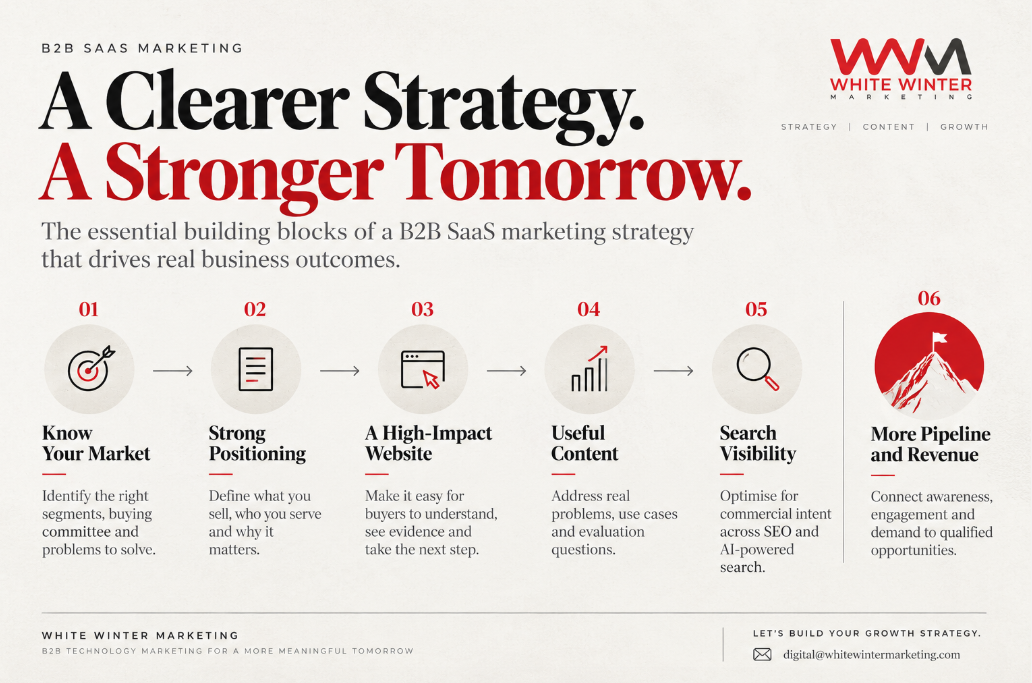
Step #6: Extend organic visibility into AI-powered search
The growth of AI-assisted search introduces another consideration for SaaS companies: how clearly can an external system understand and describe the company?
A strong foundation remains essential. The website needs clear information architecture, useful content and consistent descriptions of the company’s products, customers and expertise.
Content should also address specific questions and concepts rather than attempting to make one page rank for an indiscriminate collection of related terms.
Recent B2B guidance around AEO and GEO increasingly emphasises the importance of technically sound websites, customer-focused content, distinct sections that answer specific questions, credible third-party references and consistent brand information.
For SaaS companies, this means AI-search visibility should be approached as an extension of being genuinely useful and clearly understood, rather than as a separate publishing exercise.
The company should be able to establish consistently across its digital presence:
- What it does
- Who it serves
- Which problems it solves
- Which industries it understands
- What makes its approach different
- What evidence supports its expertise
That foundation is relevant to both traditional search and AI-mediated discovery.
Step #7: Use founder expertise where the company needs a human voice
For emerging B2B SaaS companies, the founder or senior leadership team can provide an additional source of market credibility.
Founder-led marketing works best when the executive has something substantive to contribute: observations from customers, product decisions, industry experience, implementation lessons, market analysis or a well-supported point of view.
The objective is not to publish personal content for its own sake.
It is to connect the company’s expertise with identifiable people who can explain the market, understand customer problems and communicate the thinking behind the product.
This can complement the company’s website and content strategy by giving prospective customers another way to evaluate the people behind the business.
Step #8: Treat demand generation differently from lead generation
Lead generation captures identifiable prospects.
Demand generation is broader. It creates awareness and preference among potential buyers before they are necessarily ready to complete a form or speak to sales.
That distinction is important for SaaS companies with longer buying cycles.
A prospective customer might discover a company through search, read an article, encounter a founder’s LinkedIn post weeks later, return to the website to evaluate a use case, review a customer story and only then request a conversation.
Marketing therefore needs to support both active demand and future demand.
SEO, content, LinkedIn, paid acquisition, email, events and outbound programmes do not need to operate as independent campaigns. They can distribute and reinforce the same positioning while serving different points in the buying process.
Step #9: Measure what moves closer to revenue
Traffic is useful as a diagnostic metric, but it is not the final measure of SaaS marketing performance.
A stronger measurement framework moves progressively closer to the commercial outcome.
At the visibility level, teams can monitor organic impressions, search visibility, branded and non-branded discovery and relevant AI-search signals where reliable measurement is available.
At the engagement level, they can assess meaningful website interactions, content consumption and returning visitors.
At the conversion level, they can measure enquiries, demo requests, trials, downloads and other defined conversion events.
At the commercial level, the more important measures are qualified opportunities, pipeline contribution, customer acquisition and revenue.
This distinction prevents marketing teams from optimising for the easiest number to increase. Recent B2B marketing guidance similarly emphasises moving beyond traffic and raw lead counts towards lead quality, pipeline and revenue.
Measurement also needs attribution discipline. A rise in organic traffic does not, by itself, demonstrate that SEO generated revenue. Website engagement does not automatically establish marketing causality. The quality of the measurement framework determines how confidently marketing can connect activity to business outcomes.
Step #10: Build an interconnected acquisition system
The objective of a B2B SaaS marketing strategy is not to maximise activity across every available channel. It is to build a coherent acquisition system in which each component performs a defined role.
Positioning gives the company a consistent market narrative. Product marketing provides the substance behind that narrative. The website gives buyers a place to understand and evaluate the product. Content expands the company’s reach across problems, use cases and buying questions. SEO makes those resources discoverable through relevant search demand. Founder-led marketing adds human expertise and perspective. Case studies provide evidence. Demand generation connects these assets with buyers before and during active evaluation.
Over time, these investments can reinforce one another. A strong case study can support sales, strengthen a product page and provide material for thought leadership. An authoritative article can attract search visibility while giving a sales representative a useful resource to share with a prospect. A clear product positioning framework can improve the consistency of website copy, content and executive communication.
This is what makes SaaS marketing strategic rather than simply channel-based. The goal is to create a body of positioning, content, evidence, search visibility and distribution that continues to support customer acquisition as the company grows.
Building your B2B SaaS marketing strategy?
At White Winter Marketing, we work with B2B technology companies on SaaS marketing strategy, SEO, AEO, GEO, content marketing, founder-led marketing, website strategy and demand generation.

If your marketing activities are growing faster than your underlying strategy, talk to WWM about building a more connected approach to positioning, visibility and demand generation.