When we talk about inspiring B2B marketing campaigns, the conversation usually moves towards clever creative, memorable advertising or impressive campaign numbers. SAP’s Inspire the Future is more interesting for a different reason. The campaign shows what can happen when a B2B brand changes the way it enters a conversation without losing sight of the business problem underneath it.
The campaign began in 2020, during the early months of the COVID-19 pandemic, when customers were dealing with unprecedented uncertainty. SAP recognised that many of its customers were focused on keeping their businesses operating. They were not necessarily receptive to conventional sales messaging or fear-driven communication.
So SAP took a different approach.
A simple exchange between two young boys, Abe and Eli, became the creative inspiration for Project Abe, externally known as Inspire the Future. The broader campaign used storytelling and visual content to capture buyer attention, humanise the SAP brand and connect industry business problems with positive outcomes and SAP solutions. SAP’s campaign submission describes it as a top-of-funnel initiative involving industries, lines of business, field marketing and industry business units.
One of its most distinctive expressions was The Retrofuturist Chronicles, an SAP podcast that turned enterprise technology conversations into fictional stories involving a 12-year-old girl named Miranda and her eccentric Aunt Natalie. The podcast was not simply entertainment. Its structure gave SAP a way to move from an imaginative story into real conversations about technology, innovation and industry challenges.
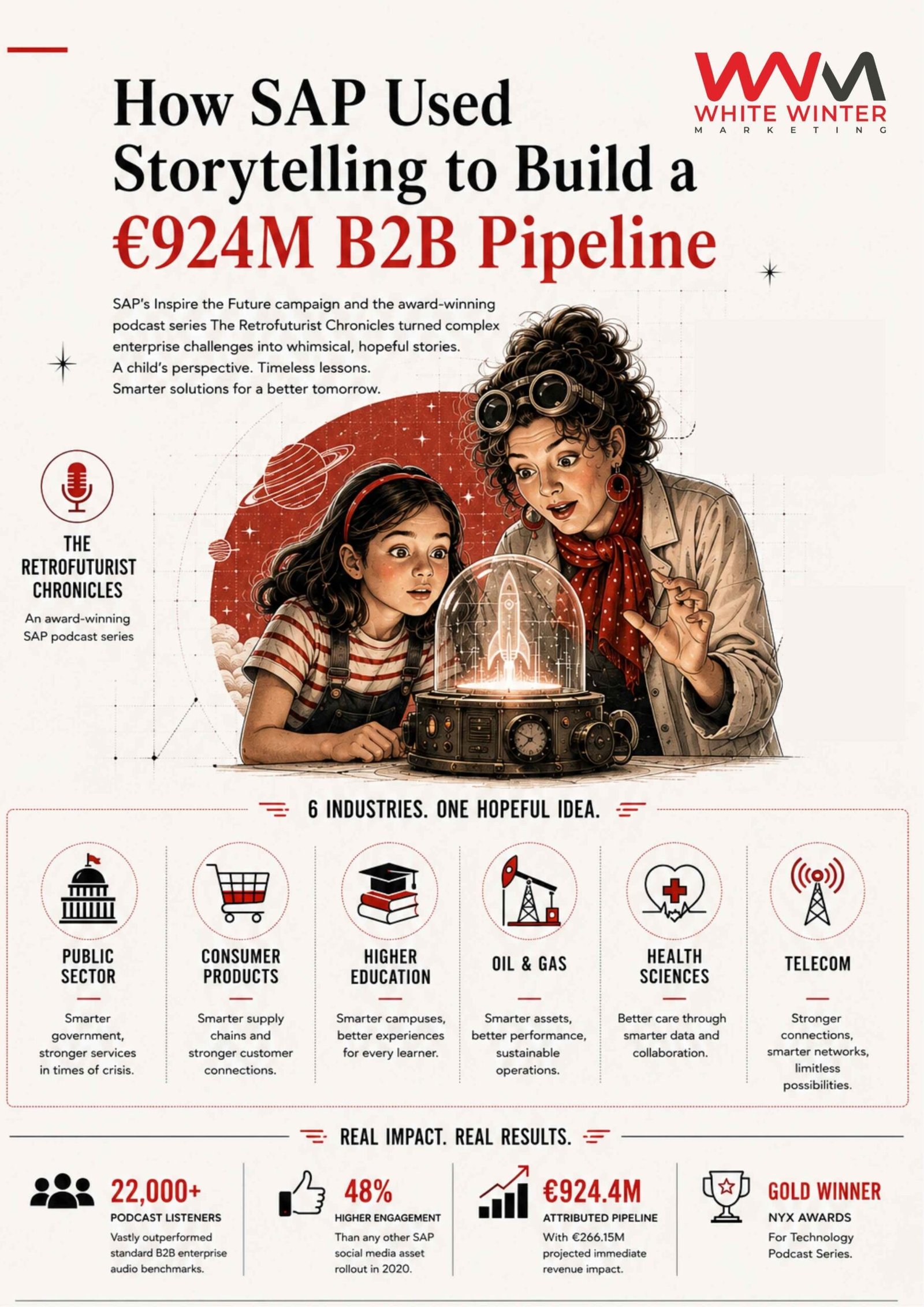
The broader campaign subsequently reported €924.4 million in pipeline and €266.15 million in projected revenue, alongside 22,000+ podcast listeners and 48% higher social engagement than SAP’s other social campaigns in 2020. These figures should be understood as campaign-level results rather than pipeline directly attributable to the podcast alone.
That distinction is important.
The real lesson is not that SAP made a podcast and generated €924 million.
The lesson is how SAP built a content and demand system around a distinctive narrative.
The Strategy: Abe and Eli, not a podcast
The creative origin of Inspire the Future was surprisingly simple.
Abe, a seven-year-old boy, wrote a letter to his best friend Eli, hoping that they could play together soon. Eli responded with a drawing of his new LEGO “rocit” set, described as “837-pecis,” and told Abe that he missed him.
For SAP’s campaign team, the exchange offered a striking contrast to the communication environment around them.
Email inboxes and social channels were increasingly filled with negative and fear-based messages. Businesses were dealing with uncertainty, disruption and rapidly changing circumstances. SAP’s customers needed support, but they did not necessarily need another company telling them what they should be afraid of.
The team saw inspiration in the simplicity of the children’s perspective.
SAP’s campaign submission explains that this became the basis for Project Abe, which was designed to engage prospective buyers through creative storytelling and visuals while addressing real business pain points. The campaign was intended to be future-facing, relatable and hopeful.
This is an important starting point for understanding the campaign.
SAP did not begin with a content format. It began with an audience insight.
The podcast came later.
From Project Abe to Inspire the Future
Project Abe was externally known as Inspire the Future.
It was structured as a go-to-market partnership involving SAP’s industries and lines of business, field marketing and industry business units. The business pains were identified by industry marketing directors in partnership with the relevant industry business units.
Six industries were included in the pilot:
- Consumer Products
- Oil & Gas
- Higher Education
- Public Sector
- Health Sciences
- Telecommunications
SAP says the industries were selected based on pipeline and revenue opportunity, competitive market data relating to projected recovery timelines, regional market support and IBU support.
This makes the campaign much more interesting than a creative exercise.
There was a commercial framework underneath the storytelling.
The campaign had a creative idea.
The industry teams identified the problems.
The content created the conversation.
And SAP’s expertise provided the connection back to technology and business outcomes.
The Retrofuturist Chronicles: where the storytelling became a content platform
The podcast gave the campaign its most distinctive creative expression.
The Retrofuturist Chronicles centres on Miranda, a 12-year-old girl, who is bright and curious but feels constrained by her age. Each episode begins with a concern in Miranda’s life. Her eccentric, retrofuturist Aunt Natalie then responds with an extraordinary story.
Aunt Natalie’s stories are intentionally absurd.
They ignore conventional boundaries of time, place, logic and even the laws of physics. Historical people and events appear alongside fictional situations, creating stories that feel simultaneously familiar and impossible.
But the structure is carefully designed.
After Aunt Natalie’s story, SAP’s Helen Dwight provides commentary that separates the fictional elements from the real historical and technological ideas. SAP futurist Martin Wezowski and VP of Industries Pradeep Amladi then explore the future of innovation, industry by industry.
The sequence looks roughly like this:
Miranda’s problem → Aunt Natalie’s story → historical or technological idea → SAP commentary → industry expertise
That is the core storytelling mechanism.
SAP did not simplify enterprise technology into children’s language.
It used a child’s perspective to create a more accessible entry point into complicated business conversations.
Miranda was the customer. Aunt Natalie was SAP.
There is an even deeper layer to the creative architecture.
The award documentation for the podcast describes the relationship between Miranda and Aunt Natalie as an allegorical one, with Miranda representing the customer and Aunt Natalie representing SAP’s ability to approach problems through innovation.
That makes the characters more than storytelling devices.
Miranda encounters a problem.
The problem initially feels bigger than her ability to solve it.
Aunt Natalie does not immediately present a product.
She tells a story.
The story changes Miranda’s perspective.
Then the podcast moves into the real business and technology conversation.
This is an unusually effective way to position an enterprise technology brand because the audience is not asked to accept SAP’s solution before understanding the problem.
The problem comes first. The expertise follows. The solution becomes relevant later.
That is a useful principle for B2B marketers.
Why retrofuturism was the right creative territory
The title The Retrofuturist Chronicles was not arbitrary.
Spotify describes retrofuturism as an exploration of the future as seen from the past, the past as seen from the future, and the nostalgia for periods when innovation was viewed with romance and optimism. The series connects that idea to the belief that the future is in the hands of today’s youth.
That gave SAP an unusual creative territory.
Instead of talking about the future through conventional technology language, it could explore the future through imagination.
Instead of saying that innovation would transform industries, it could tell stories about improbable inventions and extraordinary historical events.
Instead of presenting uncertainty as something to fear, it could approach the future with curiosity.
That was particularly relevant during the pandemic.
The campaign was created at a time when business communication was already saturated with uncertainty. SAP deliberately chose a more hopeful tone. Its campaign submission describes the objective as humanising the SAP brand and appealing to the emotional effects on purchasing behaviour and brand preference.
Six industries, one storytelling framework
The campaign did not use storytelling as a generic brand exercise.
The same narrative architecture was adapted to different industry conversations.
Public Sector
Episodes such as Tapped Out use Miranda’s own feeling of being overwhelmed as the starting point for a story about a crisis affecting an entire community. The discussion then moves towards how governments and agencies can become more effective in delivering constituent services.
Consumer Products
In Direct-to-Penguin Sales, Miranda’s interest in becoming a social media influencer leads Aunt Natalie into a bizarre Antarctic rescue story. The episode ultimately connects to online shopping, social media and how consumer products companies build lasting customer relationships.
Higher Education
The higher education episodes use familiar situations involving school, learning and personal challenges as entry points into broader questions around institutional innovation and the changing experience of higher education. The series included dedicated higher education episodes such as Crises and All That Jazz.
Oil & Gas
Oil and Water begins with Miranda worrying about the environmental impact of oil and gas. Aunt Natalie responds with a fantastical story about alternative energy, before the discussion moves towards innovation, efficiency and procurement in the oil and gas industry. Lost Memories and Other Oxymorons similarly uses a missing object as a bridge to enterprise asset management and real-time insights.
Health Sciences
The health sciences content uses personal and medical situations to introduce wider conversations around data, collaboration, patient experiences and the role of technology in healthcare.
Telecommunications
The telecommunications component brought the same narrative approach into questions around connectivity, networks and the changing technology infrastructure behind communication.
The important point is not the individual episode themes. It is the architecture.
One creative platform could support six different industry conversations without becoming six unrelated campaigns.
That is highly relevant for enterprise and SaaS marketers working across multiple verticals.
Content Marketing Campaign for SaaS Product
SAP is a much larger enterprise technology company than a typical SaaS business, but the underlying content marketing and content model is highly transferable.
A SaaS company does not necessarily need to create a fictional podcast.
It could build a narrative around a major change affecting its market, a recurring customer problem or an emerging industry question.
That central idea could then become a series of:
- Expert-led articles
- Customer stories
- Research reports
- LinkedIn content
- Executive commentary
- Video
- Podcasts
- Webinars
- Sales enablement assets
The value comes from the connection between them.
Instead of producing individual pieces of content, the company creates a content platform around an idea.
That is what SAP did particularly well.
The podcast was one expression of the idea. The wider Inspire the Future campaign extended across other formats and industry-specific assets.
Creative Social Media Campaign Boosts Sales
The social component of Inspire the Future is worth examining because it demonstrates the difference between engagement and demand.
SAP reported 48% higher social engagement than its other social campaigns in 2020. The podcast attracted more than 22,000 listeners, and industry-specific YouTube videos generated more than 10,000 views within 30 days.
Those figures show that the campaign succeeded at earning attention.
But the reported €924.4 million pipeline should not be described as a direct result of social media or the podcast.
The figure relates to the broader campaign.
That distinction is essential when evaluating B2B marketing performance.
Social engagement can indicate that the creative idea resonated.
Podcast listeners can demonstrate that people were willing to spend time with the content.
Industry-specific content can create relevance.
Pipeline indicates that the broader marketing program was connected to commercial opportunity.
These are related signals, but they are not interchangeable.
The €924.4M pipeline needs context
The most attention-grabbing number associated with the campaign is undoubtedly the reported €924.4 million pipeline, alongside €266.15 million in projected revenue.
But this is exactly where a B2B case study needs to be careful.
It would be inaccurate to write:
“SAP’s podcast generated €924 million in pipeline.”
The more defensible statement is:
SAP reported €924.4 million in pipeline and €266.15 million in projected revenue for the broader Inspire the Future campaign.
The campaign included the podcast as well as other content and marketing activities.
This distinction does not weaken the case.
It actually makes the case more useful.
It shows that creative storytelling can sit at the top of a much broader demand-generation system rather than being expected to perform like a direct-response asset.
The campaign’s reported results included:
22,000+ podcast listeners
48% higher social engagement
10,000+ views for industry-specific YouTube videos within 30 days
€924.4M reported pipeline
€266.15M projected revenue
These figures come from published campaign accounts and should be understood in the context of the broader Inspire the Future program.
Content Marketing and SEO Strategy
There is an interesting modern lesson here for companies thinking about search, AEO and GEO.
Inspire the Future was created in 2020, before Answer Engine Optimization (AEO) and Generative Engine Optimization (GEO) became common terms in B2B marketing. It would therefore be inaccurate to describe the original campaign as an AEO or GEO strategy.
The underlying principle, however, remains relevant.
A B2B company that only publishes product pages gives search engines and AI systems information about what it sells.
A company that consistently publishes useful information around its industry, customer problems, expertise, perspectives and solutions creates a much richer body of information around its brand.
That matters in today’s discovery environment.
B2B buyers may encounter a company through Google, LinkedIn, an industry publication, YouTube, a podcast, an AI answer engine or a recommendation from another professional.
A strong content ecosystem gives the brand more opportunities to be discovered and understood across those environments.
The goal is not to create content “for AI.”
It is to create content that is sufficiently specific, authoritative, useful and well structured that both people and discovery systems can understand what the company knows.
That is where AEO and GEO become extensions of a broader authority-building strategy rather than isolated technical exercises.
What makes this one of the more interesting B2B brand storytelling examples?
The obvious answer is creativity.
I think the more important answer is alignment.
The creative idea aligned with the emotional environment.
The industry selection aligned with commercial opportunity.
The stories aligned with business problems.
The expert commentary aligned with SAP’s expertise.
The content formats aligned with distribution.
And the broader campaign aligned with pipeline objectives.
That is why the campaign did not feel like a piece of branded entertainment sitting separately from marketing.
The story had a job to do.
The campaign was human without becoming vague
One of the challenges in B2B storytelling is that marketers sometimes confuse “human” with “less specific.”
SAP avoided that.
The emotional layer was deliberately simple.
Two children.
A curious girl.
An eccentric aunt.
Absurd stories.
Hope.
But once the audience was engaged, the campaign became specific about industries and business problems.
Consumer products.
Public services.
Higher education.
Oil and gas.
Health sciences.
Telecommunications.
That combination matters.
The emotion opened the door. The expertise gave the conversation substance.
This is one of the clearest lessons from the campaign for B2B marketers.
The campaign also demonstrates why brand and demand should not be treated as opposites
B2B marketing discussions often separate brand building from demand generation as if they were competing activities.
The SAP case is more nuanced.
Inspire the Future was explicitly designed as a top-of-funnel campaign to humanise SAP, influence mind-share and brand preference, and connect business pain points with positive outcomes and SAP solutions.
The podcast helped create attention and engagement.
Industry content created relevance.
Expert conversations established authority.
The broader campaign created commercial opportunities.
That is a more realistic view of how B2B demand is built.
A prospect does not necessarily move from “I have never heard of this company” to “I want a sales call” because of one asset.
There are usually several stages between those two points.
Storytelling can play a role in that progression.
What SaaS marketers can learn from SAP
Start with an audience insight, not a content format
SAP did not begin by asking whether it should create a podcast. It recognised that its audience was experiencing a particular emotional and commercial reality. That insight shaped the communication strategy.
Create a narrative strong enough to travel across formats
A good campaign idea should not depend on one channel. It should be capable of becoming articles, video, social content, executive commentary, audio and sales enablement.
Make the creative idea relevant to the business
The storytelling would have been much less valuable if it had remained disconnected from SAP’s industry expertise. The stories eventually led somewhere. They led to real conversations.
Give experts a role in the story
The SAP experts did not replace the creative narrative. They completed it. This is particularly relevant for founder-led and executive-led B2B marketing, where expertise is often the strongest differentiator a company has.
Build around problems rather than products
The campaign did not lead with product features. It led with situations. The technology conversation followed.
That sequence is worth considering for SaaS companies whose marketing has become too feature-heavy. Measure the broader system
The campaign’s reported metrics demonstrate why different stages need different measurements.
Listeners measure consumption. Engagement measures resonance.Video views measure attention.
Pipeline measures commercial opportunity. Projected revenue provides another layer of commercial context.
No single number tells the entire story.
Why this creative B2B marketing campaign still matters
The circumstances that created Inspire the Future were unusual, but the underlying marketing challenge has not disappeared.
B2B audiences are still exposed to enormous amounts of content.
Technology companies still use similar language to describe their products.
Marketing teams still need to create differentiation without losing commercial relevance.
And buyers now discover information across more channels than ever.
That makes the central lesson from SAP particularly relevant.
You do not always need to say something more loudly. Sometimes you need to find a more interesting way into the conversation.
SAP used a child’s perspective to create that opening.
It used retrofuturist storytelling to make the conversation distinctive.
It used industry expertise to make the conversation relevant.
And it connected the broader campaign to commercial objectives.
What is the real storytelling technique SAP used?
If I had to reduce the campaign to one strategic principle, it would be this:
SAP did not use storytelling to hide the business message. It used storytelling to earn the audience’s attention before introducing the business message.
That is a significant difference.
The audience first encounters Miranda’s problem.
Aunt Natalie gives them a story.
The story creates curiosity.
SAP then explains the real idea behind the fiction.
Industry experts provide context.
The business problem becomes clearer.
And SAP’s expertise becomes relevant.
That is why this is more than one of the best B2B marketing campaigns to admire for its creativity.
It is a useful example of how a B2B brand can design a communication journey.
What I would take from SAP as a B2B marketer
There is a temptation to look at The Retrofuturist Chronicles and conclude that B2B brands simply need to become more creative.
I think the lesson is more practical.
Creativity becomes more valuable when it solves a communication problem.
SAP had an audience dealing with an extraordinary situation.
It had an industry portfolio that needed to remain commercially relevant.
It had complex technology to communicate.
And it had to compete for attention in an environment dominated by uncertainty.
The solution was not to simplify SAP’s expertise.
It was to change the context in which that expertise was introduced.
That is what makes Inspire the Future such an instructive case for B2B marketing.
The campaign began with a human insight.
It developed a distinctive storytelling mechanism.
It adapted that mechanism to six industries.
It brought real experts into the conversation.
And the broader program was connected to measurable commercial outcomes.
The story created the attention. The expertise created the authority. The broader marketing system created the commercial opportunity.
That is a model worth studying, particularly for B2B SaaS companies trying to build demand without sounding like every other company in their category.

At White Winter Marketing, we think beyond the next content piece
At White Winter Marketing, we look at B2B SaaS marketing as a connected system rather than a publishing calendar.
As a SaaS marketing agency, we work with B2B technology companies on content strategy, SEO, AEO, GEO, website strategy, executive branding and demand generation.
As a branding partner for B2B SaaS companies, we help founders and leadership teams develop a distinctive market position and build content ecosystems that reinforce what the company should be known for.
The question we start with is not simply:
“What should we publish next?”
It is:
“What should the market remember us for, and what can we consistently create to prove that expertise?”
That is ultimately what I find most valuable about SAP’s Inspire the Future campaign.
It did not make enterprise technology less serious.
It found a more human way to make people interested in taking the conversation seriously.
Sources and factual references
- SAP’s Inspire the Future campaign submission, including the Abe and Eli origin story, Project Abe structure, six-industry pilot and top-of-funnel objectives.
- SAP’s The Retrofuturist Chronicles podcast description and episode material.
- 2021 MUSE Creative Awards, The Retrofuturist Chronicles, Gold Winner, Audio / Podcast.
- 2021 Webby Awards, The Retrofuturist Chronicles, Technology Podcast Honoree.
- Campaign performance figures reported in published campaign analysis, including 22,000+ listeners, 48% higher engagement, €924.4M pipeline and €266.15M projected revenue.
- Michelle Schooff’s published awards record, which distinguishes the MUSE Gold recognition from other campaign awards.