SEO growth is rarely about one ranking or one traffic spike. For a B2B technology company operating in a competitive category, the larger objective is to build a search presence that consistently puts the business in front of people looking for relevant solutions.
That was the challenge we worked on with an AI-powered B2B learning and workforce development platform.
The platform helps organizations address modern workforce learning and development requirements through areas such as AI-powered learning, skill development, personalized learning, sales enablement and workforce intelligence.
The initial GSC data gave us a clear baseline.
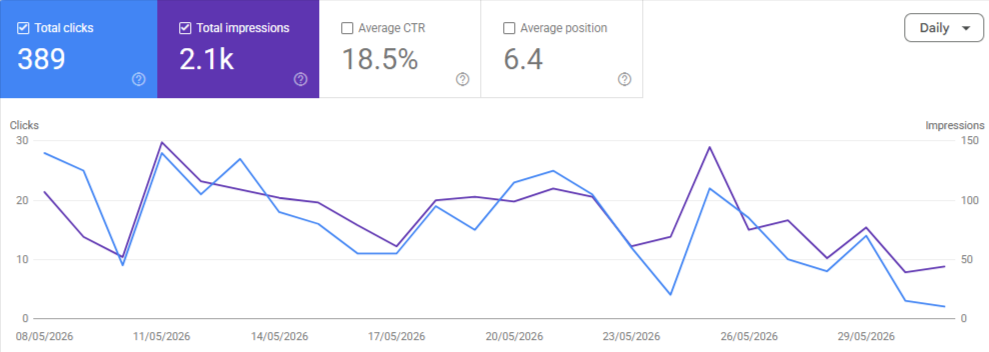
In May, the website recorded:
- 389 Google Search clicks
- 2.1K search impressions
- 18.5% average CTR
- 6.4 average position
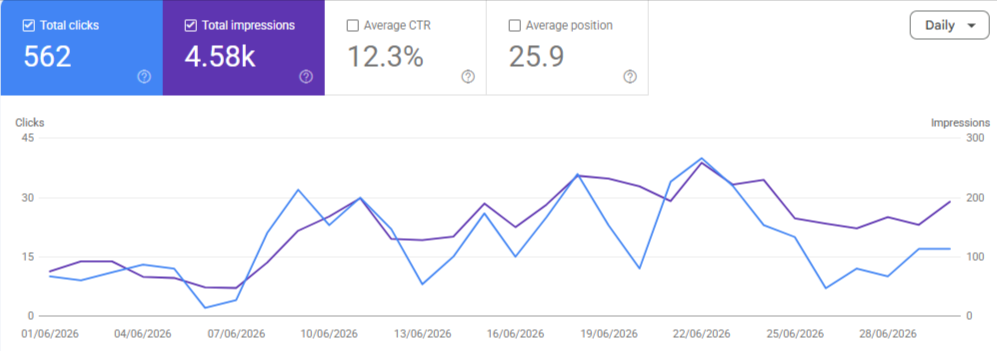
By June, the search footprint had expanded significantly.
The Challenge
The client operated in a category where the audience does not necessarily search for a single product.
Enterprise learning and workforce development involve multiple needs, including training, skill development, employee engagement, sales readiness, learning management and workforce performance.
This creates a broader SEO challenge.
The website needs to become discoverable across the problems and information needs surrounding the category, rather than relying only on branded or highly commercial searches.
Our focus was therefore on strengthening the website’s organic search presence and creating more opportunities for relevant users to discover the platform.
The Results
The clearest movement came between May and June.
| Google Search Metric | May | June | Growth |
| Clicks | 389 | 562 | 44.5% |
| Impressions | 2.1K | 4.58K | 118.1% |
| CTR | 18.5% | 12.3% | -6.2 pp |
| Average position | 6.4 | 25.9 | See context below |
The headline result was the 118.1% increase in search impressions.
The website moved from approximately 2,100 monthly impressions to 4,580, more than doubling its visibility in Google Search.
Clicks increased from 389 to 562, a 44.5% increase.
Why the Change in Average Position Matters
At first glance, the movement from an average position of 6.4 in May to 25.9 in June may appear negative. It needs context.
When a website begins appearing for a substantially broader set of search queries, impressions can rise sharply while the average position changes because the site is now being surfaced across a wider range of rankings.
In this case, impressions more than doubled while clicks also increased. That tells us that the website’s search footprint expanded considerably.
July provides another useful data point.
The website recorded:
- 3.46K impressions
- 376 clicks
- 10.9% CTR
- 22.4 average position
July impressions remained approximately 65% above May’s level, while average position improved from June’s 25.9 to 22.4.
We therefore look at the three-month movement rather than treating June as an isolated spike.
Organic Search Became a Meaningful Acquisition Channel
Google Search Console tells us how the website performed in search. Google Analytics tells us what happened after users arrived.
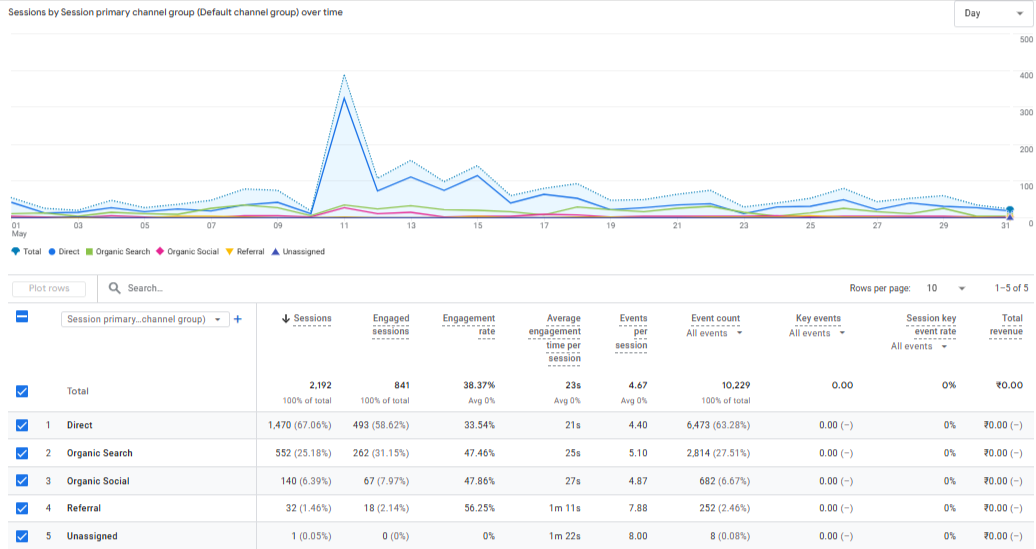
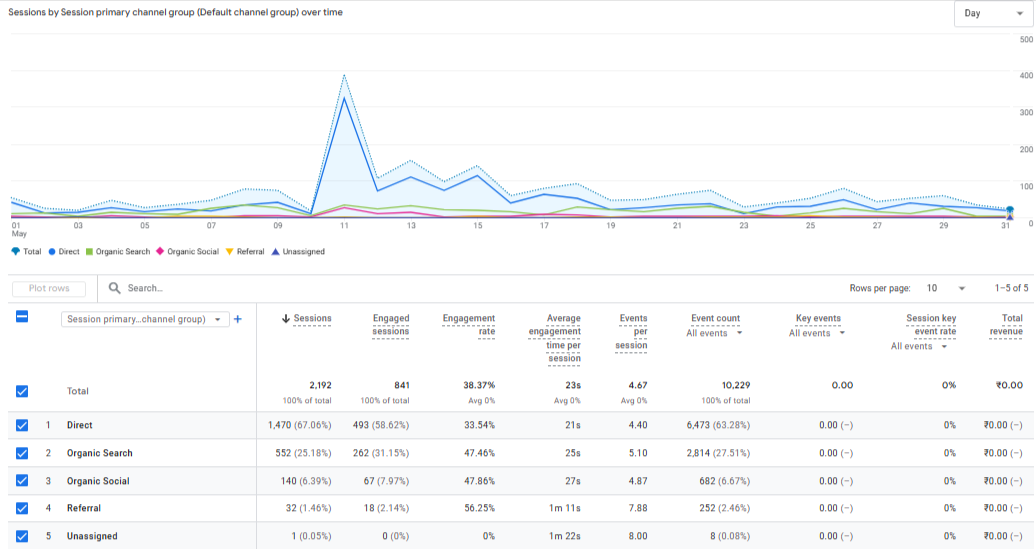
The supplied GA report shows 1,856 total users, of which 441 came through Organic Search, representing 23.77% of users in the reported period.
The Traffic Acquisition report shows:
- 2,192 total sessions
- 552 Organic Search sessions
- 25.18% of total sessions from Organic Search
- 47.40% engagement rate for Organic Search
For comparison, Direct traffic represented 67.89% of sessions with a 33.54% engagement rate in the same report.
This gives the SEO story another dimension. The objective was not simply to make the website appear more often.
Organic Search was becoming a meaningful source of website acquisition.
What We Focused On
The performance data clearly demonstrates the outcome, but the supplied project documentation does not contain a complete record of every SEO execution activity, such as the exact keyword set, number of articles published, technical fixes or backlink activity.
We therefore do not want to manufacture a list of tactics simply to make the case study look more comprehensive.
What the data does support is the outcome of the SEO program:
Greater search visibility → increased search clicks → meaningful organic acquisition → measurable website engagement
That is the story we can substantiate.
The Three-Month SEO Trend
Rather than focusing on one monthly result, the GSC data shows the broader movement.
May: 2.1K impressions 389 clicks
June: 4.58K impressions 562 clicks
July: 3.46K impressions 376 clicks
July’s impression level remained substantially above May, even after the June peak.
This is important because SEO performance should generally be evaluated through directional growth over time, not by expecting every month to exceed the previous month.
What the Results Tell Us
There are three numbers that stand out from this SEO case study.
- 118% Increase in Google Search impressions from May to June.
- 5% Increase in Google Search clicks from May to June.
- 18% Share of reported sessions coming from Organic Search in the supplied GA traffic acquisition data.
Together, these numbers demonstrate an expansion in organic search visibility and a meaningful contribution from search to website acquisition.
Why This Matters for a B2B Technology Company
B2B technology buyers rarely begin their research with a company’s name.
They search for problems.
They search for categories.
They compare approaches.
They look for information before they are ready to speak to a vendor.
For a technology company operating in an emerging category such as AI-powered workforce learning, this makes organic search particularly valuable.
The website needs to participate in the research journey, not simply appear when someone already knows the brand.
That is where SEO becomes more than a traffic channel. It becomes a market visibility channel.
SEO Is Not Just About Rankings
One of the easiest ways to oversimplify SEO is to reduce it to keyword positions.
We look at a broader sequence:
Visibility: How often is the website appearing?
Discovery: Are people clicking through from search?
Acquisition: Is Organic Search bringing meaningful users and sessions?
Engagement: Are those users engaging with the website?
Business Impact: Can that organic presence eventually support demand and pipeline?
The engagement data gives us visibility into the first four stages. The supplied data does not establish a direct SEO-to-revenue attribution, so we would not claim one.
That distinction is important.
A good case study should demonstrate what the data proves, not what we would like the data to prove.
The WWM Approach
At White Winter Marketing, we approach SEO differently from a simple traffic-generation exercise.
For B2B SaaS and technology companies, search visibility needs to work alongside content, positioning, website experience and demand generation.
The objective is to build a search presence around the questions and problems that matter to the target audience.
That means looking beyond:
“How do we rank for this keyword?”
and asking:
“How do we become visible when our potential customer is researching this problem?”
That shift changes how we think about SEO strategy.
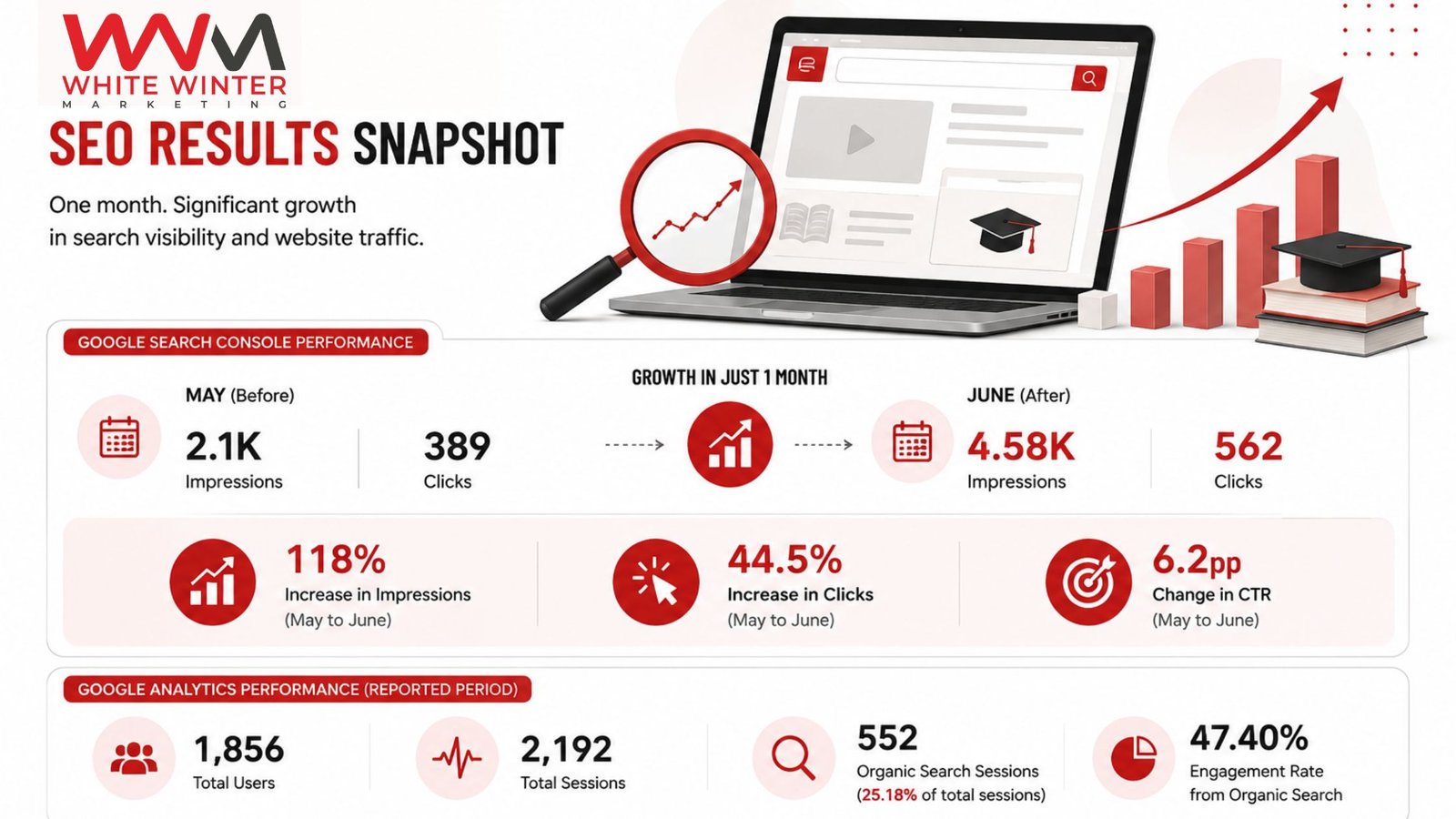
The Outcome: From 2.1K to 4.58K Search Impressions in One Month
Over the three-month period captured in the project data, the website demonstrated a significant expansion in organic search visibility.
From May to June:
Search impressions increased 118.1%.
Search clicks increased 44.5%.
In July:
Search impressions remained approximately 65% above May’s baseline.
And from the GA data:
Organic Search contributed 25.18% of reported sessions.
For us, these numbers represent something more meaningful than a traffic spike.
They show the early stages of building search visibility for a B2B technology brand.
The WWM Perspective
SEO works best when it becomes part of the company’s larger market presence.
For B2B SaaS and technology companies, that means connecting:
SEO + Content + AEO + GEO + Website + Brand Positioning + Demand Generation
Search is changing. People are discovering companies through Google, LinkedIn, AI search and answer engines. Building visibility therefore requires more than publishing articles and tracking rankings.
It requires a clear understanding of what the market is searching for, how buyers evaluate solutions and what the company should be known for.
That is the approach we bring to our work at White Winter Marketing.
We don’t just help B2B technology companies get traffic.
We help them build search visibility that contributes to market authority.
Case Study Snapshot
Client: B2B AI-powered learning and workforce development platform
Focus: Organic Search Growth
Measurement period: May to June
Key result: 118% increase in Google Search impressions from May to June
Click growth: 44.5% from May to June
Organic Search contribution: 25.18% of reported sessions
SEO Agency: White Winter Marketing
Services: SEO | Content Marketing | AEO | GEO | B2B SaaS Marketing
Note on methodology: Results and percentages in this case study are calculated from the GSC and GA screenshots supplied for the project. The GSC report provides May, June and July performance, while the GA report provides the user and traffic acquisition snapshots included in the source document.
Schedule a consultation with us for SEO requirements. Email: digital@whitewintermarketing.com