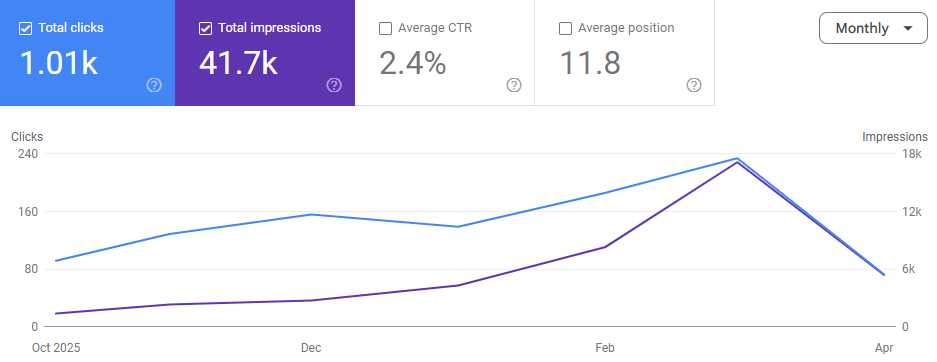
An India-based inventory and asset management SaaS provider partnered with us to improve organic visibility, generate qualified enterprise demo requests, and increase visibility in AI-powered search experiences. Within six months, we transformed a low-visibility website into an authority that ranked in Google AI Overviews and significantly improved enterprise pipeline performance.
Key Results in 6 Months
| Metric | Result |
| Qualified B2B demo requests | 100% increase |
| Google AI Overview ranking | #1 for “barcode scanners India” |
| Top-performing keywords | 50+ keywords in Top 5 |
| AI search visibility | 3× increase across Perplexity and ChatGPT |
| Cost per qualified demo | 62% reduction compared to LinkedIn Ads |

Client Overview
The client is a Pune-based $15M ARR provider of inventory management, warehouse automation, and asset tracking solutions.
Their portfolio includes:
- Warehouse Management Systems (WMS)
- Inventory Management Software
- RFID Solutions
- Industrial Barcode Scanners
- Rugged Mobile Computers
- Barcode Label Printers
The company also supplies enterprise hardware from brands such as CipherLab and TSC, helping manufacturing and logistics businesses improve operational efficiency through real-time visibility and automation.
Typical enterprise deal sizes exceeded $50,000 ACV.
Business Objectives
The engagement focused on three primary goals:
- Rank for high-intent commercial keywords including “barcode scanners India” and “AIDC solutions.”
- Establish authority within warehouse automation and industrial mobility.
- Generate qualified enterprise demo requests through organic search instead of relying on paid campaigns.
Challenges Before SEO
Despite having a mature product portfolio, the company struggled to attract enterprise buyers organically.
Limited Organic Visibility
High-intent commercial keywords such as:
- Industrial barcode scanners
- Warehouse inventory software
- AIDC solutions Pune
generated fewer than 10 impressions per day, while competitors dominated both traditional search results and AI-generated answers.
Missing Buyer-Focused Content
The website lacked educational content for procurement teams, IT leaders, and operations executives.
Important search topics were missing, including:
- RFID for enterprise asset management
- Total Cost of Ownership (TCO) of warehouse automation
- Barcode systems for regulated industries
As a result, buyers researching vendors rarely discovered the brand.
Weak Bottom-of-the-Funnel Presence
Competitors owned high-conversion searches such as:
- Best mobile computers for cold storage
- Barcode scanners for pharmaceutical warehouses
- Rugged Android scanners for manufacturing
The website had minimal supporting content and weak internal linking.
Technical SEO Issues
Several technical limitations reduced search performance:
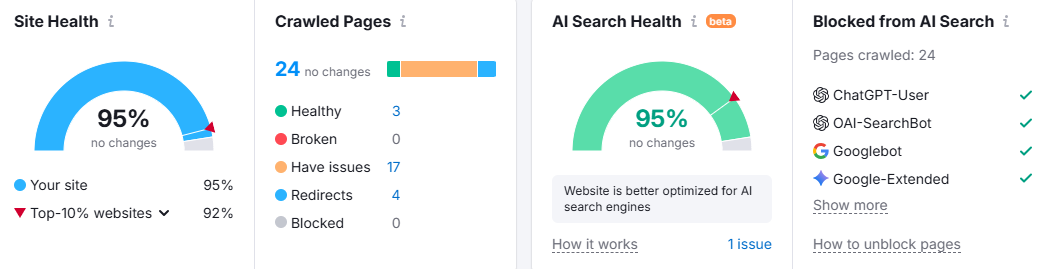
- Poor Largest Contentful Paint (LCP)
- Weak mobile experience
- More than 40 Google Search Console issues
- Crawlability problems
- Missing Product, FAQ, and HowTo schema
Poor AI Search Readiness
Although the products were competitive, the content was not structured for AI-powered search.
The website received virtually no visibility in:
- Google AI Overviews
- Perplexity
- ChatGPT citations
Related: SEO Case study for B2B Company
Our SEO + AEO Strategy
Instead of publishing isolated blog posts, we built an integrated B2B SEO strategy designed for both traditional search engines and AI answer engines.
1. Competitor & Keyword Research
Using Ahrefs and Semrush, we identified more than 200 high-intent commercial keywords, prioritizing long-tail enterprise searches such as:
- Barcode label printers for pharmaceutical manufacturing
- Industrial RFID software
- Warehouse barcode systems
These keywords offered lower competition and higher buying intent.
2. Building Topical Authority
Content was organized into four interconnected topic clusters:
- Mobile Computers
- Barcode Scanners
- RFID Solutions
- Barcode Label Printers
This strengthened topical authority while improving internal linking and crawl efficiency.
3. AEO-First Content Strategy
Every content asset was optimized for AI search.
Each article included:
- Concise answer-first summaries
- Structured FAQs
- Comparison tables
- Featured snippet formatting
- Clear definitions
- Schema markup opportunities
More than 12 content assets were published every month.
4. Technical SEO Improvements
The website underwent a complete technical optimization.
Improvements included:
- Core Web Vitals optimization
- Product Schema
- FAQ Schema
- HowTo Schema
- Improved information architecture
- Faster page loading
- Better crawlability
The site structure was redesigned around buyer research journeys rather than product categories.
Execution Highlights
On-Page SEO
Major improvements included:
- Rewriting titles and H1 headings around buyer intent
- Adding semantic keyword coverage
- Improving internal linking
- Enhancing service pages with comparison tables
- Adding stronger conversion-focused CTAs
Content Expansion
We launched multiple pillar pages supported by more than 15 supporting cluster articles.
Topics included:
- Warehouse automation
- RFID implementation
- Industrial mobility
- Inventory visibility
- Barcode printing
- Asset tracking
Technical Enhancements
Key technical improvements included:
- 40% improvement in Largest Contentful Paint (LCP)
- Complete resolution of Google Search Console errors
- Image optimization
- Lazy loading
- CDN implementation
- hreflang targeting for India and the United States
AI Overview Optimization
Content was intentionally structured for AI-generated answers.
This included:
- Short introductory summaries
- Bullet-based answers
- Product comparison tables
- Predictive FAQs
- Structured schema markup
These improvements significantly increased visibility in Google AI Overviews and other AI search platforms.
Traditional SEO vs. AEO
| Area | Traditional SEO | AEO / GEO |
| Content format | Long-form blog | Answer-first content with tables |
| Ranking objective | Blue links | AI Overview citations |
| Keyword strategy | Short commercial keywords | Long-tail buyer intent |
| Schema | Article Schema | Product, FAQ & HowTo Schema |
| Business outcome | Traffic growth | Qualified demo generation |
Results After Six Months
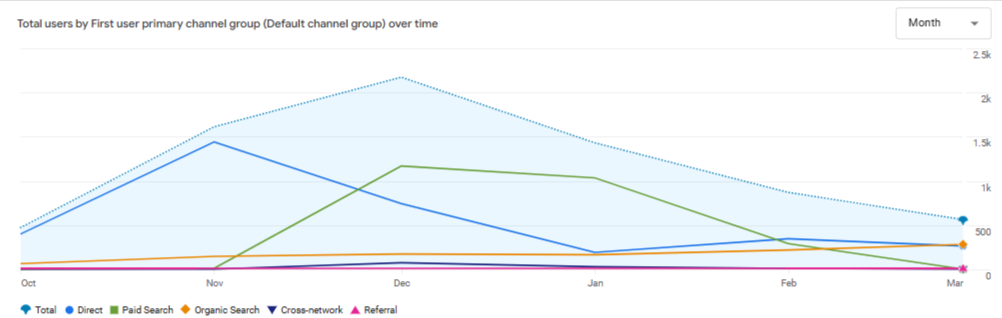
Performance improvements were measured using Google Analytics 4, Google Search Console, and CRM data.
| Metric | Before | After | Improvement |
| Qualified demo requests | Baseline | 2× | Pipeline doubled |
| Google AI Overview rankings | None | #1 for 8 keywords | Significant AI visibility |
| Keywords in Top 5 | Fewer than 10 | More than 50 | Strong authority growth |
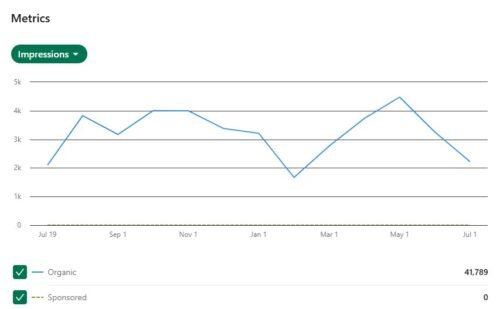
| AI search impressions | Minimal | 3× | Expanded visibility |
| Average engagement time | 1:10 | 1:45 | Better content quality |
| Cost per qualified demo | $420 | $160 | 62% reduction |
The improvements created a sustainable growth cycle:
Higher AI visibility → Greater trust → More qualified demos → Stronger revenue pipeline
Frequently Asked Questions
How long does B2B SEO take for industrial SaaS companies?
Initial AI Overview visibility was achieved within approximately 90 days. Qualified demo requests doubled after six months. Enterprise SEO generally requires 6–9 months to produce measurable pipeline impact.
What is the ROI of AEO for warehouse automation companies?
Ranking in AI-generated search experiences significantly improved lead quality while reducing acquisition costs. In this engagement, cost per qualified demo decreased by 62% compared to LinkedIn advertising.
Can software providers rank for “barcode scanners India” without manufacturing hardware?
Yes. By combining topical authority, Product Schema, comparison content, and buyer-focused educational resources, software providers can outperform manufacturers for many commercial research queries.
Key Takeaways
This project demonstrates that enterprise SEO in 2026 extends beyond traditional rankings.
Successful B2B organizations should focus on:
- Building topic clusters instead of isolated blogs
- Optimizing content for AI-generated search experiences
- Using structured schema markup
- Improving technical performance
- Targeting high-intent commercial searches instead of vanity traffic
- Creating content that answers enterprise buyer questions directly
When executed together, these elements improve visibility, increase qualified pipeline, and reduce customer acquisition costs.
Ready to Build an AI-Optimized Growth Engine?
If your B2B technology company depends on enterprise sales, your website should do more than rank. It should educate buyers, earn trust in AI-powered search, and consistently generate qualified opportunities. Talk to our team about building an SEO and AEO strategy designed for enterprise growth.