Personal Branding for SaaS CEOs: 6 Content Pillars That Build Authority
SaaS CEOs rarely run out of things worth saying. They have spent years making product decisions, negotiating with customers, hiring teams, losing deals, entering markets and adapting to changes in technology. Yet much of that experience never makes it into the public conversation around their companies.
Instead, their LinkedIn presence often becomes an extension of the corporate communications calendar: a product announcement, a conference photograph, a hiring update and an occasional leadership post. The profile is active, but it does not necessarily become distinctive.
This is where personal branding for SaaS CEOs becomes a positioning exercise rather than a publishing exercise. The objective is not simply to increase a CEO’s visibility. It is to establish a recognisable association between the leader, a particular area of expertise and a distinct perspective on the market.
That matters even more as AI makes software and content easier to produce. When products, websites and marketing messages become increasingly similar, the experience and judgment of the people behind them become more valuable.
The strongest SaaS CEO brands do not manufacture authority; they make existing expertise visible.
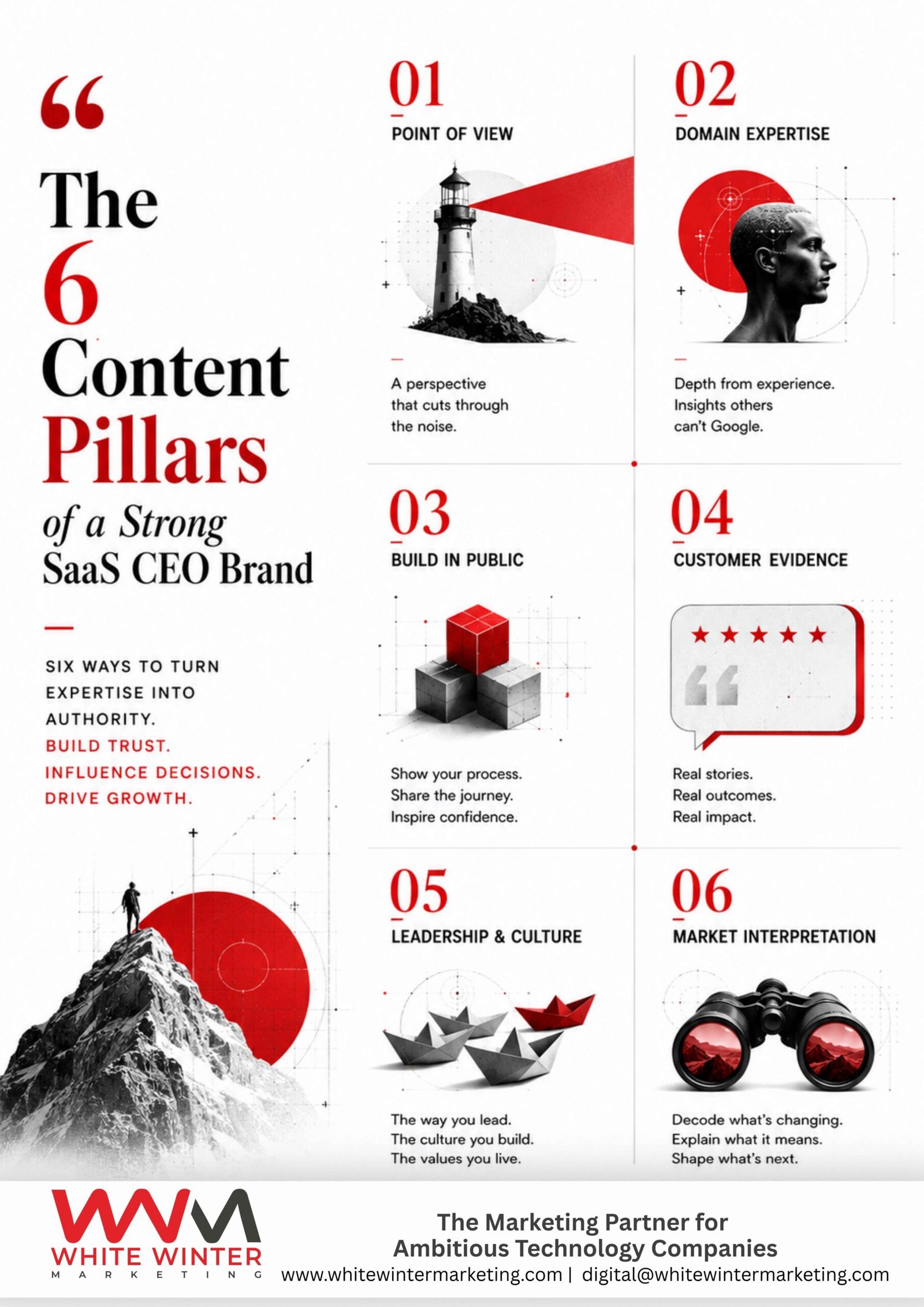
So what should SaaS CEOs actually talk about? In my experience working with technology leaders, six content pillars provide a practical foundation.
1. A Distinct Point of View
A CEO’s content needs to reveal how they interpret their market, not simply report what is happening in it.
Technology marketing is already crowded with familiar language around innovation, digital transformation, AI adoption and customer centricity. Repeating those themes does little to distinguish a leader.
A stronger approach is to identify the assumptions you disagree with.
What do customers consistently misunderstand? Which industry trend is being overhyped? What do you believe will change in your category over the next three years? What have you changed your mind about?
Dharmesh Shah, HubSpot’s co-founder and CTO, provides a useful example. His public writing frequently explores AI, software development, entrepreneurship and product thinking rather than functioning purely as HubSpot promotion. His audience therefore encounters his thinking, not simply his company’s announcements.
For a SaaS CEO, this is the beginning of thought leadership: developing a point of view that people can recognise and associate with you.
Looking to build a stronger B2B SaaS marketing strategy
Let’s discuss how we can help with SEO, AEO, GEO, content marketing, website strategy and demand generation.
2. Domain Expertise From the Front Line
Your most valuable content may be the knowledge you have stopped noticing because it has become familiar.
A CEO who has spent ten years selling enterprise software has insights into procurement, implementation and adoption that cannot be replicated through desk research. A cybersecurity founder has seen how security decisions are actually made. A vertical SaaS CEO understands operational problems that rarely appear in generic industry reports.
Those experiences are content.
Instead of writing another post about “the future of SaaS”, explain a recurring customer problem you have observed. Instead of listing AI trends, explain where customers are actually struggling to deploy AI.
This also answers a common question: What should SaaS CEOs post on LinkedIn?
They should start with the questions customers repeatedly ask, the mistakes they repeatedly make and the lessons the business has learned by solving those problems.
That creates useful material for people and for answer engines. Clear, experience-led explanations can strengthen a CEO’s association with a particular subject across search, AI search and other discovery environments.
This is where AEO for SaaS becomes less about keyword placement and more about building a body of authoritative answers.
3. Build in Public With Judgment
“Build in public” is often interpreted as sharing every product update. That is not particularly interesting.
What is interesting is showing how decisions are made.
Suppose a SaaS company redesigns its onboarding process. The conventional corporate post appears after launch: We are excited to announce our new onboarding experience.
A more useful CEO story might explain that the company reviewed dozens of onboarding journeys and discovered that customers were not struggling to understand the product. They were struggling to determine where to begin.
That observation can lead to the experiment, the change and eventually the result.
The sequence becomes:
Observation → hypothesis → experiment → lesson
As AI changes how software is built and delivered, there is more material for CEOs to explore in this way. The ongoing debate over whether AI agents will weaken traditional SaaS models is one example. Rather than repeating the “SaaS is dead” narrative, a CEO can explain what customers are actually doing, which workflows are changing and where specialised software continues to create value.
The audience gets to see the executive’s reasoning, not just the finished announcement.
4. Customer Evidence
Opinion becomes considerably more credible when it is supported by experience.
Customer stories are particularly valuable because they demonstrate expertise without requiring the CEO to claim expertise.
A conventional case study might say:
“Our platform reduced processing time by 38%.”
An executive perspective could explain why the result happened, what the company initially misunderstood and what the implementation revealed about the customer’s business.
That distinction matters.
B2B buyers increasingly encounter marketing long before they enter a sales conversation. Edelman and LinkedIn’s 2025 B2B Thought Leadership Impact Report found that strong thought leadership influences buying groups beyond the obvious decision-maker and can create opportunities for brands before they are formally considered by procurement.
For a SaaS CEO, customer evidence can therefore include implementation lessons, failed deals, unexpected objections, product decisions and recurring patterns across accounts.
These stories are useful not only for LinkedIn. They can become website content, sales enablement material, interviews and source material for broader GEO strategies for SaaS companies.
The objective is not to optimise a customer story for an AI system.
It is to publish something worth retrieving.
5. Leadership and Culture
Leadership content becomes weak when it is reduced to universal statements such as “people are our greatest asset” or “great leaders listen.”
A CEO has better material available.
What did a failed senior hire teach you? Why did you change the company’s management structure? Which behaviour do you reward? What decision changed the culture? What have you learned about hiring as the company moved from 20 people to 200?
These stories reveal how the executive operates.
They also make the person behind the company easier to understand.
The personal element should support the business story rather than exist for its own sake. A lesson from a mentor can explain a leadership principle. A difficult decision can reveal operating philosophy. A failure can explain why the company works differently today.
This is particularly relevant for SaaS companies competing for both customers and talent. People increasingly research the people behind a company before deciding whether they want to buy from it, work for it or partner with it.
The CEO’s reputation becomes part of the company’s market context.
6. Interpret the Market, Don’t Merely Report It
A SaaS CEO does not need to comment on every industry headline. But when something significant happens, they should be capable of explaining what it means.
The current debate around AI and SaaS is an obvious example.
Salesforce has been shifting more of its AI offering toward consumption-based pricing, while the wider industry continues to debate whether AI agents will replace traditional application models or make specialised software more valuable. Meanwhile, companies such as Tanium have brought founders back into leadership roles as they reposition around AI-driven changes in their markets.
These are news events.
The CEO’s value lies in interpreting them.
What does changing SaaS pricing mean for buyers? Which software categories are genuinely vulnerable to agents? Where does proprietary customer data become more important? Which AI claims are ahead of actual enterprise adoption?
Those are the questions that turn news commentary into executive thought leadership.
They also create the kind of natural question-answer relationships that help content perform across traditional search and generative search.
| Search or AI question | Authority signal to provide |
|---|---|
| What should SaaS CEOs post on LinkedIn? | Original opinions, customer lessons, product decisions and market analysis |
| How do SaaS leaders build thought leadership? | Consistent commentary grounded in first-hand expertise |
| How can SaaS founders build authority? | A clear positioning territory supported by evidence and experience |
| Why does CEO personal branding matter in B2B SaaS? | It makes executive expertise discoverable before and beyond the sales process |
The table is not a checklist for inserting questions into every article. It is a useful way of thinking about answer engine optimisation: identify the questions your audience is genuinely asking and make sure your content contains precise, experience-backed answers.
From Visibility to Authority
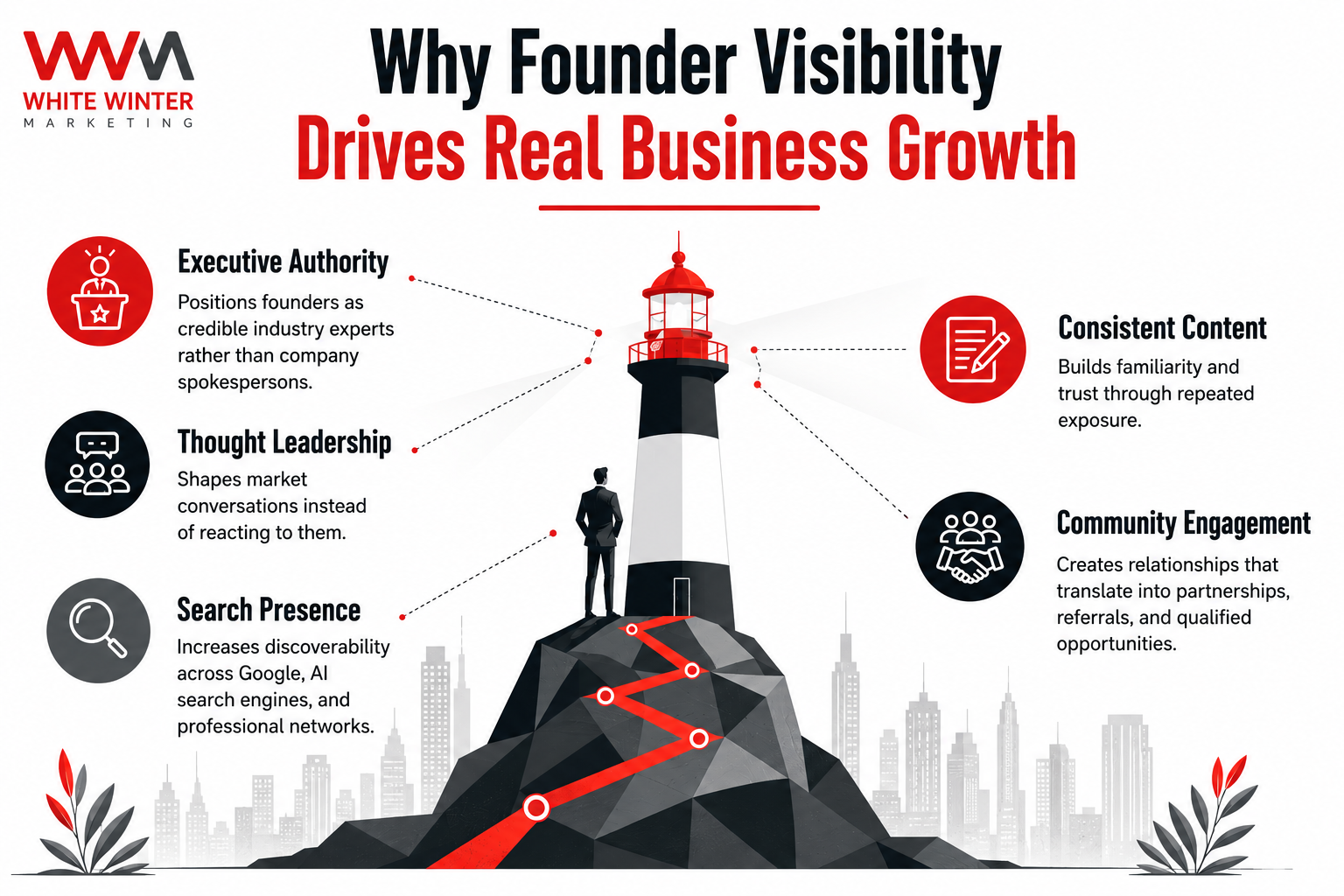
A personal brand becomes commercially useful when people begin to associate a leader with a particular subject and a particular way of thinking.
A prospect recognises the CEO before a sales conversation. A potential employee understands the leadership philosophy. A journalist knows whom to approach for an informed perspective. A buyer encounters the CEO’s thinking while researching a problem.
That is a more meaningful outcome than follower growth alone.
The question for a SaaS CEO is not how often the market sees you, but what the market remembers when it does.
The six pillars provide a practical way to build that memory: a distinct point of view, genuine domain expertise, thoughtful build-in-public content, customer evidence, leadership experience and informed market interpretation.
The result should not feel like a content calendar. It should feel like a body of work.
And in an environment where AI can generate another competent LinkedIn post in seconds, a body of work grounded in real experience may become one of the strongest forms of differentiation a SaaS leader can build.
Ready to Turn Executive Expertise Into Market Authority?
If your SaaS CEO has the expertise but not the visibility to match it, the answer is not another generic content calendar. At White Winter Marketing, we help SaaS and technology leaders turn their experience, ideas and market perspective into a distinctive personal brand that supports trust, demand and growth.
As a SaaS marketing agency, we combine founder positioning, LinkedIn thought leadership, B2B content marketing, SEO, AEO and GEO to build authority across the channels where your buyers are looking. Connect with us for a consultation and let’s identify what your CEO should be known for, and how to build it.

About the Author
Swetha Prasanna Gangavarapu is the Director at White Winter Marketing, with 10+ years of experience in SaaS, technology, and B2B marketing. She works with technology companies on go-to-market strategy, product marketing, founder-led marketing, SEO, AEO, and GEO. She is the author of 365 Days 365 Posts: LinkedIn Personal Branding, available exclusively on Amazon. Her work focuses on helping B2B SaaS companies strengthen positioning, build digital visibility, and create sustainable demand across search, AI, LinkedIn, and web.