Authority is one of those words that appears frequently in marketing conversations and is defined surprisingly rarely.
A company can have strong search visibility and limited recognition outside its category. Another can have a modest social following but be widely respected by practitioners. One organisation can publish hundreds of articles while another publishes a smaller body of original research that gets discussed by industry peers, referenced by customers and used by sales teams.
All of them are visible. They are not necessarily equally authoritative.
For B2B companies, the distinction matters because authority operates differently from simple awareness. A buyer evaluating a substantial software platform, technology service or professional partner is not merely asking whether the company exists. They are asking whether the people behind it understand the problem, whether they can substantiate what they are saying, whether credible people outside the company recognise their expertise and whether the organisation is one they would be comfortable defending internally.
The answers are rarely supplied by one marketing asset.
Authority accumulates.
It is built through the combined weight of expertise, evidence, experience, recognition and consistency.
The evidence behind the idea
The 2025 Edelman–LinkedIn B2B Thought Leadership Impact Report surveyed nearly 2,000 global professionals and examined the influence of “hidden buyers”—stakeholders who influence B2B decisions without necessarily being the primary contact with a vendor. Edelman reports that more than 40% of B2B deals stall because of internal misalignment within buying groups.
The same research found that 71% of hidden decision-makers considered thought leadership more effective than conventional marketing or sales materials at demonstrating potential vendor value, while 64% said thought leadership was a more trustworthy basis for assessing capabilities and competencies than marketing materials and product sheets.
The finding changes the way authority should be considered.
A company’s public expertise is not simply a brand-awareness asset. It can become part of the material through which different members of a buying group evaluate whether the organisation is worth considering.
Authority has several sources
There is no single formula that creates authority. For B2B organisations, however, five sources appear repeatedly.
1. Expertise
People with genuine knowledge of a subject need to be visible. This does not mean turning every founder or executive into a daily content creator. It means allowing the people who understand the category deeply to contribute meaningfully to the company’s public intellectual presence.
2. Evidence
Claims become more persuasive when they can be supported. Original research, proprietary data, customer outcomes, technical demonstrations, implementation experience, documented experiments and transparent methodology provide evidence that is difficult to reproduce through generic publishing.
3. Experience
There is a difference between explaining what should happen and demonstrating what has happened. Customer stories, implementation lessons and practitioner perspectives provide this layer.
4. External recognition
A company describing itself as expert is one form of information. Independent publications, industry associations, customers, analysts, partners, communities and recognised practitioners describing its expertise provide another.
5. Consistency
Authority is cumulative. A company that communicates a coherent point of view over several years creates a different impression from one that changes its message every quarter.
These sources reinforce one another.
Expertise produces insight. Insight produces evidence. Evidence creates confidence. Recognition extends credibility. Consistency compounds it.
Why follower counts are an incomplete measure
Reach is useful. So are impressions, rankings, followers, website traffic and engagement.
But none directly answers whether a company is regarded as a credible source on a commercially important subject.
Consider two B2B brands. Company A has 150,000 followers and publishes several posts each day. Company B has 18,000 followers, but its engineers regularly publish original benchmarks, its customers contribute detailed case studies, its executives speak at respected industry events and its research is referenced by practitioners.
Which company has greater authority?
There is not enough information to answer.
That is precisely the point.
Authority cannot be inferred reliably from one distribution metric. It has to be examined through the quality and breadth of evidence surrounding the company.
Gong and the authority of proprietary evidence
Gong has built Gong Labs as a research engine around sales conversations, deals and revenue workflows. Gong describes Gong Labs as turning data from billions of sales conversations, deals and workflows into research and benchmarks.
That creates a distinctive relationship between product capability and marketing authority.
The company does not merely say that it understands sales conversations. The nature of its product gives it access to evidence about sales conversations. The research then turns that evidence into public knowledge.
This is a powerful model because the authority asset is closely connected to the company’s actual competence.
Thought leadership becomes more useful when it carries evidence
Edelman and LinkedIn’s 2024 study surveyed 3,500 global B2B decision-makers and found that 73% considered thought leadership a more trustworthy basis for judging a company’s competencies than traditional marketing materials. The study also found that 75% of buyers and C-suite leaders had been prompted by a piece of thought leadership to research a product or service they had not previously considered.
These findings should not be interpreted as a reason for every company to publish opinion pieces.
They point toward something more specific.
Useful thought leadership gives buyers information with which to think. It can introduce a new interpretation of a problem, provide original evidence, explain an emerging development or offer a perspective that helps a buying group understand a decision.
That is different from turning a company announcement into an article and calling it thought leadership.
Authority also travels through people
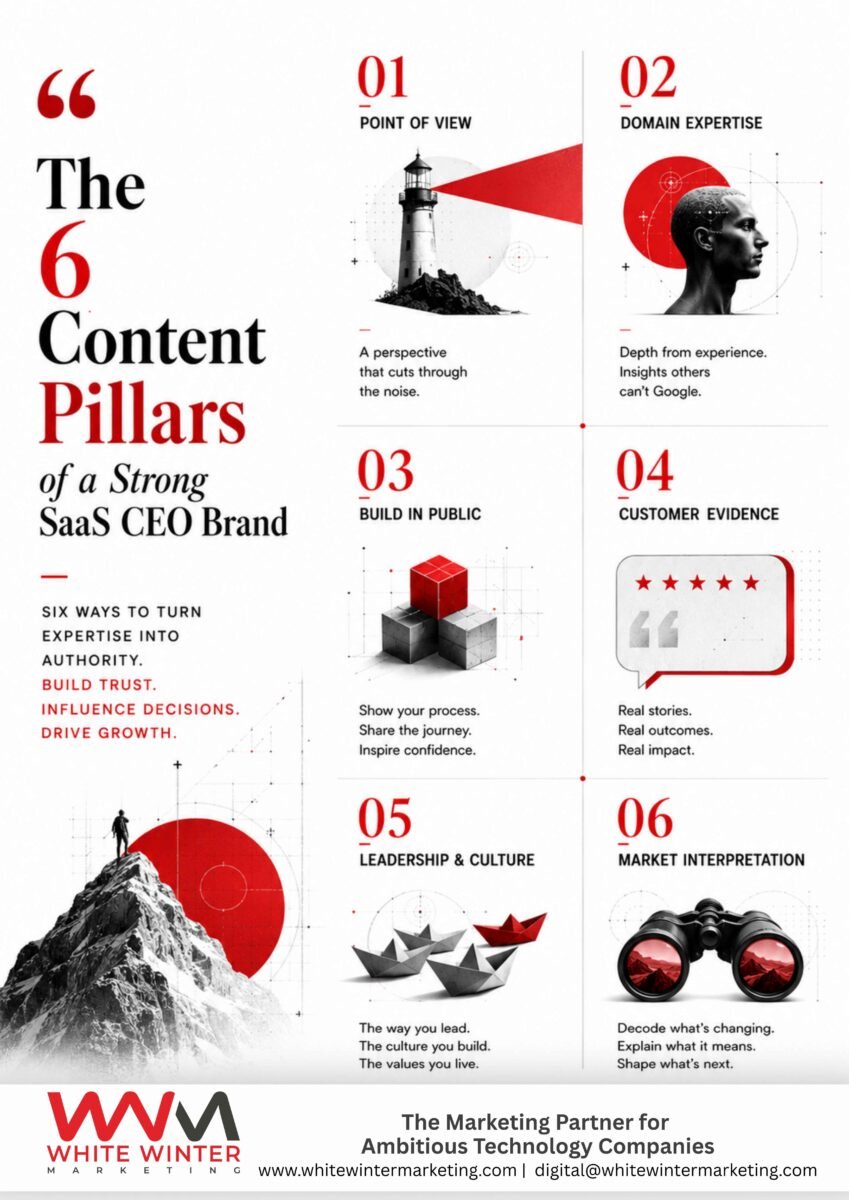
A company may have an impressive corporate brand, but buyers often encounter its expertise through people: founders, CEOs, product leaders, engineers, consultants, researchers, customer success leaders and industry specialists.
This is particularly relevant to founder-led SaaS companies.
A founder may have spent years understanding a market, solving customer problems and making product decisions, yet the public expression of that knowledge may consist largely of company announcements.
There is a considerable amount of unused authority sitting inside that gap.
That is where founder branding, executive communication and LinkedIn strategy can become strategic rather than cosmetic.
The authority map
A useful audit asks where evidence of expertise currently exists.
- People — Who inside the company has genuine expertise?
- Research — What do we know that others cannot easily reproduce?
- Customers — What outcomes can customers independently demonstrate?
- Experience — What have we learned from implementation and delivery?
- Industry — Where are our experts recognised externally?
- Media — Which credible publications discuss our work or category expertise?
- Community — Where do practitioners encounter our ideas?
- Content — What subjects do we consistently explain well?
- Product — What proprietary data or insight does the product generate?
- Consistency — Is the company’s point of view coherent across channels?
The exercise often reveals that the company already possesses many authority assets. They simply exist in different departments.
Research sits with product. Customer evidence sits with success. Expertise sits with the founder. Industry recognition sits with PR. Technical knowledge sits with engineering. Sales objections sit with revenue.
Marketing is expected to turn all of it into a coherent market presence.
That is a strategic responsibility, not merely a publishing function.
Customer stories are evidence
A conventional case study can easily become a company profile: “Company X selected our platform because of our innovative technology and excellent support.”
A stronger customer story demonstrates the decision.
What problem existed? What alternatives were considered? What changed? What was implemented? What measurable outcome followed? What did the customer learn?
For a customer story marketing agency, therefore, the objective should not simply be to produce more case studies. It should be to create decision-relevant evidence.
Video can carry authority differently
CMI’s 2025 B2B research found that 76% of surveyed marketers used video, and 58% identified it as the most effective content type they produced, followed by customer stories at 53%.
The implication is not that every B2B company needs a video-first strategy.
Rather, video provides a useful medium for demonstrating expertise that can be difficult to communicate through static copy alone: product demonstrations, technical explanations, customer interviews, founder conversations, expert panels, research findings and implementation walkthroughs.
A SaaS explainer video company can therefore contribute to authority when the video explains something genuinely useful—not simply when it makes a product look polished.
What should companies measure?
Authority cannot be reduced to one KPI, but a broader measurement system can include:
- Branded search growth
- Direct traffic
- Qualified organic visibility
- Third-party mentions
- Expert invitations
- Citations and references
- Customer advocacy
- Research downloads
- Executive content engagement
- Sales-team usage of thought leadership
- Influence on pipeline
- Inbound opportunities citing content or expertise
The purpose is not to create another dashboard of vanity metrics. It is to understand whether the market is increasingly recognising, referencing and trusting the company’s expertise.
A practical authority-building exercise
Take the three subjects for which your company most wants to be known.
For each subject, document:
What do we know?
What have we observed?
What evidence do we possess?
Who can speak credibly about it?
What have customers experienced?
What can we publish that others cannot easily reproduce?
Where is this expertise already recognised?
Then identify the gaps.
Perhaps the company has expertise but no visible expert. Perhaps it has excellent customer outcomes but weak case studies. Perhaps it has proprietary data but has never turned it into research. Perhaps executives have strong opinions but no consistent publishing platform.
Those are different problems, and each requires a different response.
Authority is ultimately a pattern
The most credible B2B brands rarely rely on one spectacular marketing asset.
Their authority appears repeatedly.
A customer encounters a useful research report. Later, they see an expert from the same company discussing the subject. They find a detailed customer story. They encounter the company’s perspective in an industry publication. A salesperson shares a practical guide that answers a question they had not yet articulated.
The individual experiences reinforce one another.
Over time, the company becomes associated with a particular body of knowledge.
That is the strategic value of authority.
It reduces the amount of explanation required every time the organisation enters a buying conversation.
Build Your Authority in the B2B Industry
At White Winter Marketing, we approach B2B visibility as a combination of positioning, expertise, evidence, content, executive presence, customer proof and distribution rather than as a publishing-volume exercise.
For a SaaS company, that can mean developing research-led content alongside SEO; translating product expertise into useful video; building a founder’s or CXO’s public point of view; developing customer stories that demonstrate outcomes; or creating a coherent B2B demand-generation programme around subjects the company is genuinely qualified to own.
For organisations evaluating a CXO branding agency India, Founder branding agency, B2B brand positioning agency or broader B2B content and demand-generation partner, the important question is not simply how much content an agency can produce.
It is whether the work can make the company’s existing expertise more visible, more useful and more credible to the people who influence the decision.
That is also where AISO for SaaS can sit within a broader strategy: as one part of ensuring valuable expertise can be discovered and represented across evolving digital environments, rather than as a substitute for the underlying authority itself.
For SaaS and B2B companies building a stronger market position, White Winter Marketing can bring these pieces together across content, executive visibility, customer storytelling, search and demand generation.
If your organisation already has the expertise, customer experience and evidence to lead a conversation in its category, the next question is how much of that authority the market can actually see.