How Much of Your Marketing Is Actually Based on What Customers Ask?
The questions coming from sales calls, customer success, support and product teams may contain more useful marketing intelligence than the next content calendar.
There is a peculiar distance between what a company knows about its customers and what its marketing communicates about them.
A sales team hears the same objection repeatedly. Customer success hears the same implementation question from new accounts. Product managers notice a recurring hesitation during adoption. Support teams know which features require the most explanation. Founders hear prospective customers describe the problem in language that never appears in the company’s website copy.
B2B Marketing, meanwhile, may be working from a persona document created months earlier, a keyword list, a competitor content audit and a quarterly calendar of topics.
Neither side is necessarily doing anything incorrectly. The difficulty is that the organisation may possess a remarkably detailed, continuously updated record of customer thinking without treating that record as a source of marketing intelligence.
That distinction matters.
The Content Marketing Institute’s 2025 B2B research found that less than a third (29%) of surveyed B2B marketers rated their content strategy as extremely or very effective; among those rating it moderately effective or worse, 39% cited a lack of connection to the customer journey. The research also found that aligning content across sales and marketing remained a challenge for 43% of respondents.
The numbers do not prove that customer conversations are being ignored. They do, however, point to a useful question for any B2B marketing organisation:
“How much of what we publish originates in what our customers actually ask us?”
Search data is extraordinarily useful. It can reveal demand, language, topic relationships and recurring information needs. It can help marketers understand how people formulate questions before they encounter a brand.
But search behaviour is only one source of customer intelligence.
A prospect who asks a salesperson, “How long will implementation actually take for a team our size?” is expressing a commercial concern.
A procurement stakeholder asking, “What happens to our data if we leave?” is expressing a risk concern.
A customer asking, “Why does this integration require our IT team?” is expressing an operational concern.
A CFO asking, “How do I justify this internally?” is expressing a decision-making concern.
None of these questions necessarily appears in a keyword database with the same wording.
Yet each can become an exceptionally useful piece of marketing.
This is where customer-informed content becomes more interesting than a simple exercise in publishing more frequently. The objective is not to turn every sales question into a blog post. It is to identify the questions that reveal how the market thinks about the category, where uncertainty exists, what information buyers require and what prevents them from moving forward.
A useful distinction: questions, objections and signals
Not every customer question deserves a content asset.
A mature marketing operation should distinguish between three different forms of information.
- Questions are requests for understanding: how the product works, what implementation involves, which integrations are supported, how alternatives compare and what happens after purchase.
- Objections indicate uncertainty around a purchase: existing solutions, switching complexity, internal resources, investment justification or adoption concerns.
- Signals reveal something broader about the market: a capability becoming more important, a new term appearing in customer language, a competitor entering conversations, or a change in the stage at which a question is being asked.
Questions often become educational content. Objections can become comparison pages, implementation guides, ROI material, customer stories and sales enablement. Signals can influence positioning, product marketing and demand generation.
Gong provides a useful example of treating customer conversations as a source of market intelligence. Its Gong Labs programme analyses sales conversations, deals and revenue workflows to identify patterns; Gong says its research draws on billions of sales conversations and related data.
The lesson is not that every marketing team needs Gong’s dataset. It is that customer conversations can be treated as a source of market intelligence rather than simply as a record of sales activity.
Build a customer-question library
One practical approach is to create a shared customer-question repository across marketing, sales, customer success, support and product.
A simple version can contain:
- Exact question — the customer’s actual wording
- Source — sales, support, CS, interview, review or community
- Context — when and why the question arose
- Frequency — how often the issue appears
- Marketing opportunity — what information could help answer it
Over time, patterns begin to emerge.
The same question appearing across sales calls may deserve a public explanation. The same objection appearing during procurement may justify a buyer guide. The same implementation concern appearing during onboarding may indicate that the website needs a clearer explanation.
This is where content strategy becomes closely connected to revenue intelligence.
The strongest content often answers the question behind the question
A buyer rarely asks only for information. They are usually trying to make a decision.
Consider: “Does your platform integrate with Salesforce?”
The literal answer might be yes.
The underlying questions could be: How difficult is the integration? How much technical work is required? Will existing workflows need to change? What information passes between systems? How long does implementation take? Which team owns the integration?
A good B2B content programme does not stop at the first question. It investigates the decision surrounding the question.
That is particularly important for SaaS companies because the purchase rarely ends with product selection. Implementation, integration, adoption, security, procurement and internal approval frequently form part of evaluation.
What customer-informed marketing can produce
A customer-question programme can inform:
- Product education pages
- Comparison guides
- Implementation resources
- FAQ sections
- Customer stories
- Research reports
- Executive thought leadership
- Sales enablement material
- Product videos
- Explainer videos
- LinkedIn content for subject-matter experts
- Webinar topics
- Buyer checklists
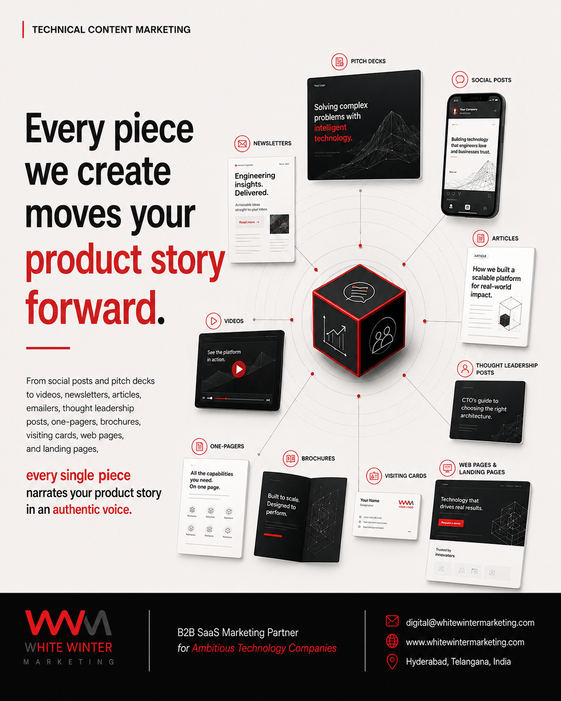
This is where a B2B content marketing agency can create more value than simply delivering a monthly article quota: the work begins with market intelligence and editorial prioritisation rather than the number of pieces required to fill a calendar.
Customer language is marketing intelligence
Customers do not necessarily describe problems using the terminology chosen by the marketing team.
They may call a problem something different. They may explain the consequence rather than the cause. They may describe a workflow rather than a category. They may use language that makes an otherwise technical problem understandable to a non-specialist stakeholder.
That language can improve website messaging, sales collateral, search content and product education.
For a SaaS SEO agency in India, keyword research can reveal what people search for, while customer conversations can reveal why the question matters commercially. The two sources become substantially more powerful when combined.
A practical monthly review
Ask:
- Which questions appeared most frequently in sales calls?
- Which objections appeared at the same stage repeatedly?
- Which questions were asked by senior stakeholders?
- Which questions appeared after prospects had already read the website?
- Which implementation concerns appeared after purchase?
- Which questions are competitors answering more clearly?
- Which customer phrases are clearer than current marketing language?
- Which questions indicate a market change?
- Which questions could become original research?
The final question is especially valuable. If many customers ask essentially the same question, the answer does not always have to be another article. It might be a study, benchmark, customer survey, video series or executive point of view.
What this means for modern B2B marketing
Customer-informed marketing is not a replacement for SEO, paid acquisition, brand building or creative work. It is the intelligence layer that can make those activities more relevant.
A SaaS demand generation agency can use customer questions to inform campaign themes. A SaaS video marketing agency can identify which concepts genuinely require visual explanation. A founder’s LinkedIn strategy can draw from recurring questions that reveal where the founder’s expertise is most useful.
Even emerging approaches such as AISO for SaaS become more meaningful when the underlying information comes from genuine customer needs rather than a list of artificially generated prompts.
The technology used to distribute information will continue to change. The value of understanding the buyer will not.
A practical starting point
Invite Marketing, Sales, Customer Success, Support, Product Marketing and Product or Implementation to one working session.
Ask every team to bring the ten questions they wish prospects and customers understood before making a decision.
Group the responses into Understanding, Evaluation, Risk, Implementation, Comparison and Outcomes.
Then rank them by frequency, commercial importance and the quality of information currently available.
The result is not simply a content calendar. It is a map of the information environment surrounding the purchase.
The larger opportunity
The strongest B2B marketing organisations are increasingly capable of doing something more valuable than producing content consistently: they can turn the organisation’s accumulated understanding of customers into a public body of useful knowledge.
That knowledge can educate buyers before a sales conversation, help different stakeholders reach the same understanding, give sales teams stronger material to share, provide subject-matter experts with meaningful points of view and create a more coherent presence across search, social, video and editorial environments.
The question, therefore, is not whether your company has enough content ideas.
It is whether your marketing operation has a reliable way of hearing what the market is asking, understanding why those questions matter, and turning the answers into something genuinely useful.

We are a trusted B2B Marketing Agency
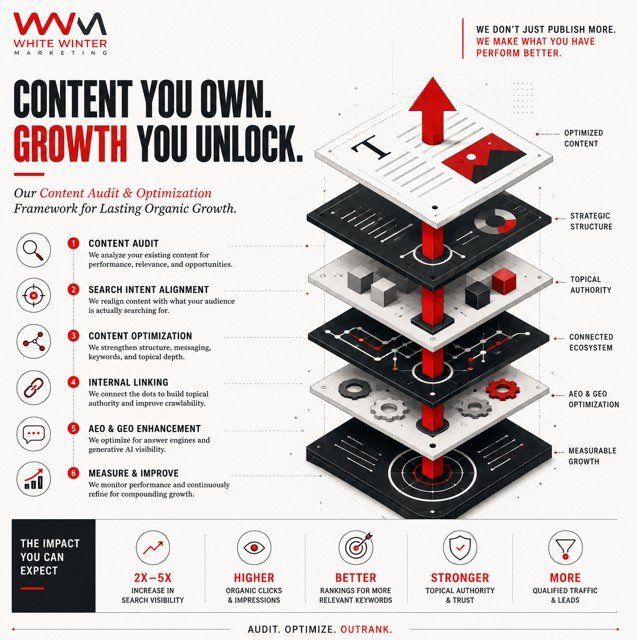
At White Winter Marketing, we work with SaaS and B2B organisations across customer understanding, positioning, content, search, executive visibility and demand generation.
For organisations looking for a B2B SaaS marketing agency, the starting point should not be a list of deliverables. It should be an understanding of the questions your market is already asking—and the knowledge your organisation is uniquely qualified to provide.
If your sales calls, customer conversations and product expertise contain insights that your marketing has not yet captured, that is a useful place to begin.