Hiring a content marketing agency is relatively straightforward. Evaluating whether that agency is delivering meaningful business value is considerably more difficult.
A B2B SaaS company might receive four blogs every month, regular LinkedIn posts, keyword reports, backlinks and a monthly performance dashboard. The publishing calendar remains active, website traffic gradually increases, and the agency reports that the agreed deliverables have been completed.
Yet the sales team continues to struggle with the same questions. Why are qualified prospects not discovering the company? Why do potential customers struggle to understand its differentiation? Why is the website attracting visitors who never progress towards a commercial conversation?
These questions expose a recurring problem in B2B SaaS marketing: the difference between content production and content marketing.
Content production creates assets. Content marketing creates a connected body of information that helps a company become discoverable, establish credibility, influence consideration and support commercial decisions.
For SaaS companies operating in competitive markets, a content marketing agency should be accountable for much more than maintaining a publishing schedule.
Why Content Marketing Is Not Delivering Its Full Potential for B2B SaaS Companies
Content marketing has become an established component of B2B marketing. However, adoption has not necessarily translated into strategic effectiveness.
The Content Marketing Institute’s 2025 B2B research found that only 29% of marketers with a documented content strategy considered it extremely or very effective. Among marketers whose strategies were moderately effective or worse, 39% identified a lack of connection to the customer journey as a contributing factor. Another 35% cited insufficient use of data.
The same research found that 74% of respondents said content marketing helped generate demand or leads, while 49% reported that it helped generate sales or revenue.
These findings point to an important distinction. Content can contribute to commercial outcomes, but its effectiveness depends on how well it is connected to audience needs, business objectives and the buying journey.
Source: Content Marketing Institute, B2B Content Marketing Benchmarks and Trends 2025.
For a SaaS company, the problem often begins with how content requirements are defined. A marketing team asks for more blogs, more social posts and more keywords. The agency responds with a production calendar.
Neither party necessarily addresses the more important question: What should a prospective customer understand about this company before deciding to engage with its sales team?
This is what we call the Content Delivery Gap: the distance between the assets an agency produces and the business outcomes those assets are expected to support.
What Should a B2B SaaS Content Marketing Agency Actually Deliver?
A capable SaaS content marketing agency should operate across six connected responsibilities.
1. Market Intelligence and Buyer Research
Content strategy should begin with understanding the market, not selecting keywords from a spreadsheet.
A SaaS product may serve several industries, business functions and decision-making roles. The information required by a CTO evaluating technical architecture will differ considerably from what a CFO needs to understand before approving an investment.
The agency should therefore develop a clear picture of:
- Ideal customer profiles and target industries.
- Buyer personas and the wider buying group.
- Business problems that trigger product evaluation.
- Competitor positioning and category differentiation.
- Search behaviour and information requirements.
- Commercial objections and purchase considerations.
Consider a SaaS company selling warehouse management software.
A warehouse operations manager might search for ways to improve inventory accuracy. An IT director may investigate system integrations, data security and deployment requirements. A CFO may compare implementation costs and operational returns.
All three belong to the same buying group, but they require different content.
What this means for the business:
Content should address the information requirements of the entire buying group rather than focus exclusively on one generic customer persona.
2. Content Architecture and Strategic Planning
A publishing calendar is not a content strategy.
A proper SaaS content marketing strategy establishes how individual content assets work together to build topical coverage, address search intent and support different stages of the buying journey.
An agency should develop:
- Content pillars and topic clusters.
- Educational and problem-oriented articles.
- Product and solution pages.
- Competitor comparison content.
- Industry-specific landing pages.
- Bottom-of-funnel buying resources.
- Content distribution and repurposing plans.
For example, a company selling an industrial IoT platform could build a content cluster around industrial IoT implementation.
The cluster might include an introductory guide to industrial IoT, an article on connected asset monitoring, a comparison of building versus buying an IoT platform, an implementation checklist and a product-specific solution page.
Each asset serves a different information requirement. Together, they establish a more comprehensive understanding of the company’s expertise.
What this means for the business:
Every new article should strengthen an existing strategic theme or address an identifiable gap in the buyer’s research process.
3. SEO, AEO and GEO: Building Visibility Across Discovery Channels
Search engine optimisation remains important for SaaS companies, but the discovery environment is expanding.
Prospective customers now encounter information through conventional search engines, AI-generated summaries, answer engines, generative AI platforms, industry publications and professional communities.
A modern SaaS content marketing agency should understand the distinct requirements of three related disciplines.
SEO: Search Engine Optimisation
SEO improves a website’s organic visibility through:
- Technical SEO and website health.
- Search intent and keyword research.
- On-page optimisation.
- Internal linking and content architecture.
- Relevant backlink acquisition.
- Content quality and topical authority.
AEO: Answer Engine Optimisation
AEO focuses on making information easy for answer-oriented systems to identify, retrieve and present.
It involves:
- Question-led content structures.
- Direct and unambiguous answers.
- Clear definitions and explanations.
- Descriptive headings.
- Relevant FAQ sections.
- Structured information and supporting evidence.
GEO: Generative Engine Optimisation
GEO focuses on improving the visibility and representation of a brand across generative AI experiences.
Its strategic considerations include:
- Consistent brand and product information.
- Original research and proprietary insights.
- Relevant third-party references.
- Topical authority.
- Clear product and service descriptions.
- Credible digital mentions and citations.
These activities overlap, but they are not interchangeable. Strong organic rankings do not automatically guarantee AI citations, and no agency can guarantee that a generative AI platform will recommend a particular company.
What this means for the business:
A SaaS brand needs an integrated discovery strategy that accounts for how buyers search, ask questions, compare solutions and research providers.
4. Thought Leadership and Executive Positioning
A SaaS company has two distinct communication assets: its product expertise and the knowledge of the people building the business.
Product pages explain functionality. Thought leadership communicates judgement, experience and market understanding.
This distinction matters in categories where products appear similar and competing vendors make comparable claims.
A content marketing agency should help founders and executives communicate perspectives on:
- Changes in their industry.
- Emerging technology and market developments.
- Customer challenges.
- Product and implementation decisions.
- Lessons from working with customers.
- Commercial and operational trends.
Founder-led LinkedIn content is particularly useful when the objective is to establish an identifiable voice in a specific market.
However, executive content should not become a stream of generic motivational observations. It should communicate ideas that the executive has a credible reason to discuss.
Seth Godin’s explanation of his frequently quoted statement, “content marketing is the only marketing left”, is relevant here. He clarified that he was not advocating the mass production of algorithmically driven articles. His argument concerned the authenticity and meaning behind the content a brand creates.
Source: LinkedIn, Seth Godin’s Seven Life-Changing Ideas for Marketers.
What this means for the business:
Executive positioning should communicate expertise that cannot be replicated simply by publishing more frequently.
5. Conversion-Oriented Content and Sales Enablement
Not every prospect is ready to book a demonstration after reading an educational article.
B2B SaaS purchases often involve technical evaluation, internal approvals, budget discussions and comparisons between competing solutions.
Content should therefore help prospects move from understanding a problem to evaluating possible solutions.
A content marketing agency should be capable of developing:
- Customer case studies.
- Product comparison guides.
- Solution briefs.
- Industry-specific use cases.
- Technical implementation guides.
- ROI and business-case resources.
- White papers and downloadable checklists.
- Conversion-oriented landing pages.
Consider a prospect evaluating two enterprise software platforms. A general article about the category may introduce the subject, but a detailed comparison of deployment requirements, integration capabilities, implementation considerations and support models is more useful during vendor evaluation.
What this means for the business:
Content should reduce the amount of uncertainty a prospect faces before engaging with sales.
6. Distribution, Repurposing and Performance Measurement
Publishing an article does not guarantee that the intended audience will encounter it.
Distribution should be part of the original content plan, not an afterthought.
An agency should establish how content will reach its intended audience through:
- Organic search.
- Company and founder LinkedIn profiles.
- Email newsletters.
- Industry communities and relevant publications.
- Sales outreach and prospect follow-ups.
- Repurposed visual and short-form content.
Performance measurement should also extend beyond publication counts and website sessions.
Useful metrics include:
| Measurement area | Relevant indicators |
| Organic visibility | Impressions, clicks, non-branded traffic and rankings |
| Audience relevance | Target-market traffic and relevant engagement |
| Brand visibility | Brand mentions, industry references and AI citations |
| Consideration | Comparison-page visits, case-study engagement and resource downloads |
| Lead generation | Qualified enquiries and conversion rates |
| Pipeline contribution | Content-assisted opportunities and opportunity progression |
Attribution requires care. A prospect may discover a company through search, read a founder’s LinkedIn post, revisit a case study and eventually respond to an outbound email.
It would be inaccurate to attribute the entire outcome to a single touchpoint.
What this means for businesses:
A good agency should explain how it measures direct conversions and assisted influence separately.
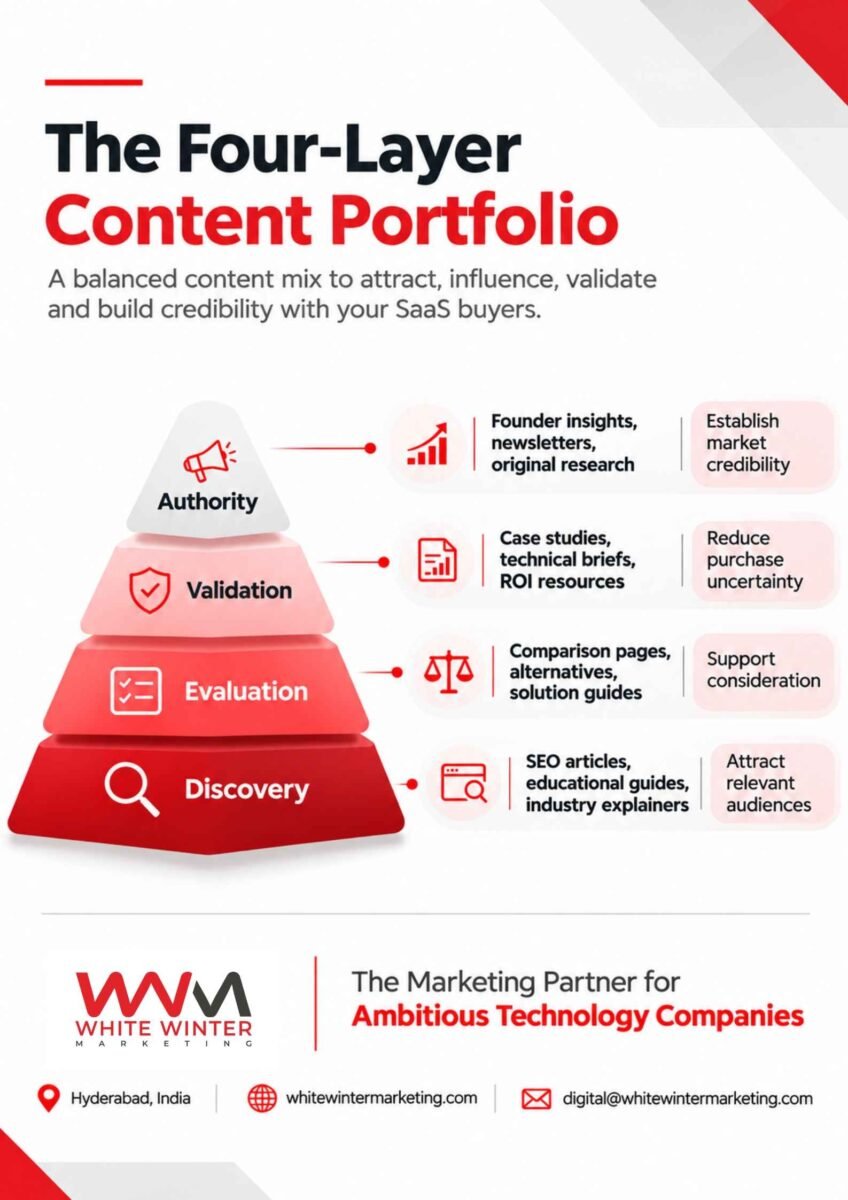
The Four-Layer Content Portfolio Every SaaS Company Should Consider
A useful way to evaluate an agency’s work is to examine the balance of its content portfolio.
We recommend looking at four distinct layers.
| Content layer | Typical deliverables | Strategic purpose |
| Discovery | SEO articles, educational guides and industry explainers | Attract relevant audiences |
| Evaluation | Comparison pages, alternatives and solution guides | Support consideration |
| Validation | Case studies, technical briefs and ROI resources | Reduce purchase uncertainty |
| Authority | Founder-led content, newsletters and original research | Establish market credibility |
The distribution will differ by business maturity.
An early-stage SaaS company may need stronger educational coverage and product positioning. An established company entering a new market may require industry-specific landing pages, competitive comparisons and localised content.
The agency should be able to explain why the portfolio is structured in a particular way.
How to Evaluate a SaaS Content Marketing Agency Before Hiring One
A proposal may contain an impressive list of deliverables. The more useful exercise is to examine how the agency intends to produce those deliverables and what strategic responsibility it will assume.
Ask these seven questions:
- How will you understand our ICP and buying group?
Look for a research process rather than assumptions based on the product category.
- How do you connect content topics with commercial intent?
The agency should distinguish informational searches from evaluation and purchase-oriented searches.
- Do you integrate SEO, AEO and GEO?
Ask how the agency approaches conventional search visibility and AI-powered discovery.
- Can you develop founder-led and executive thought leadership?
The agency should have a process for extracting subject-matter expertise and translating it into credible content.
- Can you create content for different buying stages?
Look beyond blogs. Ask about case studies, solution pages, comparison guides and technical resources.
- How do you measure performance?
Traffic, rankings and publication volume are useful indicators, but they should not be the only measures of success.
- Who owns research, strategy, production and distribution?
Understand exactly which activities are included in the engagement and which require additional investment.
What Should a B2B SaaS Content Marketing Engagement Include?
The scope should be determined by the company’s goals, resources, competitive environment and current marketing maturity.
A structured engagement might include:
| Workstream | Typical activities |
| Strategy | ICP research, competitor analysis and content planning |
| SEO | Technical review, on-page optimisation and keyword strategy |
| Content | Blogs, landing pages, solution pages and resource development |
| AEO and GEO | Answer-oriented structures, entity consistency and AI visibility initiatives |
| Founder branding and company-page content | |
| Distribution | Newsletters, repurposing and content promotion |
| Reporting | Organic performance, engagement and lead-quality analysis |
The scope should be transparent about content volumes, revision cycles, approvals, distribution responsibilities and reporting.
It should also distinguish between deliverables that an agency controls and business outcomes influenced by factors beyond its control.
For example, an agency can commit to research quality, publication schedules, optimisation and reporting. It cannot guarantee a particular number of qualified leads without accounting for product-market fit, pricing, competition, website conversion and sales execution.
Frequently Asked Questions
What services does a SaaS content marketing agency provide?
A SaaS content marketing agency typically provides content strategy, buyer research, SEO, AEO, GEO, blog writing, landing-page development, thought leadership, LinkedIn content, case studies, newsletters and content performance reporting.
How is B2B SaaS content marketing different from general content marketing?
B2B SaaS content marketing addresses complex products, multiple decision-makers, technical evaluation and longer buying cycles. It requires content that educates prospects, explains product differentiation and supports vendor evaluation.
How much content should a SaaS company publish each month?
There is no universal publishing volume. The right frequency depends on market competition, available subject-matter expertise, content quality, business objectives and existing content coverage. A smaller number of comprehensive, commercially relevant resources can be more valuable than a high volume of repetitive articles.
Should a SaaS company hire a specialist content marketing agency?
A specialist agency can be useful when the company needs expertise in B2B positioning, technical content, organic search, AI discovery and executive communication but does not want to build every capability internally.
How long does SaaS content marketing take to show results?
The timeline depends on domain authority, competition, publishing consistency, content quality and distribution. Organic search and topical authority generally require sustained investment. Some content can support sales conversations earlier through direct distribution, newsletters and outbound campaigns.
The Right Content Marketing Agency Builds More Than a Publishing Calendar
The value of a B2B SaaS content marketing agency should be assessed by the system it builds around a company’s expertise.
That system should help prospective customers discover the business, understand its capabilities, evaluate its differentiation and develop sufficient confidence to begin a commercial conversation.
At White Winter Marketing, we approach B2B SaaS marketing through connected capabilities spanning content strategy, SEO, AEO, GEO, LinkedIn branding and content-led demand generation.
Our focus is on helping technology companies communicate their expertise more effectively and establish visibility across the channels their buyers use.
Looking for a SaaS content marketing partner? Connect with White Winter Marketing to discuss your content strategy, organic visibility and marketing requirements.